Crazy Time RTP 1 Bet at 96.08% Is Best Long-Run Play

Crazy Time RTP: Why the “1” Bet (96.08%) Is the Best Long‑Run Play — When to Chase the 20,000x Bonus Estimated reading time: 7 minutes Key takeaways The “1” bet has the highest published RTP at 96.08%, making it the best expected-value play for long sessions. Bonus wagers (including Crazy Time) have lower RTP (around 94.41%) but offer the chance at massive multipliers such as the advertised 20,000x. Use a bankroll split: keep most funds on the “1” for longevity and a small separate bonus fund (5–15%) for controlled chasing of big multipliers. Crazy Time RTP: the raw numbers Evolution’s official information lists the overall theoretical RTP as 94.41%–96.08%, depending on which wager you back. You can read the official breakdown on Evolution’s how to play page. Put plainly: Highest listed RTP: the “1” bet at 96.08% (best expected return). Lowest listed RTP: the Crazy Time bonus wager at 94.41% (largest variance). Third‑party breakdowns give more granular RTPs for specific bonus rounds and number bets — for example, Pachinko ~94.33%, Coin Flip ~95.70%, Cash Hunt ~95.27%, and number wagers 2/5/10 clustered around the mid‑95% range. See a third-party breakdown for those figures. RTP is a long-run theoretical average, not a guarantee for a session. But it does tell you the expected cost of play. If you bet $100 repeatedly on the “1” bet in the long run, the math says you’ll keep about $96.08 of that $100 on average — an expected loss of about $3.92 per $100. Bet the Crazy Time bonus instead and that expected loss increases to about $5.59 per $100. Why the “1” bet (96.08%) wins on paper There are two simple reasons the “1” is the mathematically best play: frequency and payout symmetry. Number bets pay that number times your wager when the wheel lands on it. The “1” appears more often in the wheel’s math and pays only 1x, so its payout frequency keeps the theoretical return higher. That’s backed by Evolution’s published RTPs on the same game information page. The math isn’t glamorous — it’s just expected value. Higher RTP equals lower expected loss per spin. Here are practical loss figures so you can feel them in your wallet: “1” bet at 96.08% → expected loss ~$3.92 per $100. Crazy Time bonus at 94.41% → expected loss ~$5.59 per $100. If your goal is to stretch a bankroll and minimize theoretical loss, the “1” bet is the place to be. If your goal is spectacle and the off-chance of a life‑changing multiplier? Bonuses are an understandable choice — just know what you’re trading away in expectation. Crazy Time bonus frequency and the 20,000x temptation Evolution says players face roughly a 1-in-6 chance of a bonus round on each spin. That figure comes straight from Evolution’s literature and is a useful rule of thumb when planning how often you’ll see the features you want (1-in-6 chance). Crazy Time runs four bonus rounds — Coin Flip, Cash Hunt, Pachinko, and the eponymous Crazy Time — and a Top Slot that can attach random multipliers to a number or bonus before the spin. That Top Slot can swing a session: it’s where you sometimes see very large combined multipliers. Evolution lists the Crazy Time bonus maximum as 20,000x your stake in its official materials. That’s the advertised top‑end multiple on the game’s how‑to‑play page. Note that some third‑party pages list a 25,000x cap for particular operator configurations, so check the operator’s game wrapper if the absolute maximum matters to you (25,000x maximum). That explains the psychology: the bonus wager’s lower RTP is the cost of a tiny shot at a huge multiple. That tiny shot is exactly what draws players — but it’s also what makes those wagers poor value for sustained bankroll growth. Crazy Time bets: what each wager really does to your math Let’s put the bets side by side so you can see the trade-offs without the noise. Number bets (1, 2, 5, 10) — These are the “base” wagers. Evolution’s numbers place them in the high‑95% RTP neighborhood, with the “1” at the top at 96.08% and 2/5/10 slightly lower. A concise third-party breakdown lists those mid‑95s values. Coin Flip — Two outcomes, a multiplier applied; mid‑95% RTP territory but slightly lower than the best number wagers. Cash Hunt — Choose among targets; offers a wide multiplier spread but lower RTP than the top number bet. Pachinko — A puck drops, with possible “Double” hits that can cascade; slightly lower RTP again. Crazy Time bonus — Lowest RTP at ~94.41% but the possibility of the largest single‑spin win, up to the advertised 20,000x maximum or higher on some listings. Numbers matter: lower RTP equals higher expected loss. That’s the immutable arithmetic behind the showy multipliers. Practical staking plan: how to allocate between “1” and the bonuses There’s no one true strategy, but if you want to maximize longevity while still getting the thrill, here’s a clear, number‑driven approach. Two rules I like at the table: Keep most of your bankroll on the “1” bet to preserve expected value. Treat bonus wagers as a separate “entertainment” fund sized to the amount you can comfortably lose. Concrete example: say you have a $500 session bankroll. Base allocation: put 80% ($400) to use as your long‑play pool and bet mostly on “1” — for instance $1 per spin on “1” gives you 400 theoretical spins of base play (ignoring wins and losses). Bonus allocation: earmark 10% ($50) as your “bonus fund.” With a bonus bet size of $1 or $2, that translates to 25–50 attempts at bonus rounds. Statistically you’ll hit a bonus about once every six spins when you bet on a bonus segment, but since you’re not staking the bonus every spin, that fund buys you intentional, controlled exposure. Reserve 10% ($50) for flexibility, stop-loss, or to exit gracefully. This plan does two things: it keeps your long-run expected return nearer the 96.08% of the “1” bet while letting you chase big
Buckshot Roulette review eight-shell loop vs RNG on Steam

Buckshot Roulette review — Shotgun Russian roulette on Steam: strategy, luck, and why it’s not real gambling Estimated reading time: 6 minutes Key takeaways Buckshot Roulette pairs a randomized eight‑shell mechanic with tactical item management across a three‑round campaign. Strategy matters — blanks act as extra turns and consumables shift odds — but RNG and clustered live shells can still overturn play. The Steam edition includes the full soundtrack; the game is a fictional indie title, not a regulated gambling product. Buckshot Roulette review: how the core risk‑reward loop works If you hear someone at the bar describing a tense, tabletop horror game where the revolver is swapped for a pump‑action 12‑gauge, that person is probably talking about this Buckshot Roulette review — a single‑player, face‑off with an AI called The Dealer that launched on Steam on April 4, 2024. Developer Mike Klubnika’s site and publisher CRITICAL REFLEX built a compact, brutal experiment in choice under pressure: eight randomized shells, a decision each turn to fire at the Dealer or at yourself, and a three‑round campaign that stacks more lives and items into the equation as you go. At its heart the game is elegantly grim. You and The Dealer sit across from one another in a nightclub tableau. Every decision is a binary risk: pull the pump, then pull the trigger at your opponent or at your own head. The shotgun uses an eight‑shell magazine containing a randomized mixture of live shells and blanks, and a live shell costs one life (or one defibrillator charge) for the person hit while a blank gives the shooter an extra turn. Those facts come straight from the designer notes and summaries on the official pages — see the Buckshot Roulette wiki for the mechanical outline and the official game page for the setting and credits. Translation: blanks are fuel, live shells are damage. Your choices — when to shoot at the Dealer versus yourself, when to spend an item, whether to risk drawing additional shells — are the loop. The magazine is shuffled between turns, so you rarely get certainty. Strategy vs luck: can you beat the magazine? If you’re asking whether Buckshot Roulette gameplay rewards cleverness more than blind luck, the short answer is: both. The long answer is where the fun is. The game’s randomized eight‑shell magazine is the primary source of variance. Because the research doesn’t publish a fixed live‑to‑blank ratio, you can’t calculate a published RTP or house edge the way you would for a casino slot or roulette wheel. That uncertainty is intentional. Unlike a poker table where you can count outs and infer odds from visible cards, Buckshot Roulette leaves key variables hidden. You don’t get a printed probability sheet — you get tension and a pattern search. What strategy does buy you? Information management: use blanks like currency. A blank equals an extra turn and lets you force outcomes or bait the Dealer. Inventory timing: consumables appear in rounds two and three and can change a single turn’s payoff. Saving the right item for a clutch moment matters. Resource prioritization: lives and defibrillator charges are finite. Playing too aggressively early can mean you’re out of margin when items arrive. But don’t kid yourself: when the magazine has live shells clustered or when the game’s RNG isn’t in your favor, even perfect play will get punished. The Dealer is an AI opponent with access to the same item economy, and The Dealer’s decisions introduce an additional strategic layer you must anticipate. Three‑round campaign and consumables: where choices compound The campaign is split into three rounds, each one ratcheting up pressure by changing how many lives and tools you and The Dealer have. Round one is the rawest — basic lives, no consumables. Round two introduces consumables: the player and Dealer each receive two items. Round three increases that to four items each, and both sides can hold up to eight items total. That escalation matters because items aren’t just trinkets. According to the game notes, consumables can alter odds or change the consequences of a turn — meaning they can convert a probabilistic fight into a tactical one when used correctly. Practical play patterns I’ve seen work: treat round one as reconnaissance. You’re discovering the Dealer’s tendencies and the game’s pacing. Round two is where you start shaping outcomes with items, and round three is when the inventory you hoarded either saves you or leaves you regretting every unused boost. One subtle but important point: the Dealer also receives items. You are not the only player who can bend probability. Expect the AI to play defensively or offensive based on its items, which changes the meta between tries. Buckshot Roulette Steam edition, presentation, and soundtrack The Steam edition launched April 4, 2024, and Steam tags the game as Action, Indie, Simulation — a fair classification for a tense one‑on‑one experience that leans into atmosphere as much as mechanics. You can find it listed as Buckshot Roulette on Steam. Mike Klubnika composed the game’s soundtrack and the Steam release includes the full score, which is a neat touch for a title that trades on a nightclub setting and close quarters dread. The developer’s own page provides context on the creative intent and the visual style. Presentation is not just cosmetic here. The cramped environment, the sound of the pump, the Dealer’s posture — these all feed into the player’s risk calculus. If you’re sensitive to horror or simulated self‑harm imagery, be warned: the theme intentionally references Russian roulette and self‑directed harm, rendered as a fictional tabletop mechanic. Buckshot Roulette review: why it’s not real gambling Important editorial note: Buckshot Roulette is a video game, not a regulated gambling product. The developer and storefront pages make no claim of RTP, house edge, wagering rules, or payout mechanics used by licensed casinos. The public documentation explicitly lacks standard gambling metrics — there’s no published return‑to‑player table, no betting limits, and no wagering requirements. Treat the randomized shells and
Blackjack basic strategy chart lowers six-deck S17 to 0.41%

How to Use a Blackjack Basic Strategy Chart to Cut the House Edge to ~0.41% (Six‑Deck S17 Guide) Estimated reading time: 6 minutes Key takeaways Use the correct six‑deck S17 basic strategy chart to reduce the house edge to roughly 0.41%. Memorize high‑frequency plays (split A‑A and 8‑8, never split 10s/5s, stand on 17+) before the full chart. Always match the chart to table rules (decks, 3:2 vs 6:5, H17 vs S17) to avoid giving up EV. What a blackjack basic strategy chart actually tells you A chart converts expected‑value math into five clear decisions: hit, stand, double, split, or surrender. It does that for every player hand against every dealer up‑card. Think of it as a decision matrix: your hand on the left, dealer up‑card across the top, and a single instruction in each cell. Follow it and you’re playing the EV‑maximizing move every time under the table’s rules. How to read a basic strategy chart — step by step Start with these quick checks before you follow the chart’s box. Identify your hand: hard, soft, or pair. Find the dealer up‑card: 2 through Ace across the top. Follow the cell: H for hit, S for stand, D for double (or Dh/Da when restricted), P for split, R for surrender. For example, a hard 12 versus a dealer 4 shows “stand” because the dealer is likely to bust with a 4. A soft 18 (A‑7) versus a dealer 9 will often show “hit” or “double if allowed.” These nuances are exactly why you need the right chart for the table rules you’re playing. Match the chart to the table rules (why that matters) Small rule differences change the EV ranking of actions. Number of decks, blackjack payout, and whether the dealer hits or stands on soft 17 all shift the math. If you want to test different rule sets or see how much each rule swings the edge, use a blackjack house‑edge calculator. It’ll show you composition‑dependent results and the difference between total‑based charts and perfect play. Why the dealer stands on soft 17 matters for a 6-deck basic strategy When the table rule is “dealer stands on soft 17” (S17), the dealer gives up a small amount of reach. That changes a few recommended doubles and stands in multi‑deck strategy charts. For the common six‑deck S17 game, using the correct 6-deck basic strategy is the way to reach the roughly 0.41% house edge level I mentioned earlier. Use the wrong chart and you can give that advantage back—or worse. Core “must-know” rules — memorize these first Before you memorize a full chart, lock these table stakes into your head. They’re short, high‑frequency plays that save the most EV when done right. Always split aces and eights. Splitting aces keeps you in the game with strong potential hands; splitting eights turns a losing 16 into two chances. These are non‑negotiable plays in every multi‑deck chart I trust. Source Never split tens or fives. Tens make a hard 20; fives make a hard 10—both are better played as single hands. This rule appears across single‑deck and multi‑deck guidance. Single‑deck note · multi‑deck note Stand on hard 17 or higher. It’s basic, but still worth saying. With 17+ you’re ahead enough that hitting risks too much busting. Source Stand on hard 12–16 versus dealer 2–6. Dealer bust probability is highest with 2–6, so you force the dealer to beat you. Source Hit hard 12–16 versus dealer 7–Ace. When the dealer’s up‑card is strong, you need to improve your total. Source Double hard 10 vs dealer 2–9; double 11 often. When you have a strong double opportunity (10 or 11), the math favors increasing your wager for one card in many spots. Precise exceptions depend on the dealer’s ace and the table rules. More on doubles Splitting, surrender and insurance — the non‑intuitive parts These three often confuse players because they feel optional or situational. They’re not optional from an EV perspective. Surrender is powerful but rule‑dependent. In many multi‑deck charts you surrender hard 16 (but not 8‑8) against a dealer 9, 10, or Ace, and surrender hard 15 against a dealer 10 if surrender is allowed. Check the four‑deck example. Insurance and “even money” are almost always wrong under basic strategy. They’re a separate side bet with negative expectation unless you’re counting cards. Decline them at the table. Source How to use the chart at the table — a short routine Before you sit, read the table placard. Confirm decks, payout (3:2 vs 6:5), and whether the dealer stands on soft 17. If it’s a six‑deck game and the dealer stands on soft 17, pull the 6-deck basic strategy chart or a close multi‑deck chart. Place your bet and play following the chart for every hand until decisions feel automatic. If a table pays 6:5 for blackjack, walk away; that rule alone kills much of the benefit of perfect play. Use the placard to spot that quickly. Practice drills to make decisions automatic Muscle memory beats hesitation at a noisy, crowded table. Try these short drills—ten minutes a day for a week will move most decisions from conscious to automatic. Hard‑hand flash drill: Flash cards for hard totals 8–17 versus dealer 2–Ace. Call the play out loud and check against the chart. Pair split drill: Run through all pairs and the dealer’s up‑cards. Know the must‑split/must‑not list by heart. Soft‑hand drill: Practice A‑2 through A‑9 decisions; soft hands often flip between hit, stand, or double. One‑minute table simulation: Use a random card app or a shuffled deck; play 50 hands using only the chart and no money. Over time, add a stopwatch. The goal is to answer in under three seconds—fast enough that table pressure doesn’t make you panic. Composition-dependent play and when a chart isn’t perfect Most printed charts are “total‑dependent”: they look only at your total, not the exact composition of the cards. Perfect play can be composition‑dependent and slightly adjust decisions based on which cards make up
Mines mini review 2026 – 96% first-pick safe with 1 mine
Mines Mini Review 2026 — Compare RTP, Provably‑Fair Checks and Survival Odds (1, 5, 10, 24 Mines) Estimated reading time: 6 minutes Key takeaways The provider determines RTP, grid options, provably-fair tools, and payout curves — “Mines” is not a single standardized game. Memorize base survival odds on a 5×5 board (1→96%, 5→80%, 10→60%, 24→4%) and use them to set realistic cash-out targets. Provably fair verifies round integrity but does not change house edge; manage volatility with stake sizing and auto-cashout rules. Mines mini review: why the provider matters more than the name Call it Mines, Minesweeper, or a “mines” minigame — whatever you play, start this Mines mini review knowing one thing: Mines is not a single, standardized slot. The provider decides the RTP, grid options, max win, and how you can verify a round. That changes everything you need to check before you stake money. Walk into two casinos and both might list “Mines.” One is Spribe’s take with a commonly reported ~97% RTP; another is an operator or original studio claiming 99% RTP. Those are different games under the same label. [how Mines works] Examples from 2026: Spribe Mines — frequently listed at about 97% RTP and published with provably-fair verification tools. Stake/Shuffle Originals Mines — operator versions reported at ~99% RTP and described as provably fair. Hacksaw/Turbo/other variations — RTPs vary across versions; some use alternative grid sizes or “Turbo” modes. If you treat every “Mines” the same, you’ll quote wrong numbers and make bad bankroll decisions. The in-game help panel or the casino’s rules page is where the true specs live — RTP, volatility options, and verification steps. creates confusion 2026 checklist: what to verify before playing Mines Think of this as an airport security list for your bankroll. Before you press “Play,” confirm: Provider name — Spribe, Stake Originals, Hacksaw, Turbo, Galaxsys, etc. Different providers mean different math. [how Mines works] Advertised RTP — ranges reported in 2026 include about 95% up to 99% depending on build and operator settings. Max win and stake limits — some builds cap the maximum payout or limit bets when a bonus is active. Grid size — most common is 5×5 (25 tiles), but some versions allow other sizes; that changes survival math. [alternate grid listings] Fairness system — is the game provably fair (client/server seed, hash verification) or audited RNG? Know how to run the check. [Stake provably-fair info] Bonus and wagering rules — does the casino allow bonuses on Mines? If so, what’s the contribution and wagering requirement? (Some listings show up to 40× on certain casino promos.) [example wagering terms] Feature differences — auto-pick/auto-cashout, turbo options, or multiplier algorithms can change the experience and variance. Mines mini review: survival odds on a 5×5 board (concrete math) Most Mines versions use a 5×5 board. Let N=25 tiles and M mines. The probability your first pick is safe is simply (25 − M)/25. Simple math, direct consequences. Here are the exact first-pick safe probabilities you should memorize for decision making: 1 mine: 24/25 = 96% first-pick safe. 5 mines: 20/25 = 80% first-pick safe. 10 mines: 15/25 = 60% first-pick safe. 24 mines: 1/25 = 4% first-pick safe. Those figures are the baseline risk per click. If you want deeper context, here are survival probabilities for k picks (surviving k consecutive safe reveals) for common mine counts on a 25-tile board. I computed these from the standard combinatorial product rule used in Mines. [mathematical formula] M = 1 — survive 3 picks: 88% (22/25). Survive 5 picks: 80% (20/25). With just one mine, survival probability drops linearly with picks: survive k = (25 − k)/25. M = 5 — survive 3 picks: ≈49.6%. Survive 5 picks: ≈29.1%. M = 10 — survive 3 picks: ≈19.8%. Survive 5 picks: ≈5.65%. M = 24 — survive more than one pick is impossible: there’s one safe tile on the board; if your first pick was safe you’ve already found it and any further distinct pick will hit a mine (so survival for k>1 = 0%). What this means practically: with 5 mines, trying for three safe picks is about a coin flip. With 10 mines, surviving three picks becomes a long shot. With 24 mines, you’re basically betting to find the one safe tile — exciting but short-lived. How volatility, multipliers and RTP interact (and why you can’t infer one from another) Player-adjustable volatility is the hallmark of Mines: you pick the mine count and that reshapes the outcome distribution. [player-adjustable volatility] Two points worth underscoring: Choosing more mines raises variance. It increases the chance of immediate loss (often on the first click) but skews the rare wins larger. Higher volatility does not automatically mean higher expected return. The RTP is baked into the game build by the provider or operator; changing the mine count reallocates risk, not necessarily the long-run house edge. [game mechanics explained] Because the multiplier curve and payout table are set by the specific game build, never assume that pushing up the mine count gives you a better expected payout. It changes the variance profile, not necessarily the math behind the house edge. Fairness, provably fair checks and what they actually guarantee “Provably fair” gets tossed around a lot. It’s useful, but it’s not magical. Provably-fair systems let you verify that a particular round’s outcome matched the hash/seed published by the server and client before spins or picks, which proves the operator didn’t alter that specific round after the fact. [provably-fair descriptions] Important clarifications: Provably fair confirms integrity of generated outcomes; it does not reduce the house edge or let you beat the game. How to use it: view the pre-round server hash and the post-round seed, then run the verification tool or follow the provider’s instructions. If the math checks, the result was generated according to the published algorithm. Some builds use server-side RNG with audits instead; ask the casino which system the game uses if fairness verification matters to you. Bonuses, wagering rules
Texas Hold’em rules reveal 8 beginner tips to win more today

Texas Hold’em Rules: Step-by-Step Guide, Hand Rankings and 8 Beginner Tips (Plus 20–50 Buy-In Bankroll Advice) Estimated reading time: 8 min read Key takeaways Memorize the hand flow and poker hand rankings; the five‑card best hand wins at showdown. Position and strong starting‑hand selection beat fancy moves for beginners. Use conservative bankroll rules (aim for roughly 20–50 buy‑ins) to survive variance. Practice at micro stakes or play‑money, and review hands to speed learning. If you want to learn Texas Hold’em rules and get into the nuts and bolts of real play — blinds, pre‑flop, flop, turn, river and showdown — this is the guide that walks you through the exact hand flow, the poker hand rankings you need to memorize, and eight practical Texas Holdem tips to start winning more often and losing less. I’ll also give clear bankroll rules (think 20–50 buy‑ins) so you don’t burn your roll on your first weekend. Texas Hold’em rules: the hand flow, step by step Every hand follows the same sequence. Get these six stages nailed and you already play better than half the table. Blinds. The two players to the dealer’s left post the small blind and big blind — forced bets that seed the pot and create action for every hand. Pre‑flop. Everyone receives two face‑down “hole” cards and the first betting round begins. Decisions here shape the rest of the hand. Flop. Three community cards are dealt face up. You can now use those plus your hole cards to make a hand, followed by another betting round. Turn. The fourth community card arrives. Bets usually get larger; more hands are decided here than you might think. River. The fifth and final community card is dealt, and the last betting round plays out. Showdown. If two or more players remain after the final bet, everyone reveals cards. The best five‑card hand wins. If you want the official step sequence in one place, the WSOP Texas Hold’em guide lays it out cleanly and is worth a bookmark. Poker hand rankings: what beats what (memorize this) There’s no room for guessing at showdown — know these poker hand rankings cold. Royal flush — A, K, Q, J, 10 of the same suit (the absolute nut hand). Straight flush — Five consecutive suited cards (e.g., 7‑8‑9‑10‑J of hearts). Four of a kind — Four cards of the same rank (quad kings, for instance). Full house — Three of a kind plus a pair (e.g., AAA88). Flush — Five cards same suit, not consecutive. Straight — Five consecutive cards, mixed suits. Three of a kind — Three matching ranks. Two pair — Two different pairs. One pair — Two cards of the same rank. High card — If nothing else, highest single card wins. When two players hold the same category (say, two pair), the higher‑ranking cards and kickers determine the winner. If the five‑card hands are identical, the pot is split. For a tidy reference that explains how to form a five‑card hand from your hole and community cards, see the PlayWSOP hand rankings page. Texas Hold’em rules — the betting actions you need to know On every betting round you’ll choose one of the core actions. They’re simple, but choosing the right one is a lifetime of work. Check — Pass the action if no bet has been made. Bet — Put chips into the pot to start action or build the pot. Call — Match the highest bet on the table. Raise — Increase the current bet size. Fold — Surrender the hand and forfeit chips already committed. Rules about minimum raises and bet sizing differ by format: no‑limit lets you shove your entire stack, pot‑limit ties raises to the pot size, and fixed‑limit limits raises to a set amount each round. The basic betting structure is the same across formats, but how much you can risk in one move changes dramatically. How to play Texas Hold’em: 8 practical starter tips (no fluff) These are the rules of thumb I’d tell a buddy at the bar before they sat down at a real table. Short, actionable and true. 1) Play fewer starting hands. Beginners lose money by seeing too many flops. Stick to strong pairs, high broadway cards (A‑K, A‑Q), and suited connectors like 9‑10s in late position. 2) Position matters more than ace‑high. Acting last gives you information. Tighten up in early positions (UTG) and widen your range on the button and cutoff. 3) Think ranges, not exact cards. Instead of guessing “does he have pocket jacks?”, consider the plausible group of hands an opponent could have given their seat and actions. 4) Value‑bet your strong hands. If you believe you’ve got the best hand, bet for value. Let worse hands call you — passive play under‑earns. 5) Don’t bluff automatically. A bluff only works when the narrative lines up: the board, your prior actions and the opponent’s range must make your story believable. 6) Watch board texture. Connected or monotone boards create straights and flush possibilities, so a top pair on 8‑9‑Q can be fragile. 7) Avoid chasing losses (tilt). One bad beat doesn’t change the math. If your decisions worsen after a loss, stand up and take a break. 8) Review hands afterward. Make a note of tricky spots and analyze the lines, not just whether you won or lost. A practical example: facing a bet on the flop with pocket kings on a J‑7‑2 rainbow, value‑bet for thin calls on the river when the board stays dry. If the turn brings a Q and you face heavy action, reassess — the board improved many hands that beat you. Bankroll rules: why 20–50 buy‑ins matters (and how to apply it) Bankroll management separates recreational players from those who last. The simple rule: use only money you can afford to lose and pick stakes that match your roll. Guidelines vary by format and your risk tolerance: Casual guidance often recommends about 20–30 full buy‑ins for many formats. For cash
Safest Online Casino Games Five Picks Blackjack 99.5% RTP

Safest Online Casino Games: 5 Low‑House‑Edge Picks (Blackjack 99.5% RTP, 9/6 Video Poker & Baccarat) Estimated reading time: 6 minutes Key takeaways Blackjack (with basic strategy) and full‑pay 9/6 video poker offer the highest RTPs (~99.5%) among common casino games. Stick to mathematically sound bets: Banker in baccarat, Pass/Come + Odds in craps, and even‑money bets on single‑zero roulette. Avoid side bets, progression systems and feature buys — they drastically increase house edge or variance. How I rank the safest online casino games “Safest” here is about math and behaviour. I weight three things. RTP / house edge (higher RTP = safer long‑run loss rate). Volatility (lower variance = steadier short‑term results). Decision simplicity (fewer side bets and complex systems to tempt you). For RTP and house‑edge comparisons I rely on published tables and game studies, like the RTP explainer that lays out how RTP converts to house edge and variance, and game tables that show which titles and paytables hit the top marks. See an overview of RTP concepts at RTP explained and a consolidated payout comparison at casino payout tables. 1) Blackjack — safest for players who learn basic strategy If you want one game that consistently gives you the best odds, blackjack is it — but only when you use basic strategy. With the right rules (3:2 pay on naturals, fewer decks) and basic strategy, blackjack routinely reaches about 99.5% RTP, roughly a 0.5% house edge.[11] Bets to make: Use basic strategy on the main hand; when offered, choose games listed with 3:2 blackjack and fewer decks. Consider single‑deck or favorable multi‑deck tables where the quoted RTP is high. For provider examples and strong RTP titles see the review of top games like best casino games. Bets to avoid: Side bets (Perfect Pairs, 21+3) and 6:5 blackjack tables — these increase house edge sharply. Also skip optional insurance unless you’re counting cards. House‑edge to remember: Optimal play ≈ 0.5% house edge; poor rules or side bets can spike that to 2–5%. Responsible tip: don’t let a “hot hand” or a Martingale chase take over. Blackjack’s low house edge is erased quickly if you double or triple your bets after losses. 2) Full‑pay Video Poker (9/6 Jacks or Better) Video poker is a machine game — but unlike slots, paytables matter a lot. The gold standard is full‑pay 9/6 Jacks or Better, which sits around 99.5% RTP when played with perfect strategy. Other full‑pay variants (Deuces Wild, Aces & Faces) also hit the high‑RTP range when the paytables are generous.[11][13] Bets to make: Play full‑pay 9/6 Jacks or Better and use a solid strategy chart. Many games require max coins to unlock the top royal payout — playing max coins at a low denomination keeps the math intact. Bets to avoid: Poor paytables (8/5, 7/5) and “double‑up” gamble features that turn your win into a coin‑flip. Those options raise variance and reduce effective RTP. RTP examples: Jacks or Better titles are often listed near 99.5% on payout comparators; broader payout lists show video poker among the highest RTP categories at reputable casinos. Practically: video poker gives slot‑like comfort with table‑game value — but only if you pick the right machine and stick to strategy. For an aggregated payout perspective see casino payout tables. 3) Baccarat — keep it boring, bet Banker Baccarat is famously simple: bet Banker, Player, or Tie. The house edge on the Banker bet is about 1.06% (roughly 98.94% RTP) after the usual 5% commission — still a low‑variance, low‑decision option that’s safer than most casino staples.[15] Bets to make: Consistently back the Banker. It has the best mathematical expectation over time. Bets to avoid: Tie bets and proposition/side bets — they look tempting with big payouts but carry large house edges. Why it’s safe: Few decisions and a consistent house edge make it easier to stick to budgets and avoid tilt. Remember: the Banker bet often pays slightly less (after commission), but it remains the safest single‑bet choice on the table. For an easy summary of low‑edge casino bets see the low‑house‑edge listings at best odds comparison. 4) Craps — play Pass Line plus Odds Craps can be intimidating, but played conservatively it’s one of the safest table games. Stick to the Pass Line (or Come) and back it with the free Odds — those Odds bets have no built‑in house edge, so your combined edge falls into the 0.6–0.8% range depending on the odds multiple you take.[13] Bets to make: Pass Line or Come with maximum allowable Odds behind the bet. Odds are paid true odds, which improves your overall RTP. Bets to avoid: Proposition bets (“Any 7”, Hardways, Big 6/8) — these have heavy house edges and wild variance. Practical note: the fewer exotic bets you touch, the closer craps plays to blackjack-level safety. Short take: craps is a lesson in pickiness. If you only play the “no‑brainer” bets, you’ll be surprised how quietly the table treats your bankroll. See a plain comparison of top low‑edge games at RTP & odds breakdowns. 5) European Roulette — single zero matters Roulette isn’t as friendly as blackjack or full‑pay video poker, but European (single‑zero) roulette is significantly safer than American double‑zero. European wheels sit around 97.3% RTP (2.7% house edge). If you find French roulette with La Partage or En Prison, even‑money bets effectively push to around 98.65% in some rulesets.[11] Bets to make: Even‑money bets (red/black, odd/even, high/low) on a single‑zero wheel, or play tables with La Partage/En Prison if available. Bets to avoid: American double‑zero wheels and complicated inside bets that raise variance and spend down your session fast. Context: American roulette’s 5.26% house edge makes it nearly twice as unfriendly as European — check the wheel before you sit down. Roulette is still volatile within a session — the safety comes from picking the right wheel and sticking to simple bets. For an at‑a‑glance look at roulette vs other games see the best‑paying game lists at top paying games. Honourable
Pubs Casino Review Crypto-Friendly Casino and Sportsbook

Pubs Casino Review — Crypto-Friendly Casino & Sportsbook: What Players Need to Know If you like your casino with a side of crypto and a sportsbook to boot, Pubs Casino probably landed on your radar. Expert reviewers often praise its modern interface and crypto-focused features, but player feedback paints a more nuanced picture — especially around withdrawals and bonus terms. This review breaks down what Pubs does well, where it trips up, and how to decide whether it fits your playstyle. Quick verdict — who should try Pubs Casino? Pubs Casino is a good match for players who prioritize: Crypto payments: If you want to deposit and withdraw with cryptocurrencies, Pubs positions itself as a crypto-friendly option. All-in-one entertainment: It pairs a casino library with sportsbook markets, which is convenient for players who move between slots, table games and sports bets. Modern UX and support: Expert sites often highlight its usability and responsive support as positives. However, if you’re a high-frequency withdrawer, a bonus hunter who expects generous, flexible promotions, or someone who dislikes verification friction, Pubs may not be ideal. Multiple reviews flag daily withdrawal limits and possible fees for extra cashouts — details that matter when you need your bankroll on demand. Product mix: casino games + sportsbook One of Pubs’ selling points is that it combines a traditional casino slate with a sportsbook. That’s handy if you like switching from live dealer blackjack to in-play football bets without jumping platforms. Expert reviews describe the interface as modern and easy to navigate, which lowers the learning curve for newcomers and keeps things flowing for experienced players. What matters: a unified account and smooth navigation matter more than flashy bells and whistles. When casinos bundle products, clunky transitions or separate wallets can ruin the experience; reviewers generally report that Pubs keeps the user journey tidy. Payments and crypto — convenient, but watch the fine print Pubs markets itself as crypto-friendly—a key attraction for players who prefer Bitcoin and other digital currencies. That said, several review aggregators and player comments mention operational constraints that affect actual access to funds: Limited daily withdrawals: Multiple sources point out that Pubs restricts the number of withdrawals you can make per day. That’s a real inconvenience if you habitually cash out small amounts throughout the day. Possible withdrawal fees: Some reviewers note a 3% charge for additional withdrawals beyond the allowed daily limit. For larger or frequent cashed-out players, that adds up quickly. Why this matters: crypto’s big selling points are speed and control. A casino that limits withdrawals or tacks on extra fees erodes those advantages. If fast, fee-free crypto movement is critical to you, confirm the exact withdrawal policy and any fees before you deposit. Bonuses and wagering terms — promising offers, restrictive conditions Bonuses are part of the draw for many online casino players, and Pubs offers promotional packages. Independent reviewers, however, flag that bonus value can be diminished by strict wagering terms: Short wagering windows: Some promotions come with a tight time limit to meet wagering requirements, which can be difficult for casual players. Other restrictive terms: As with many casinos, game weighting, maximum bet caps while wagering, and game exclusions can significantly affect how useful a bonus is. Practical tip: read the bonus T&Cs carefully — not just the headline offer. If you’re a bonus hunter, the promotional calendar might look attractive at first glance, but the value disappears if the turnover window is too short or the playthrough rules are harsh. Trust & reputation — mixed signals from experts and players Assessing trustworthiness means looking at both expert reviews and player sentiment. On the expert side, Pubs receives positive marks for usability and customer service. For example, industry review sites generally view it as a polished, crypto-forward platform — take a look at Betpack’s take for a succinct expert perspective: Betpack’s review of Pubs. On the player side, the story is more mixed. Pubs maintains a verified presence on Trustpilot and responds to negative reviews, which are good trust signals. Bitranked highlights this engagement on its review page: Bitranked’s Pubs review. But player complaints on Trustpilot and other aggregators include issues tied to withdrawal friction and verification, which are recurring themes across community feedback — see Pubs’ Trustpilot page here: Pubs’ Trustpilot page. Why it matters: a verified review profile and active PR/response team are positive. But player experiences that consistently cite the same pain points — withdrawal limits, fees, or verification hurdles — deserve weight when you choose where to play. Common pain points explained — what players actually experience Let’s unpack the most common complaints so you know what to expect if you sign up: Withdrawal restrictions: Daily withdrawal caps and chargeable extra withdrawals are mentioned in multiple reviews. That means you may not be able to access all your winnings instantly, and extra cashouts could cost you. Verification friction: Some players report protracted verification processes. That’s not unusual in crypto-friendly operations dealing with AML/KYC, but it’s worth noting if you prefer frictionless onboarding. Bonus usability: Short wagering windows and strict conditions reduce the practical value of bonuses for casual players. Reality check: these are not necessarily dealbreakers for everyone. If you’re planning to play with moderate stakes and use crypto sparingly, the limitations may be manageable. If you’re a high-volume bettor, they could be a major annoyance. Who should consider Pubs — and who should look elsewhere? Pubs works best for: Players who want crypto payment options and a sportsbook/casino combo. Casual players who don’t expect to withdraw many small amounts multiple times a day. Those who value modern UX and responsive customer support. Pubs is less suited to: Players who frequently cash out small amounts and need instant access without fees. Bonus hunters who expect flexible wagering windows and generous T&Cs. Anyone uncomfortable with potential verification delays or who needs guaranteed same-day fiat withdrawals. If you want another perspective from a bonus-focused reviewer, Bonusmaniac’s assessment of Pubs highlights similar trade-offs: Bonusmaniac’s Pubs review.
Smart Play and Safety in Online Casino Gambling Guide
Online Casino Gambling Guide: How to Play Smart, Stay Safe, and Enjoy the Ride Welcome — pull up a chair and let’s talk online casinos the way a savvy friend would: blunt, friendly, and useful. If you’re dipping a toe into online gambling or you already have an account and want to tighten up your approach, this guide walks you through the essentials: how to pick a legitimate site, how to understand games and odds, and how to manage your money so gambling stays fun and not dangerous. You’ll get practical checks, real-world tips, and links to trusted resources to verify what you find. How Online Casinos Work — the basics that matter At their core, online casinos are entertainment platforms powered by software. Games run on random number generators (RNGs) or, in the case of live dealer tables, on streamed human dealers. The house always has an edge built into the rules of the game — that’s not a conspiracy, it’s the business model. Your job as a player is to understand where the edge sits and how to keep it from eating your entertainment budget. Why this matters: if you don’t know how a game decides winners, you can’t judge whether a strategy helps or hurts. Learning the mechanics before you stake money is a recurring piece of advice across expert guides, and it’s the difference between informed play and blind hope. Safety Checklist: How to choose a legitimate site Before you hand over personal or payment details, run the site through a quick safety checklist. The most consistently recommended checks across trusted sources are: License verification: Confirm the casino is licensed by a recognized regulator and holds permissions valid for your location. Regulatory oversight is the foundation of consumer protections and payout enforcement. For practical guidance on license checks and what to look for, consult the comprehensive site checklist at the University of Auckland resource on online casinos: Online casino: a comprehensive guide. SSL/HTTPS security: Look for HTTPS and the padlock icon in your browser before you enter passwords or credit card numbers. Encryption is non-negotiable for protecting your data — always confirm it before signing up or depositing funds. Independent testing and fairness seals: Prefer casinos that publish independent audits or RNG testing seals such as eCOGRA or equivalent. Third-party testing shows the games are producing random results and that payout rates are being reported honestly. Casino.org’s consumer guidance highlights the value of these certifications in choosing safe sites: How to choose a safe, legitimate online casino. Responsible gambling tools: Top operators offer deposit limits, loss caps, and session timers. These features are practical safety nets — use them before you find yourself chasing losses. Casino.org also outlines responsible gambling tools and why they matter: Responsible gambling resources. Extra tip: double-check license validity for your jurisdiction. Some casinos are licensed but only allowed to operate in certain countries — a detail you can confirm on the regulator’s website or via the casino’s license reference. If you want a concise reminder on doing that, TrifeDesign’s article explains license validation steps in plain language: How to verify online casino licenses. Bonuses Explained — read the fine print first Bonuses are the shiny lure most casinos use to attract new players. They can boost playtime, but the headline offer rarely tells the whole story. Before you accept any promotion, scan the terms and conditions for these critical elements: Wagering requirements: This is the number of times you must play through a bonus before you can withdraw winnings. A 30x wagering requirement on a $100 bonus means a lot of play is required before cashing out. Game-weighting rules: Some games contribute differently toward wagering requirements. For example, spins on slots often count 100%, while blackjack and roulette might count much less or even be excluded. Withdrawal limits and expiry dates: Some bonuses come with caps on how much you can cash out from bonus winnings, or they expire after a short time. Always check these limits before depositing. Why this matters: a large-sounding bonus can be worse than a smaller, no-strings offer if the wagering terms are punitive. New Game Network’s guide gives a detailed primer on how bonuses and wagering requirements work so you know what to expect: Online casino guide: tips, tricks and strategies. Choosing Games Strategically: Where your edge shrinks Not all casino games are created equal when it comes to player advantage. If your aim is to maximize entertainment value and reduce expected loss, consider these heuristics: Lower-house-edge options: Games like blackjack and video poker can offer some of the lowest house edges when you use basic strategy. That doesn’t mean you’ll win — the house still has the mathematical advantage — but your money stretches farther compared to higher-edge options. High-variance slots: Many online slots are built for volatility: occasional big payouts but long stretches without wins. They’re fun and can produce life-changing payouts, but they’re not favorable if you want consistent playtime. Learn before you bet: Read the rules, practice in free-play mode, and understand bet sizes and paylines (in slots) or pay tables (in video poker). Casinocenter’s rules and strategy section is a useful place to study game mechanics and basic strategy guides: Casino rules and strategy. Practical approach: if you like blackjack, learn the basic strategy chart and practice in play-money tables. If you love slots, choose ones with higher return-to-player (RTP) percentages published by the provider and accept volatility as part of the experience. Bankroll Management: Your most reliable advantage Smart players treat bankroll management like a subscription to entertainment, not an investment. That mindset itself is a huge advantage. Here are practical rules that actually make a difference: Set a fixed budget: Decide in advance how much you can afford to lose and don’t exceed it. Think of it as the cost of a concert ticket — money spent for entertainment value. Use casino safety features: Deposit limits, loss limits, and session time limits are there for a reason.
What is Pub Casino? A friendly UK online slots guide
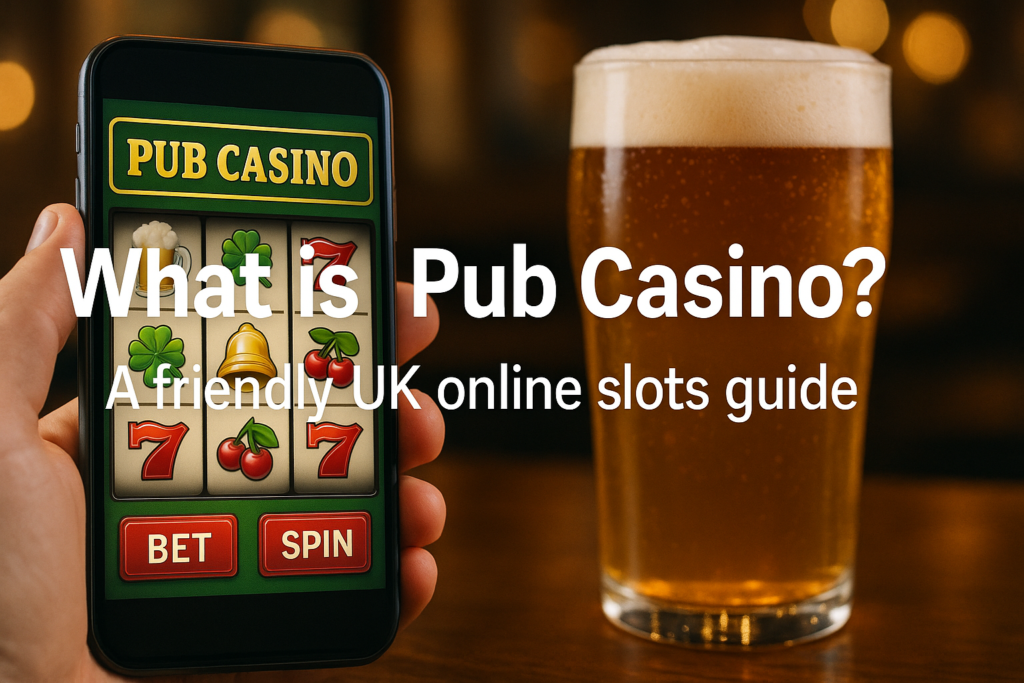
What is Pubs Online Casino? A clear, friendly guide to Pub Casino — the UK-facing newcomer If you’ve been scrolling betting feeds, you might have bumped into the name Pub Casino (sometimes heard as “Pubs Online Casino” in casual chat). It’s one of those modern brands that borrow pub-style warmth in their marketing while being entirely internet-based. Launched in 2023 for the UK market, Pub Casino packages hundreds of video slots, a live casino lobby, app access and promotional bells and whistles designed to appeal to slot players who like a social, straightforward experience. Let’s walk through what it is, what it offers, how it works, and whether it’s worth trying — with practical tips so you know what matters before you deposit. So, what is Pub Casino — literally? At its simplest: Pub Casino is an online casino brand. It’s not a physical pub with fruit machines and a bartender; instead, it’s a website and mobile app that offers gambling games you can play on your phone, tablet or laptop. The brand was highlighted in press coverage when it launched in 2023, and most reporting positions it as a UK-focused operator aimed at slot players who want easy access to popular titles and a live games environment like roulette and blackjack. That “pub” part of the name is deliberate marketing — it suggests friendliness, a casual atmosphere and instant access to games you might enjoy if you were relaxing in a local. But it’s important to remember: Pub Casino operates entirely online, so the experience, rules and protections are governed by digital gambling standards rather than the informal rules you find in a real pub. Games and platform: what you’ll actually play Pub Casino’s product mix is built around two pillars: slots and live casino. According to launch coverage, the site offers hundreds of online slots — so expect everything from classic three-reel-style titles to modern video slots and branded games — plus a live casino section with real dealer tables for roulette, blackjack, baccarat and game-show style formats. Live casino matters because it changes the experience: instead of purely RNG-driven spins, you’re watching a human dealer run a table in real time. That social element is a big reason why the “pub” theme works for the brand. The operator also rolled out dedicated iOS and Android apps at launch, which many players prefer for speed, push notifications about promotions, and convenience. If you’re considering the app route, check the app store listing and the brand’s website for minimum device requirements and app permissions before you install. Promotions, bonuses and the fine print New casinos often hook players with welcome offers, and Pub Casino is no exception. Coverage at launch mentioned a welcome package that included 50 free spins with no wagering requirement — unlocked after a £10 deposit and some wagering — which is the kind of headline offer that catches attention. That “no wagering” detail is important and rare: it typically means winnings from those free spins are paid out as withdrawable cash rather than locked behind rollover rules. But — and this is crucial — promotional headlines rarely tell the whole story. Free spins and no-wager claims usually come with conditions: time limits, game restrictions, maximum cashout caps, identity verification requirements and sometimes playthrough tied to the deposit or specific game categories. Before taking any offer, read the full terms and conditions on the brand’s promotions page and make sure you understand any caps on winnings or withdrawal requirements. Payments: how to deposit and withdraw Payment choices are a big part of convenience and safety. At the time of launch, at least one casino comparison site listed Paysafecard among Pub Casino’s accepted methods. Paysafecard is a popular pre-paid voucher option in the UK that lets you top up without sharing banking details online — useful if you want to keep gambling activity separate from a bank card. You’ll want to confirm the full list of accepted methods on Pub Casino’s own cashier page as operators change payment options and add e-wallets, cards or bank transfer options over time. Practical points on payments: Check processing times: Deposits are usually instant, but withdrawals vary — cards and e-wallets are often faster than bank transfers. Watch verification: Most legit casinos require ID documents before processing withdrawals; this is normal and aimed at fraud prevention. Fees and limits: Look for any withdrawal fees and minimum/maximum limits on both deposit and withdrawal pages. For an example of where payment methods like Paysafecard are listed, see this payment overview at Compare.bet: Paysafecard banking options on Compare.bet. Is Pub Casino safe and regulated? This is the part where a sensible player gets cautious. Being “UK-focused” is a hint that an operator targets British players, but it doesn’t automatically confirm licensing or regulatory status. The benchmark in the UK is the Gambling Commission — a regulator that issues licences to operators and enforces consumer protections. My advice: before creating an account, look for the operator’s licensing and regulatory information on the footer of its website and then cross-check that licence number on the regulator’s official site. If you don’t see clear licence details or the name and licence number don’t match the regulator’s database, be cautious. You can use the UK Gambling Commission site to confirm licences and guidance for players: UK Gambling Commission. Other safety markers to look for include: Responsible gambling tools: deposit limits, time-outs and self-exclusion options. SSL encryption: make sure the site URL begins with https:// and displays a valid certificate. Transparent RTP and game providers: reputable providers and published return-to-player rates (RTP) are better than anonymous proprietary games. If you’re unsure about an operator’s trustworthiness, independent resources such as GambleAware offer advice on safer play and help for players who are worried: BeGambleAware. “Pub online casino” as an idea — what the phrase really means Sometimes you’ll see the term “pub online casino” used more generally, not as a brand name. In gambling literature and casual usage, it
Pub Casino UK A Straightforward Guide for British Players
Pub Casino UK: A Straightforward Guide for British Players Think of Pub Casino as your friendly local with an online twist — a British-flavoured, no-nonsense casino built for players who want to jump in, spin a few reels, try a live dealer table, and cash out without faff. Launched in 2023 and operated by L&L Europe Ltd, the site has been positioned as a simple, familiar alternative to the flashier, more gimmicky operators out there. This guide walks through what matters: licensing, games, bonuses, payments, mobile play, and the practical bits you’ll want to check before staking your pounds. What is Pub Casino and who runs it? Pub Casino is a UK-focused online casino aimed squarely at British players. The operator is L&L Europe Ltd, and the casino is regulated by the UK Gambling Commission — a big tick for players who want strict player protection and transparent rules. Multiple independent reviews note the UKGC licence and compliance controls as one of Pub Casino’s core selling points. For the most direct source, you can visit the Pub Casino official site here: Pub Casino (official site). Why this matters: UKGC regulation means Pub Casino is bound by mandatory identity checks, anti-money‑laundering procedures, safer gambling tools, and clear rules on bonus terms and payout processes. If you value oversight and consumer protections, the licence is not just a line on the footer — it shapes how the whole site operates. Games, libraries and what to expect at the tables If you’re here for variety, Pub Casino covers the basics and then some: slots, live casino, and classic table games are all present. Sources report the game library in slightly different terms — some reviews cite around 1,600+ titles while others point to 2,000+ slots and live games. A few outlets even show lower counts (700+), so expect discrepancies depending on which games each reviewer included (jackpots, old titles, or regional restrictions can shift totals). What that means for you: you’ll find a wide spread — new releases and solid classics — plus live dealer roulette, blackjack, and baccarat for players who want the table vibe. The takeaway is simple: Pub Casino isn’t an arcade full of rare niche titles, but it’s broad enough to keep most players entertained. For third-party perspectives and game counts, see the reviews at Casino.org and OLBG, which helped consolidate the available figures during launch-season coverage. Live casino and table play Live casino is a headline feature for Pub Casino. If you prefer human dealers and a more social casino experience, the live area gives you that pub-night feel without leaving the couch. Live game quality and variety can change over time as providers rotate, so if a particular live studio or stakes bracket matters to you, double-check the live lobby before depositing. Bonuses, promotions and the small print Pub Casino’s welcome offer is a place where you’ll see variation across reviews. Some sources report a launch promotion of 50 cash spins, whereas others mention a 100% deposit match. The important thing to remember: online casino offers change frequently. What was available at launch in 2023 may not be the same today, and UK-regulated sites must publish clear bonus terms — including wagering requirements and any game exclusions. Practical tip: always read the bonus terms before opting in. Look for wagering requirements (how many times you must play through bonus funds), maximum bet caps while wagering, and whether spins apply to a single slot or a wider list. Different reviewers noted that Pub Casino’s promos are straightforward and not overloaded with confusing conditions, but that doesn’t replace checking the current offer on the site. For snapshots of how different outlets described the welcome package during the casino’s early months, see the reviews at Betting.co.uk and TopRatedBingoSites. Payments, verification and withdrawal speeds One of Pub Casino’s stronger talking points from multiple sources is a fast payment experience. Reviews comment on withdrawals that can be processed same day or within 1–3 days depending on the method, with occasional descriptions stretching to 1–5 days. Those differences usually come down to three things: Payment method — e-wallets such as PayPal or Trustly are typically fastest. Verification status — fully verified accounts get quicker payouts. Internal processing times — casinos vary on how quickly they approve withdrawals. Pub Casino supports popular UK methods like PayPal and Trustly according to reviewers, which is handy because those services offer speed and familiarity for UK players. If you want money out quickly, deposit and withdraw with the same method, complete account verification early, and avoid sending small test withdrawals that complicate bank checks. Why this matters: withdrawal speed affects your overall enjoyment and trust in a casino. A fast, predictable cashout is a mark of professional housekeeping; slow, unexplained delays are a red flag. The independent takes on Pub Casino consistently highlight its low-friction payout experience as one of the site’s practical advantages — see additional commentary in the Racing Post review: Racing Post review. Licensing, safety and player protection Pub Casino operates under a UK Gambling Commission licence, which frames the site’s regulatory duties: identity checks, anti-money laundering, safer gambling tools, and transparent complaints channels. That licence number and regulatory status were repeatedly noted across early reviews and is central to the site’s identity as a UK-first operator. What to look for on any UKGC-licensed site: Clear links to safer gambling tools — deposit limits, self-exclusion, reality checks. Transparent bonus and withdrawal terms. Contact channels, including email and live chat, plus an escalation route if something goes wrong. Pub Casino’s compliance practices were called out positively by reviewers who emphasised strong player-protection controls. For a breakdown of reviewer notes around licensing and compliance, check this summary at OLBG. Mobile, user experience and customer support Playability on your phone or tablet is key for many British players, and Pub Casino focuses on browser-based mobile play rather than a dedicated app. That means you can load the site from Chrome or Safari and jump straight into