Queen in blackjack Ace Plus Queen Equals Blackjack

Queen in Blackjack: Why a Queen Is Always 10 Points — what it means for blackjack and your next move Estimated reading time: 6 minutes Key takeaways A queen always counts as 10 points in blackjack, grouped with 10, J and K. Queen + ace is a two-card blackjack; queen + any 10-value card is a 20 and you generally stand. Treat pairs of queens as a hard 20 — don’t split — and play hard 12–16 carefully versus the dealer upcard. What a queen in blackjack actually counts as Short version: a queen = 10. Full stop. The clear rule shows up in standard casino documentation: face cards count as ten points, identical to tens, so a queen is treated the same as a 10-value card. See the standard rules for the precise language used in many regulated game guides. And don’t get cute about suits. Hearts, spades, diamonds or clubs do not change that value. The Washington State rules explicitly note that suit doesn’t affect the card’s score, which is why that queen of clubs hits the felt exactly the same as the queen of hearts when it comes to totals (suit doesn’t affect value). Two-card hands: queen + ace and queen + 10-value results Some of the most meaningful outcomes in blackjack are two-card combos, and the queen plays a starring role there. If you pair a queen with an ace, you’ve got a two-card 21 — an immediate blackjack. That’s not just good luck; that combination qualifies as the classic blackjack under standard rules (two-card blackjack). Put a queen next to any other 10-value card — a jack, king or plain 10 — and you’ve got a 20. That’s as solid as it gets without hitting blackjack: 20 is a powerful total and one of the best outcomes you can hold before the dealer plays out their hand (20 total). Why the queen is grouped with 10-value cards in blackjack Playing cards are organized by rank, and casinos treat tens and face cards as one category for scoring. It keeps the game simple and consistent: all four ranks — 10, J, Q, K — are worth ten points each. That’s why you’ll often hear dealers call them “tens” or “10-value cards.” Grouping face cards this way simplifies payouts, dealer decisions and even card counting. When a queen pops up, it moves the same needle as a ten or a king — it’s a single unit in the game’s math. Practical implications for basic play when you’re holding a queen Knowing a queen is 10 points is useful, but the real value comes when you translate that into decisions. Here are concrete, table-ready implications. Queen + 10-value (20): Stand. You’re almost never hitting a 20. It beats a huge swath of dealer outcomes and gives you good odds of winning the hand. Queen + ace (blackjack): That’s a two-card 21. Under standard rules it’s a blackjack and settles immediately according to the house’s payout rules; check the casino’s pay schedule before you sit (blackjack treatment). Queen + small card (hard totals): For example, queen + 6 = 16, queen + 2 = 12. These become the classic “stiff” hands: vulnerable, uncomfortable and often forcing a choice between standing and hitting depending on the dealer upcard. Pair of queens: That’s a hard 20. Basic strategy nearly always says don’t split tens — splitting a pair of queens gives you two weaker hands in exchange for one very strong 20. Those aren’t theoretical micro-adjustments; they change how you react in the moment. A queen next to an ace is a handshake-and-get-paid situation. A queen next to a 6 will have you thinking about the dealer’s upcard and whether to take a hit. How a queen affects specific actions: hitting, standing, doubling and splitting Let’s break it into quick rules you can use at the table. When you have 20 (queen + any 10): Stand. Period. When you have a blackjack (queen + ace): The hand is resolved as a two-card blackjack per typical rules; you don’t play it out against the dealer’s hand (two-card blackjack). Hard 12–16 with a queen: These “stiffs” require dealer-upcard context. Versus dealer 2–6 you’ll often stand; versus 7–Ace you’re more likely to hit. The queen just gives you the hard total to evaluate. Doubling: Doubling opportunities aren’t affected by the queen itself; they’re dictated by the combined total. A queen plus a low card rarely produces a hand you’d double on. Splitting: Only possible if you’re dealt two queens. Splitting tens is an advanced move that usually reduces EV; almost every basic strategy chart recommends standing on a pair of tens. Common mistakes players make with queens at the table Some misreads show up repeatedly. First, mixing up suit with value. Players sometimes think suits or face-card rank matter for scoring. They don’t. A queen is numeric value 10 regardless of hearts or clubs (suit doesn’t affect value). Second, splitting tens. You’ll meet fellow players who split a pair of queens “for action.” They usually walk away wishing they hadn’t. A pair of tens is one of the strongest non-blackjack hands. Third, misreading insurance when the dealer shows an ace. If the dealer peeks and you don’t have blackjack, the insurance bet is a side wager that generally favors the house. A queen + ace already gives you the natural; insurance is a separate decision the queen doesn’t change. Counting and card composition: why queens matter to counters Card counters classify tens and face cards as the same weight because they influence the remaining composition in the shoe the same way. When multiple tens and queens are out of the shoe, the pile left for future hands becomes richer in low cards, shifting the odds. For someone tracking composition, a queen is an immediate ten-value hit to the count — it’s not a face card with special status, it’s a ten. That’s why the phrase “10-value cards blackjack” is common in counting conversations:
Blackjack Strategy Chart Printable for 4-8 Decks S17

Blackjack Strategy Chart: Printable Sheet, 10 Must‑Know Rules, and How It Lowers the House Edge to ~0.5% Estimated reading time: 6 minutes Key takeaways Use a basic-strategy chart to decide Hit, Stand, Double, Split, or Surrender based on your hand and the dealer’s upcard. Match the chart to the table rules (decks, S17/H17, doubling, surrender) to keep the house edge near ~0.5%. Memorize the ten core rules and keep a printable chart when learning to avoid costly mistakes. How to read a blackjack strategy chart Start with your hand on the left side of the chart and find the dealer’s upcard across the top. The intersecting cell gives the recommended play. Common action codes are simple: H for hit, S for stand, D for double, SP for split and R for surrender. That’s the language the casino understands and the chart uses. See a quick guide at how to read the chart. Printable blackjack strategy chart (4–8 decks, dealer stands on soft 17) Below is a compact, printable blackjack strategy chart matched to common casino tables: four‑ to eight‑deck shoes with the dealer standing on soft 17 (S17). This is the chart you want pinned to the rail when you’re learning. Hard totals 8 or less: Hit. 9: Double vs dealer 3–6, otherwise Hit. 10: Double vs 2–9, otherwise Hit. 11: Double vs 2–10, Hit vs Ace. 12: Stand vs 4–6, otherwise Hit. 13–16: Stand vs 2–6, Hit vs 7–Ace. 17+: Always Stand. Soft totals (Ace counted as 11) A‑2, A‑3: Double vs 5–6 (if allowed), otherwise Hit. A‑4, A‑5: Double vs 4–6, otherwise Hit. A‑6: Double vs 3–6, otherwise Hit. A‑7: Stand vs 2,7,8; Double vs 3–6; Hit vs 9–Ace. A‑8, A‑9: Always Stand. Pairs (splitting) A‑A: Always Split. 8‑8: Always Split. 2‑2, 3‑3: Split vs dealer 2–7, otherwise Hit. 4‑4: Split vs 5–6 only, otherwise Hit. 5‑5: Never Split (play as 10). 6‑6: Split vs 2–6, otherwise Hit. 7‑7: Split vs 2–7, otherwise Hit. 9‑9: Split vs 2–6 and 8–9, Stand vs 7 and 10/Ace. 10‑10: Never Split; always Stand. Surrender (if offered) Early or late surrender rules vary; commonly surrender 16 vs dealer 9–Ace or 15 vs dealer 10 depending on the table. Print this page or copy the section that matches your table’s rules. If the casino restricts doubles or offers surrender, use the variants in the “When the chart changes” section below. Quick note on terminology: some players say “blackjack sheet” or “blackjack strategy sheet” — they mean the same thing: a condensed set of charts you can study and, where allowed, consult before decisions. Ten must‑know rules from the blackjack strategy chart Always split A‑A and 8‑8. Splitting Aces gives two chances at 21; splitting eights turns a losing 16 into two playable hands. Never split 10s or 5s. A 10‑10 is a strong 20; two 5s are better doubled as a hard 10. Hit hard totals 11 or less. You can’t bust with 11 or less, so be aggressive. Stand on hard 17 or more. The risk of busting outweighs the upside of drawing. Double 10 or 11 against weak dealer cards. When the dealer shows 2–9 (for a 10) or 2–10 (for an 11), doubling is usually correct. Stand on 12–16 versus dealer 2–6; hit versus 7–Ace. Dealer’s weakness is your signal to lock in. Use soft‑hand doubles when possible. Soft hands (A‑x) are flexible — doubling can pay off when the dealer is weak. Don’t chase splits with bad rules. If doubling after split is not allowed, some splits lose value; adjust accordingly. Know surrender rules before you sit down. Surrender can save half your bet in specific spots — it’s a defensive play. Always check the payout and rules first. A 3:2 blackjack payout is meaningfully better than 6:5 — check the table before you play. The rules above are the muscle memory you want. Memorize ten and you’ll handle most in‑game surprises without referring to the full chart. When the blackjack strategy chart changes Basic strategy isn’t one-size-fits-all. It adjusts based on rule variations that materially affect the math. Number of decks. Single‑deck charts differ from multi‑deck charts; our printable sheet is tuned for four‑ to eight‑deck shoes. S17 vs H17. If the dealer hits soft 17 (H17), basic strategy shifts slightly and the house edge rises. The chart you use must match the S17 or H17 rule. Doubling restrictions. Some tables only allow doubling on 10/11; that changes several doubling/standing decisions. Surrender availability. If surrender is not offered, remove those options and follow the hit/stand alternatives. For details on when surrender applies, consult reliable strategy resources on surrender rules. Blackjack payout. A 3:2 payout for a blackjack keeps the game playable. A 6:5 payout chops long‑term returns and should make you reconsider that table — always check the table rules before you sit. How a blackjack strategy chart cuts the house edge to roughly 0.5% Play the matching chart at a favorable S17, multi‑deck table and basic strategy compresses the casino’s advantage to about 0.5% — that’s the figure most strategy tables aim for. The research backing that comes from mathematical simulations of perfect basic strategy on common casino rules; you can read the details in a basic-strategy chart guide. What does a 0.5% house edge mean in practice? For every $100 bet, the expected casino profit over the long run is about 50 cents if you and the house play the standard rules. That doesn’t mean you won’t win sessions — variance is real — but it does mean you’re not handing the house more edge than necessary. Bad rules and sloppy decisions widen the gap. For example, switching to a 6:5 blackjack payout or using the wrong chart for H17 can add several tenths of a percent — enough to double the house edge in some cases. Using the chart at the table: practical tips Verify table rules (decks, S17/H17, doubling and surrender) before betting. If you’re learning, keep a small bet and a printed
Can a Blackjack Strategy Card Help You Beat Six-Deck S17?
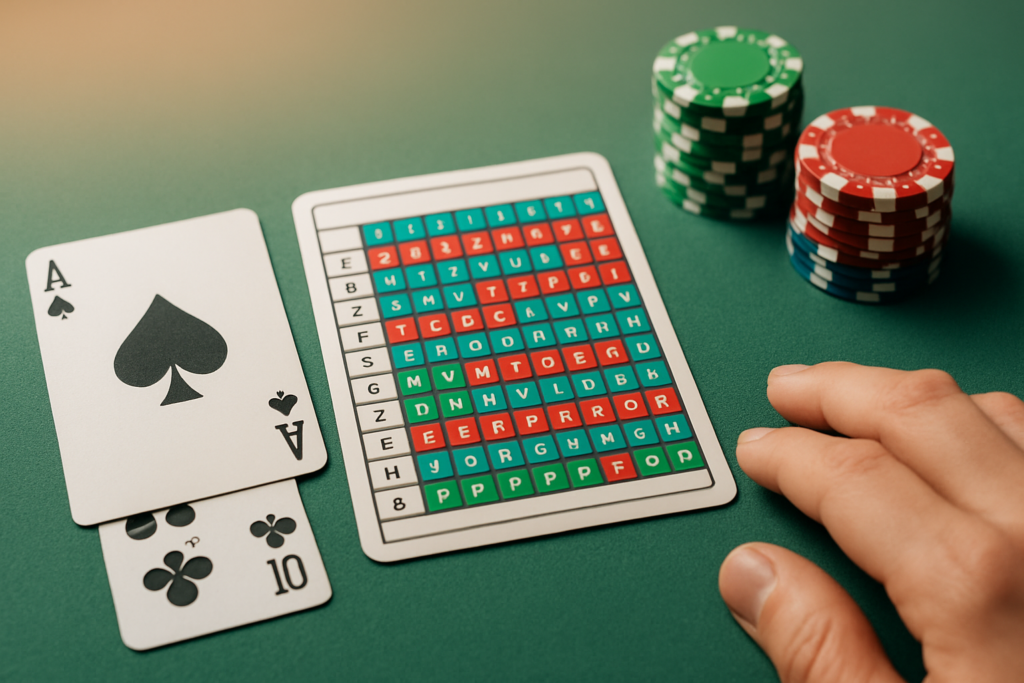
Six-Deck Blackjack Strategy Card (Dealer Stands on Soft 17) — Play to ~0.41% House Edge, Don’t Take Insurance Estimated reading time: 6 minutes Key takeaways This card is tailored to six decks with dealer standing on soft 17 (S17) and assumes 3:2 blackjack and DAS allowed. Correct basic strategy under these rules yields about a 0.41% house edge; insurance is a bad bet (~7.395% house edge). The card lists core actions for hard hands, soft hands, and pairs — match the chart to the table rules before playing. Practice short drills and consult a rule-matched chart if the table uses different rules (H17, 6:5, no DAS, different deck count). How this blackjack strategy card is built (S17, six decks) Basic strategy is not universal. It shifts with deck count and rule tweaks. This card is built for: six decks, dealer stands on soft 17 (S17), blackjack pays 3:2, double after split allowed, late surrender not used, dealer peeks for blackjack. This rule mix is common in online shoe games and many casino “strip-style” tables. Under these six-deck S17 rules, correct basic strategy gives about a 0.41% house edge; see the basic-strategy estimate for technical origin. If your table differs (different deck count, dealer hits S17, 6:5 blackjack, no DAS, etc.), use a rule-matched chart. The Wizard of Odds blackjack calculator helps test exact rules. Printable blackjack strategy card — core decisions Below is a compact, print-friendly strategy summary for the above rules. Think of it as a one-page cheat-sheet covering hard hands, soft hands (containing an ace), and pairs. Hard totals (no ace) Hard 8 or less — Hit. Hard 9 — Double vs dealer 3–6, otherwise Hit. Hard 10 — Double vs dealer 2–9, otherwise Hit. Hard 11 — Double vs dealer 2–10, otherwise Hit. Hard 12 — Stand vs dealer 4–6, otherwise Hit. Hard 13–16 — Stand vs dealer 2–6, otherwise Hit. Hard 17+ — Stand. Soft totals (ace counted as 11) Soft 13–14 (A,2–A,3) — Double vs dealer 5–6, otherwise Hit. Soft 15–16 (A,4–A,5) — Double vs dealer 4–6, otherwise Hit. Soft 17 (A,6) — Double vs dealer 3–6, otherwise Hit. Soft 18 (A,7) — Double vs dealer 3–6; Stand vs 2,7,8; Hit vs 9–A. Soft 19+ (A,8–A,9) — Stand. Pairs (splitting) Pair Aces — Always Split. Pair 8s — Always Split. Pair 2s and 3s — Split vs dealer 2–7, otherwise Hit. Pair 4s — Don’t split (Hit, except some charts split vs 5–6; this card keeps standard play: don’t split). Pair 5s — Never Split; treat as a hard 10 (Double vs 2–9, otherwise Hit). Pair 6s — Split vs dealer 2–6, otherwise Hit. Pair 7s — Split vs dealer 2–7, otherwise Hit. Pair 9s — Split vs dealer 2–6 and 8–9; Stand vs 7,10,A. Pair 10s — Never Split; Stand. This condensed card captures the moves that matter most in live play. For a full, table-style chart with every matchup printed neatly, use detailed resources such as the Wizard of Odds basic strategy page. Why these specific rules (and where the ~0.41% number comes from) The house edge is rule-driven. Under many six-deck S17 rule sets the long-run edge against a perfect basic-strategy player is roughly 0.41%. That number comes from calculators and simulations for a typical “liberal” six-deck shoe where the dealer stands on soft 17. “Liberal” rules like DAS and 3:2 blackjack tighten the house edge; stricter rules (no DAS, H17, 6:5 blackjack) increase it. Public tools let you test specifics. Use the blackjack calculator to plug in deck count, payouts, and options. Playing a simplified strategy instead of a complete one costs measurable expected value. Under Vegas-strip-style rules the cost of a simplified strategy is about 0.53%, while the more detailed strategy reduces the cost of imperfect play to around 0.14%. More math is available on the Wizard of Odds basics page. Insurance and “even money” — why you should decline Insurance is almost always a losing side-bet unless you are counting. For six-deck games the average insurance house edge is roughly 7.395%. Take “even money” when your blackjack is against a dealer Ace? Under basic strategy you should decline — playing your blackjack normally has better long-run expected value. See the insurance explanation for the calculation behind the headline. Match the card to the table: don’t be that player Confirm the table’s rules before using this card. Number of decks (single, double, six, eight). Dealer action on soft 17 (S17 vs H17). Blackjack payout (3:2 vs 6:5 — the latter is a big negative). Whether double after split (DAS) is allowed and if re-splitting aces is allowed. Late surrender availability. When in doubt, plug the combination into the Wizard of Odds blackjack rules overview or the calculator to produce the correct chart. Practicing the card and avoiding mistakes Two minutes a day with practice drills beats an hour at the table making avoidable errors. Here’s a drill plan that helps: Play free online drills or a simulator for 20 minutes focusing on one section — hard, then soft, then pairs. Carry this one-page card and consult it for 50 hands, then phase it out until plays are automatic. When you make a mistake, note if it was a rule mismatch (e.g., H17 vs S17) or a memorization slip. Short practice sessions reduce the “simplified strategy” leak. Over thousands of hands a few tenths of a percent matters. Common situations players ask about (quick answers) Dealer shows Ace — never take insurance under basic strategy. Decline even-money offers. Face-down hole card — if the dealer peeks and pops 21, you lose less time because the dealer settles early; always check whether the table peeks. Surrender — if the table offers late surrender, it can improve your position on certain hands; check the rules and the detailed chart. Counting — basic strategy is the baseline. If you’re not counting, don’t deviate from basic strategy hoping for “hot” runs. For technical math on rule impacts and to compare variants, the strategy calculator
Free blackjack demo Quantum Blackjack Plus 99.68% RTP
Free Blackjack Demo: Play No-Download Blackjack for Free — Best 99%+ RTP Games and Rules Checklist Estimated reading time: 7 minutes Key takeaways Check the demo’s rule panel: blackjack payout, dealer S17/H17, decks, doubling and splitting rules shape RTP most. Some demos report ≥99% RTP (Quantum Blackjack Plus, Lightning Blackjack); confirm the exact rule build before playing for real. Use demos to drill basic strategy with a fixed virtual bankroll and hand quota; track decision errors, not chip wins. Why those small rule changes matter for a free blackjack demo Blackjack looks simple on the surface: beat the dealer without busting. But the house edge is a creature of details. Two blackjack tables that look identical can differ by almost a full percentage point in long-run returns because of rule differences. RTP numbers you see listed for demos aren’t marketing fluff — they reflect the rule mix the provider used for that title. A “blackjack” demo with a 3:2 blackjack payout, dealer standing on soft 17 and liberal double/split rules will usually offer much better long-term returns than a variant paying 6:5 on naturals with restrictive doubling. That’s why reputable trackers and catalogs list game-level RTPs. For a quick reference, SlotCatalog compiles reported RTPs for specific titles, including very high-return demos like Quantum Blackjack Plus and Lightning Blackjack — we’ll examine those next. Best free blackjack demo games (99%+ RTP) — ranked Here are demo titles that show up in RTP listings at or above roughly 99% in their reported configurations. These are standings of the demos themselves, not a guarantee of every table with that name on every site. Quantum Blackjack Plus (Playtech) — 99.68%. Reported as one of the highest-RTP demos in SlotCatalog’s listings. If you find this demo, check the rules panel for blackjack payout and surrender options before moving to real money. Quantum Blackjack Plus Lightning Blackjack (Evolution) — 99.56%. Evolution’s Lightning brand tends to tweak side features; the base game can be very player-friendly in some demo builds. Always confirm the dealer S17/H17 rule. Lightning Blackjack Blackjack MH (Play’n GO) — 99.49%. Play’n GO’s variants can be close to 99% depending on decks and payout. Look for the detailed paytable in the demo window. Blackjack MH IGT PlayDigital Blackjack — around 99%. IGT’s digital conversion often reports near-99% returns in demo form; the exact figure depends on the game build. Check the provider info inside the demo. IGT PlayDigital Blackjack TaDa Gaming Blackjack — ~97.00%. A perfectly playable demo, but note the lower reported RTP compared with the 99%+ group. That difference matters over long sessions. TaDa Gaming Blackjack Two important caveats: demo RTPs are conditional on the specific rule set for that build, and side bets often have much lower returns than the main game. For example, a published side-bet RTP in a multi-deck demo can sit around the mid-90s — lower than the base game’s figure and a clear signal to treat side bets as entertainment rather than value. See this side-bet RTP example for the math behind that warning. Free blackjack demo — rules checklist (what to check before you play real money) When you’re scanning free blackjack demo menus, get into the habit of hitting the info or paytable button before you start hitting buttons. Here’s a concise checklist of the rules that move RTP the most. Blackjack payout: Is a natural paid 3:2 or 6:5? 3:2 remains the player-friendlier payout. The demo paytable will tell you. Dealer on soft 17: Does the dealer hit (H17) or stand (S17) on soft 17? S17 is better for the player; H17 usually increases the house edge. Number of decks: Single-deck, double-deck, and shoe games have different odds. Fewer decks generally help the player, all else equal. Doubling rules: Can you double on any two cards? After splits? Restrictions here affect the effectiveness of doubling strategies. Splitting rules: Can you resplit pairs? What about splitting aces? Limits on resplits reduce player flexibility and raise house edge. Surrender availability: Early or late surrender can shave a noticeable amount off house edge; if the demo shows surrender, note whether it’s early or late. Side-bets and their RTPs: Side-bet RTPs often trail the base game substantially. Treat them as optional fun; check the paytable numbers first. Shuffling and shoe behavior: For shoe games, look for shuffle frequency and penetration if the demo shows it; those impact card-counting viability (not that we’re advocating counting in casino play here). These items are in the demo’s info panel. If a demo doesn’t show the rules up front, treat it with suspicion — and don’t assume the demo replicates the best real-money rules. How to use a free blackjack demo to practice basic strategy without fooling yourself Demo play is the best low-cost training ground for decision-making under blackjack rules — if you use it right. The trick is to separate skill practice from entertainment luck-chasing. Set a practice goal: Decide what you’re practicing — hitting/standing decisions, doubling/splitting scenarios, or playing basic strategy on shoe games. Use a fixed virtual bankroll: Give yourself 1,000–10,000 demo chips per session and a hand quota (e.g., 200 hands). This builds repetition without endless scrolling. Stick to basic strategy charts: Match the chart to the demo’s rule set. Charts differ when you go from single-deck to multi-deck or from S17 to H17. Drill the tough spots: Force splits and doubles in awkward hands to practice. Record results logically: Track mistakes (wrong doubles, wrong stands) rather than wins/losses. Demo results are noisy; your learning progress is what matters. Don’t confuse demo luck with proof: Demo balances have no cash value, and short demo sessions tell you little about long-run edge. The demo can train reflexes and rule familiarity, but it can’t change math. See the official note that demo balances are non-cash on no cash value. One practical drill: pick a 200-hand block on a demo shoe game with the same rules you intend to play for real. Use the correct basic strategy chart and
Blackjack Online for Fun Five Quick Checks on Decks S17 Payouts
Blackjack Online for Fun: 5 Quick Checks to Find No-Signup Free Blackjack (Decks, S17, Payouts) Estimated reading time: 6 minutes Key takeaways Verify the demo label and that no signup or card details are required before you play. Confirm decks, dealer S17/H17 behavior, doubling/splitting rules, and blackjack payout (3:2 vs 6:5). Use short, focused drills in demo mode and re-check rules at any cash table before betting real money. How demo play really works (and what it won’t do) When casinos say “play for fun” they mean a version of the game that uses the platform’s interface and random number generator but pays out play-money only. Look for a clear demo button or a label that says demo or “play for fun” option before you click. Demo play is great for learning rules, trying strategies, and seeing how a site handles bets, side bets, and split/double UI. It’s not a perfect mirror, though: demo tables can omit live-dealer interaction, real-money promotions, wagering requirements, and account verification steps you’ll face later in real play (official guide). Five quick checks before you click “free blackjack demo” These are the five details that change how the math and the decisions play out. Treat them like the checklist you run before you sit at a table in a bricks-and-mortar casino. 1) Demo label and no-deposit requirement Check the tile. It should say “Demo,” “Practice,” “No real money,” or “Play for fun.” If a site asks for a card number, deposit, or account verification before giving you demo chips, it’s not a true no-cost demo. Why it matters: a genuine demo lets you explore without financial commitment. If you’re specifically looking for blackjack no signup, make sure the provider explicitly allows play without registering. 2) Number of decks Look for the decks count in the game rules or the info icon: single-deck, double-deck, or six-/eight-deck. The number of decks affects basic strategy and the house edge. Why it matters: fewer decks generally narrow the house edge and slightly change correct strategy on doubling and splitting. When you practice, match the deck count you expect to play for real so your decisions translate. 3) Dealer hits or stands on soft 17 (S17 vs H17) Find the dealer soft-17 rule in the rules panel. It should say “Dealer stands on soft 17” or “Dealer hits soft 17.” Why it matters: dealer hitting a soft 17 (H17) increases the house edge compared with dealer standing (S17). That affects insurance math, surrender and several borderline plays — so you want practice that uses the same dealer behavior as the real-money tables you’ll use later. 4) Doubling and splitting rules Scan the restrictions: can you double after split (DAS)? Can you double on any two cards or only on specific totals? How many times can you split, and are aces limited to one card? Why it matters: these rules dramatically change strategy. For example, inability to double after a split removes profitable plays in many hands. If your goal is to practice basic strategy or card counting cues, match these options between demo and cash play. 5) Blackjack payout (3:2 vs 6:5 and other odds) Check the blackjack payout: the good tables pay 3:2 for a natural blackjack; some pay 6:5 or other reduced rates. Why it matters: a 3:2 payout is standard and far friendlier than 6:5. If you practice on a demo with 3:2 and then sit down at a 6:5 cash table, your returns will be worse than your practice session suggested. Confirm the payout in the rules screen before testing strategy. Where to spot these details quickly on a site Game providers and casino lobbies usually tuck the rules into an “i” icon, a small rules link, or the game description. If you can’t find decks, S17/H17, doubling/splitting rules, and payout in that info pane, treat that as a red flag. Check the game tile for a demo option or “Play for fun” label. Open the info panel for decks, dealer behavior, and payout. Try a few hands and verify UI behavior for splits and doubles so you don’t learn the wrong button sequence. Three key differences you’ll hit when moving from demo to real money Demo practice is low-pressure and handy. But the transition to cash play brings three immediate changes you should expect and plan for. 1) Real money needs account verification and deposits Switching to cash means you’ll create an account, verify identity (KYC), and make a deposit. Those verification steps can take time and require documentation. Why it matters: your bankroll behavior changes when real money is at stake. The mechanics of play are similar, but the psychology and the administrative steps are not. 2) Promotions, wagering requirements and cash terms Real-money play can be bundled with bonuses, free spins, or wagering requirements. Demo sessions won’t show those constraints. Why it matters: bonus terms often include wagering amounts, game-weighting rules, and maximum bet caps. If you assume demo conditions equal bonus-backed play, you’ll get surprised at cashout time. 3) Table limits, side-bets, and live-dealer differences Demo tables sometimes offer unlimited or very low limits and may not show live dealer options. Live dealer tables also add human timing and chat dynamics that change the tempo of play. Why it matters: side-bets and table limits change variance. Live dealers introduce slower rounds and social pressure — not things you’ll feel while playing speed-mode demo blackjack. Common demo pitfalls players miss A few traps come up again and again in demos. Watch for them so practice time actually helps you improve. Demo balances are arbitrary. Don’t assume a huge demo bankroll will translate to real-money comfort. Autoplay and speed settings can teach bad habits. Practice making deliberate decisions. Some demos hide rules in small text — read the rules panel before blaming RNG. Promotions and tournaments usually aren’t shown in demo play, so ignore any impressions about bonus value until you see terms in a real account. Where to find truly no-signup free
European vs American roulette: 2.70% vs 5.26% edge per $100

European vs American roulette: Which Wheel Gives Better Odds (and How Much You’d Lose Per $100) Estimated reading time: 6 minutes Key takeaways Single-zero European roulette has a 2.70% house edge (≈ $2.70 lost per $100 wagered) versus 5.26% (≈ $5.26 per $100) for double-zero American wheels. French roulette with La Partage or En Prison halves the house edge on even-money bets to 1.35% (≈ $1.35 per $100) when those rules apply. Avoid the American five-number bet (0-00-1-2-3): it carries a 7.89% edge (~$7.89 per $100) and is much worse than standard wagers. If you’re deciding between a single-zero wheel and the twin-zero monster, you want numbers, not hype. European vs American roulette is a simple math question: one extra pocket doubles the casino’s edge in plain percentage terms — and that difference shows up directly in your expected loss per $100 wagered. Here’s the short version: European roulette carries a standard house edge of 2.70% (RTP 97.30%), American roulette tacks that up to 5.26% (RTP 94.74%), and French roulette with La Partage can cut the edge on even-money bets to 1.35%. Those percentages translate to about $2.70, $5.26 and $1.35 expected loss per $100 wagered, respectively. I’ll show you where those numbers come from, why a particular American five-number bet is a trap, and a tight pre-play checklist to verify game rules online so you’re not paying more than you think. European vs American roulette: the math that matters Start with the wheels. European roulette has 37 pockets: numbers 1–36 and a single 0. American roulette has 38 pockets: 1–36 plus 0 and 00. That extra pocket is the whole story behind the higher house edge. European roulette — 37 pockets, house edge 2.70%, theoretical RTP 97.30% (how to play roulette). American roulette — 38 pockets, house edge 5.26%, theoretical RTP 94.74% (how to play roulette). French roulette — mechanically like European (single zero) but rules such as La Partage can cut the edge on even-money bets to 1.35% (casinos with best odds). What does that mean in plain money terms? Take every $100 you wager in total — not your bankroll, but your total stakes. Expected loss equals house edge × money wagered. European: 2.70% of $100 = $2.70 expected loss. American: 5.26% of $100 = $5.26 expected loss. French (with La Partage on even-money bets): 1.35% of $100 = $1.35 expected loss. That math is tidy and unavoidable. RTP and house edge are long-run theoretical values — they don’t promise any short-session outcome — but they tell you which wheel gives you a fighting chance. European vs American roulette: payouts, common bets and why odds feel different Roulette volatility is driven by the bets you make, not the wheel label. Here are the mechanics that shape session swings. Straight-up (single number) pays 35:1; it’s the highest payout but wins only 1/37 (European) or 1/38 (American) of the time. Split, street, corner, six-line cover more numbers and pay less relative to your chance of winning. Outside bets — red/black, odd/even, 1–18/19–36 — pay 1:1 and win roughly half the time on a single-zero wheel (slightly less on double-zero because of the extra pocket). Dozens and columns pay 2:1 and cover 12 numbers each. Even though payout structures are identical across wheel types, the extra zero on American wheels reduces your win probability for any given bet. That’s why an outside bet feels worse in the long run on a double-zero table: the math hasn’t changed, your chance has. Why the American five-number bet is a sucker’s choice Not all bets are created equal. The notorious five-number wager on American tables — a straight bet covering 0, 00, 1, 2 and 3 — carries a house edge of 7.89%, far worse than the standard 5.26% for the table as a whole (roulette house edge breakdown). Put another way: that five-number bet will cost you about $7.89 per $100 wagered in expected losses. That’s almost three times the loss you’d face on French even-money bets with La Partage available. Why do players make it? Sometimes it’s offered as a “special” or displayed prominently on old American wheel layouts. Sometimes it’s a sentimental call from visiting a Las Vegas-style table. Either way, it’s mathematically inferior to almost every other standard wager and best avoided if you care about minimizing loss. How French roulette La Partage and En Prison shift the odds French roulette uses single-zero mechanics but adds rules that matter on even-money outside bets. Two common rules are La Partage and En Prison. La Partage — when the ball hits zero on an even-money bet, half your stake is returned and the other half is lost. That effectively halves the house edge on those bets, dropping it from 2.70% to 1.35% on even-money wagers (why French rules reduce the edge). En Prison — instead of losing half, your entire bet is “imprisoned” for the next spin; if it wins on the next spin you get it back, if it loses you lose it. The effective edge result is similar to La Partage for even-money bets. Both rules only improve the odds on even-money bets; they don’t change the math for straight-up or inside bets. If your priority is the smallest expected loss per wager, seek tables that explicitly state La Partage or En Prison in the rules. RTP, house edge and volatility — what those terms actually tell you RTP (return to player) and house edge are two sides of the same coin: RTP = 100% − house edge. For example, a 2.70% house edge equals 97.30% RTP (casino game math explained). Important clarifications: RTP is a long-run theoretical average across millions of spins, not a session guarantee. Volatility is about frequency and size of wins: even-money bets are low volatility, straight-up bets are high volatility. No betting system — Martingale, Fibonacci, whatever — changes the underlying probabilities. Previous spins don’t make a number more or less likely next time (roulette responsible gambling). So when you see “RTP 97.30%”
How to Play Baccarat Banker’s Edge ≈1.06%

How to Play Baccarat: Rules, the Banker Bet (≈1.06% House Edge) and Bets to Avoid Estimated reading time: 8 minutes Key takeaways Banker is the mathematically best standard bet in an eight-deck shoe (≈1.06% house edge after a 5% commission). You do not choose hits or stands; fixed third-card rules control play for Player and Banker hands. Avoid Tie and most side bets if your goal is minimizing expected losses; check payout tables first. How to play baccarat: the basics and what you’re actually betting on Baccarat boils down to three simple wagers: Banker, Player, or Tie. You’re betting on which of those two hands finishes closer to 9 after the cards are dealt. “Player” and “Banker” are just names, not decisions you make mid-hand. See the concise game breakdown at Pinnacle’s how-to. Card values are quiet but simple: Aces = 1. 2–9 = face value. 10, J, Q, K = 0. Only the last digit of the total counts (e.g., 7 + 8 = 15 → 5). Two-card totals of 8 or 9 are “naturals” — no more cards for that hand. Typical payouts: Player bets pay 1:1, Banker pays 1:1 less a commission (commonly 5%), and Tie usually advertises 8:1. Exact payouts and commissions vary by casino — check the table placard before you sit. For a table-level primer, see Pagat’s baccarat rules. How to play baccarat: the fixed third-card rules explained You do not choose to hit or stand — the dealer follows fixed third-card rules. Memorize the short version and you’ll understand what happens on the layout. Player hand rules If the Player’s two-card total is 0–5, the Player draws a third card. If the Player’s total is 6 or 7, the Player stands. If the Player has a natural 8 or 9, no further cards are drawn for either hand. Banker hand rules (depend on Banker total and whether the Player drew a third card) If Banker total is 0–2, Banker draws a third card no matter what. If Banker total is 3, Banker draws unless the Player’s third card was a 8. If Banker total is 4, Banker draws if the Player’s third card was 2–7. If Banker total is 5, Banker draws if the Player’s third card was 4–7. If Banker total is 6, Banker draws if the Player’s third card was 6–7. If Banker total is 7, Banker stands. These are the standard shoe-game rules used in most casino baccarat tables and online variants. You can read the same table of rules at Wizard of Odds baccarat basics. Banker bet odds and why it’s the standard “best” wager Baccarat is one of those games where a little math tells you everything you need to know. In a standard eight-deck shoe with a typical 5% commission on Banker wins: Banker — roughly 45.86% chance to win, pays about 0.95:1 after commission, house edge ≈ 1.06%. Player — roughly 44.62% chance, pays 1:1, house edge ≈ 1.24%. Tie — roughly 9.52% chance, pays 8:1 commonly, house edge ≈ 14.36%. Those figures come from detailed calculators and published tables — see Sportsline’s compiled odds at Sportsline’s baccarat odds and Pinnacle’s rules page for context. Why does Banker win more often? Because the Banker acts after the Player and has more information when deciding whether to draw (via fixed rules). That advantage offsets the commission the house takes on Banker wins. Practical takeaway: in plain baccarat with no special promotions, Banker is the mathematically best standard wager in an eight-deck game. It doesn’t guarantee short-term wins, but it gives the smallest expected loss over time. Which bets to avoid: Tie and most side bets Tie bets look sexy because of large payouts, but the math is brutal. Typical 8:1 or 9:1 payouts do not reflect the true chance of a tie (about 9–10% in eight decks) and lead to a house edge often north of 14%. Side bets (pairs, bonus outcomes, “super six” variations) are common amenities designed to be exciting and profitable for the house. Before you touch a side bet, do this: Read the payout table on the table placard or on-screen. Calculate or lookup the house edge for that payout; many common side bets have double-digit house edges. Avoid them if you care about keeping expected losses low. Practical example: a typical Tie paying 8:1 has a house edge around 14% in an eight-deck shoe. Even if you hit a Tie occasionally, the long-term math is crushing. See a journalist’s look at side bet traps at Evening Standard’s baccarat guide. Table checklist: what to verify before you play Think of this as your pre-flight checklist. Verify these items at the table — they materially change expected returns. Deck count: Is it 6 decks or 8 decks? Most shoe baccarat games are eight-deck; fewer decks slightly change percentages. Commission: Is Banker commission 5%? Some games feature different commissions or “commission-free” Banker with altered payouts. Tie payout: Is the advertised Tie payout 8:1, 9:1, or something else? That matters a lot. Side bets available: Check the payout table for pair/bonus bets and note their payouts. Table limits: Minimums and maximums affect bankroll strategy and whether you can follow a simple staking plan comfortably. Online, the game rules and payout tables are usually an information icon or rules page. On the casino floor, the placard and dealer can answer — politely ask before you sit down. For an overview of variations, see Casino.org’s baccarat guide. Bankroll and strategy: realistic expectations and common myths No betting pattern beats the built-in house edge. Systems like Martingale or pattern-chasing boards won’t change probabilities. Baccarat hands are independent; previous results don’t “due” future ones. Smart, practical rules to follow: Use Banker as your base bet when you want the mathematically lowest house edge. Set a loss limit and a win target before you start; walk away when you hit either. Ignore streaks and pattern boards — they make conversation, not better odds. If you enjoy side bets for entertainment,
Blackjack Strategy Card H17 vs S17 and 3-2 Payouts
Blackjack Strategy Card: Pick the Right Chart for H17 vs S17 and 3:2 Tables to Cut the House Edge to ~0.5% Estimated reading time: 6 minutes Key takeaways Always match your basic strategy card to the table rules (H17 vs S17, deck count, and payout). Prioritize 3:2 payout tables; 6:5 payouts significantly increase the house edge. Small rule changes (H17, no surrender, limited doubling) shift the house edge by measurable tenths of a percent. Use the card to learn common lines, but confirm rules before the first hand and adjust the chart as needed. Introduction If you walk into a casino thinking “I’ll wing it,” you’re leaving cold, measurable value on the table. A blackjack strategy card is a small, inexpensive tool that tells you the mathematically optimal decision — hit, stand, double, split or surrender — for every player hand versus the dealer’s upcard. Think of it like a road map that trims the casino’s edge to the smallest possible margin. For a favorable, standard ruleset a correct chart can push the house edge down to around about 0.5%. Which blackjack strategy card for H17 vs S17? One of the most common rule splits you’ll see is whether the dealer hits soft 17 (H17) or stands on soft 17 (S17). That S17/H17 distinction is one of the simple, real-world rule changes that affects the recommended plays on soft hands and, ultimately, the house edge. In plain terms: H17 (dealer hits soft 17) usually increases the house edge by about about 0.2% versus the same game where the dealer stands on soft 17. It might not sound like much, but it’s a meaningful shift when your whole goal is to minimize loss over time. So what do you do? Use a blackjack strategy card explicitly labeled for H17 or S17. Charts for H17 change recommendations on soft totals — the ace-plus-number hands — where the dealer’s ability to hit again changes the odds on doubling and standing. If a casino’s posted rules say “Dealer hits soft 17,” grab the H17 chart and follow the soft-hand rows rather than a generic one-size-fits-all card. Match your blackjack strategy card to 3:2 vs 6:5 tables Blackjack payout rules are non-negotiable and they bite harder than most players realize. A table that pays 3:2 for a natural blackjack is vastly friendlier to the player than a 6:5 payout table. Always check the payout before you sit. If you play at 3:2 tables and use the correct chart, you’re playing the game the way it was mathematically modeled. Basic strategy assumptions and expected edge numbers (like the ~0.5% figure) are based on traditional blackjack payouts. Switch to 6:5 and the math behind many plays changes — the house takes a bigger cut and the correct chart for a 3:2 game won’t be as close to optimal. When you spot a 6:5 sign, weigh the trade-off: shorter betting limits or convenience might be tempting, but the payout change materially affects your expected loss per hour. If you’re serious about minimizing the house edge, prioritize 3:2 games. How rule changes shift the house edge — quantify the damage Let’s quantify the bits you can control with your chart choice and the bits you can’t. Correct basic strategy on a favorable, standard ruleset: ~0.5% house edge. Dealer hitting soft 17 instead of standing: ≈ 0.2 percentage points increase in the house edge. Rule changes like no-surrender, limited doubling, or 6:5 payout: each shifts the edge by measurable tenths of a percent — cumulatively they can turn a near-break-even strategy into a sizeable disadvantage. Those “tenths” language matters. If misplaying a hand or using the wrong chart costs you only 0.1–0.3% more per bet, that’s still hundreds of dollars over long sessions. The right chart minimizes variance and reduces the inevitable drag of the house edge. How to use a blackjack strategy card at the table Using a basic strategy card is straightforward, and you don’t need to be a math prodigy. Follow this checklist every time you sit down: Identify whether your hand is hard, soft, or a pair. Locate that section on the chart — hard hands, soft hands, or pairs. Find the dealer’s upcard across the top and read the recommended action. Double-check the chart matches table rules: deck count, S17/H17, blackjack payout, double/surrender options. Execute the play and repeat. That five-step loop — identify, find, read, check, play — is the practical routine. It keeps you from guessing and from being tempted into “clever” deviations that widen the house edge instead of narrowing it. Choosing charts for deck count, doubling and surrender Not all basic strategy cards are created equal. The ideal card recognizes these table-specific rule details: Number of decks (single, double, multi-deck) Dealer hits or stands on soft 17 (H17 vs S17) Blackjack payout (3:2 vs 6:5) Double-down restrictions (which totals you may double) Surrender availability (early or late surrender) Resplitting and doubling-after-split rules Why care about deck count? Because the mathematical probabilities for some hand matchups shift slightly between single-deck and shoe games. The correct card for a six-deck shoe may differ by a few recommended plays from a single-deck card. The differences are often in edge fractions, but when your goal is to cut the house advantage to roughly half a percent, these fractions matter. If you want quick reliable guidance on which chart fits which ruleset, look for charts explicitly advertised as matching the casino conditions. A chart that’s matched to rules will state whether it’s for single-deck, multi-deck, H17 or S17, and whether surrender is included. Common mistakes with basic strategy cards — and how they cost you Here’s the bartender-style truth: the biggest losses usually come from predictable mistakes, not from bad variance. Using the wrong card. If you’re on an H17 table but using an S17 chart, you’re effectively giving the house a head start. Ignoring payout changes. Playing 6:5 with a 3:2 chart is like using the wrong fuel in a car — it still
Baccarat house edge Banker 1.06% vs Player 1.24% today

Baccarat house edge: Banker 1.06% vs Player 1.24% — how to read a table’s RTP and avoid the 14.36% tie trap Estimated reading time: 8 min read Key takeaways Banker is the best main bet (≈1.06%) but check the commission and table rules first. Player is slightly worse (≈1.24%); Tie (8:1) is a high‑edge trap (~14.36%). Always read the paytable for commission, deck count, tie payout and side‑bet RTPs. Baccarat house edge: the core numbers and what they mean Standard punto banco baccarat keeps the math straightforward. Face cards and 10s count as zero, aces are one, the rest are face value. Only the final digit of the hand’s total matters — 8 and 9 are the best hands. The drawing rules are fixed and automatic, so you aren’t making hit‑or‑stand choices like in blackjack (baccarat rules and mechanics). That structure produces three main bets with very different expectations: Banker — Pays even money minus a commission (typically 5%). House edge ≈ 1.06%, which is about a 98.94% RTP (Banker bet house edge). Player — Pays even money with no commission. House edge ≈ 1.24%, or about a 98.76% RTP (Player and Banker comparisons). Tie — Often pays 8‑to‑1 online and in many casinos. House edge soars to ≈ 14.36%, roughly an 85.64% RTP — the most expensive wager on the table (tie bet odds explained). Short version: if you want the best theoretical return on the main wagers, Banker wins. But the commission and other rules can nudge those numbers. Know the table’s exact paytable before you bet. How table rules move the baccarat house edge There isn’t a single “baccarat house edge” for every table. Small rule changes shift the math in meaningful ways. Commission rate: Most live tables take 5% on Banker wins. Cut that commission, and Banker’s advantage improves. Some variants advertise “no-commission” Banker, but watch the fine print — many offset with altered payoffs that change the effective edge. Number of decks: The game can run from 6 to 8 decks online and in casinos. Deck count changes the odds slightly; the house edge moves in small increments, so it’s worth checking the table spec (deck and commission effects). Tie payout: That 8‑to‑1 tie payout is the usual online figure, and it creates a huge house edge. Some venues pay 9‑to‑1, 10‑to‑1, or offer “super tie” promotions — those alter the tie bet’s house edge substantially. Side bets and special features: Pair bets, fortune piles, or dragon bonuses almost always carry much worse edges than the main bets. Treat them like slots — fun, but expensive (side-bet house edges). When a casino advertises a single RTP number — say “99% baccarat RTP” — read the small print. That figure often applies to one wager (usually Banker) rather than the table as a whole (advertised RTP caveats). How to read a baccarat paytable like a pro Don’t be fooled by glossy lobby pages. Here’s how to parse a paytable so you can compare tables properly. Look for the Banker commission line. If it’s 5%, expect ~1.06% house edge on Banker; if it’s different, run the numbers or avoid assumptions. Find the tie payout. If it’s 8:1, that’s the ~14.36% trap. Higher payouts can be friendlier, lower are worse. Check the number of decks. The table spec should list this; 6 or 8 decks are common online. Check whether the advertised RTP applies to Banker, Player, Tie, or an overall blended figure. Spot side bets and their payouts. Anything paying 11‑to‑1 for a pair with a double‑digit house edge is a sucker bet unless you’re playing for novelty. Example: an online “NetEnt Baccarat Professional” listing is typically around 98.94% RTP for the Banker bet — that’s not an overall table figure, it’s specifically the Banker wager’s return (NetEnt Baccarat RTP example). Choose the table: format, provider and volatility Format matters. Live‑dealer baccarat feels different from RNG baccarat. Squeeze tables slow the deal and highlight the drama of revealing cards. Speed variations compress rounds. Game provider and volatility can be surprisingly relevant. Some titles show a published volatility score and a single‑wager RTP like Origami baccarat, which lists a 99.00% RTP and “medium” volatility on one platform — but that number might represent only one bet’s return (Origami baccarat listing). When you compare tables, match these things: Live vs RNG vs squeeze Provider and exact game title Published volatility or variance rating Min/max bet limits Why it matters: a low‑variance Banker bet over a long session behaves very differently from chasing side bets on the same table. If you care about bankroll longevity, those differences are practical, not theoretical. Side bets and the tie — the money leaks you can avoid Side bets and tie bets are where casinos build their profits. The main bets are low‑edge — the extras are not. Example: common Player Pair/Banker Pair side bets often pay 11‑to‑1, but analyses put their house edge near 10.36%. That is roughly ten times worse than a Player or Banker main bet (pair and side‑bet analysis). And the tie — it sounds glamorous: a big payoff for a rare result. But the math is brutal. With an 8‑to‑1 payout the house edge computes to about 14.36%. That’s closer to a slot machine’s return than a table game’s. Rule of thumb: if your goal is minimizing expected loss, stick to Banker (with transparent commission) or Player. Treat tie and side bets as entertainment rather than strategy. Practical examples and bankroll perspective Let’s ground this with numbers. Suppose you bet $10 per hand for 1,000 hands (that’s $10,000 wagered overall). Betting Banker with a 1.06% edge gives an expected loss ≈ $106 over that run. Betting Player with a 1.24% edge gives an expected loss ≈ $124. Betting Tie at 14.36% gives an expected loss ≈ $1,436 — on average, a far worse grind. That doesn’t mean you’ll experience those exact losses in 1,000 hands — variance still matters — but the expected value over many replications is
Odds of Winning the Lottery Powerball 1 in 292,201,338

Odds of Winning the Lottery: Powerball is 1‑in‑292,201,338 and Here’s What That Really Means Estimated reading time: 6 min read Key takeaways Powerball jackpot odds are 1 in 292,201,338 per single play; Mega Millions is about 1 in 290,472,336. Buying more tickets increases your chance linearly but remains extremely small unless you buy huge numbers of tickets. The advertised jackpot is usually an annuity; the cash option is materially smaller and jackpots can be split among winners. What the odds of winning the lottery actually are Let’s lay out the headline figures so there’s no confusion. Powerball jackpot odds: 1 in 292,201,338. Mega Millions jackpot odds: 1 in 290,472,336. Powerball — match five white balls (no Powerball): 1 in 11,688,053. Mega Millions — chance of winning any prize: about 1 in 23.07. Those first two lines are the ones that matter if you’re thinking “jackpot.” The others show why smaller prizes are actually where most wins happen. That 1 in 23 for any Mega Millions prize includes $2, $10, and mid-tier hits — not the billion-dollar checks. How buying more tickets changes the odds (and why it barely helps) Buying extra tickets does increase your probability, but the improvement is linear and tiny compared to the size of the pool. Example: if you buy 10 unique Powerball tickets, your chance of that draw producing the jackpot on one of your tickets is roughly 10 in 292,201,338 — or about 1 in 29.2 million. Better than one ticket, yes. Still astronomically unlikely. Think in plain terms: each ticket is one draw out of ~292 million possible combinations. Ten tickets are ten tries. Ten divided by 292 million is still a very small number. That’s why syndicates that buy thousands of tickets are tempting in theory but massive in cost and logistical hassle in practice. Independence of draws — why “due” numbers are a myth Lotteries are memoryless. A losing streak yesterday does not increase your odds today. Each Powerball or Mega Millions drawing is independent; the machine has no scorecard tracking “overdue” sets. Quick-pick numbers and player-selected numbers have identical mathematical chances as long as the combination is a valid entry. The only difference is human behavior: popular birthdays or sequences make it likelier you’ll share a prize if that combo hits. So picking less-common numbers won’t improve your chance to hit the jackpot, but it can reduce the chance you share it with others if you do win. Jackpot advertised vs. cash option — and the reality of split wins When you see a jaw-dropping advertised jackpot on the board, that figure is usually the annuity total — not the lump-sum cash in your hand. The advertised number assumes an annuity paid over decades. The immediate cash payout is materially smaller. Recent jackpot listings show this difference in action. See the Powerball reporting and the jackpot listings for examples of advertised totals versus likely cash options. Another practical detail: if more than one ticket hits the exact winning combination, the jackpot is split equally. That means a “shared” jackpot can significantly reduce what each winner actually gets — and with popular number patterns or large rollovers, splitting is a real possibility. Understanding smaller prizes: the real odds that people often miss People fixate on the jackpot, but most winners walk away with modest checks. Mega Millions’ overall prize odds — about 1 in 23.07 — include everything from matching just the Mega ball for a free play up to multi-million-dollar secondary prizes. Powerball’s second-tier prize for matching all five white balls (but missing the Powerball) is about 1 in 11,688,053. That’s still long odds, but drastically better than the jackpot line. If you play mainly for the entertainment of small wins (free ticket, $4, $10, $100), those overall odds are what you should focus on, not the astronomical jackpot probability. Practical takeaways: what to do (and not do) with these odds Here’s the part most people skip: how to translate the numbers into actual behavior at the counter. Decide a fixed entertainment budget. Treat a lottery ticket like a movie ticket: you pay to enjoy the possibility, not to guarantee returns. Buying extra tickets is increasing your entertainment stake, not turning the math in your favor. Ten tickets for Powerball moves you to roughly 1 in 29.2 million — still not a plan to retire on. Quick picks are fine. Self-picks are fine. The draw doesn’t care. What matters is not chasing losses or increasing spending because the jackpot rolled over. Remember the annuity-versus-cash difference before you imagine walking away with the big advertised number. The difference can be tens or hundreds of millions on the largest jackpots. Responsible-gambling standards recommend clear information about odds and limits. If you need guidance on limits or game rules, check resources like government responsible gambling standards. How journalists and statisticians communicate these chances Reporters and lotteries usually give both the precise odds for a single play and context for smaller prizes. That’s good practice because a single-play jackpot probability (1 in ~292 million) sounds abstract until you see equivalent comparisons. For example, the chance of winning any Mega Millions prize at ~1 in 23 is more tangible: you’ll hit something roughly once every two dozen plays on average. But the distribution of prizes is heavily skewed toward very small amounts. Numbers matter: the exact odds above come from official game data and reporting, not hearsay. When you read about a 1-in-292-million chance, you can trust that figure as the single-play probability for Powerball. Scaling the math: what “covering the field” would require People sometimes ask: what if I bought every combination? Mathematically, buying every unique combination would guarantee a win for that draw. Practically, this is essentially impossible: it requires purchasing hundreds of millions of unique tickets, plus dealing with the chance of splitting the jackpot and the huge cash outlay. That’s why syndicate stunts in headlines usually involve enormous sums and complex logistics. They make for interesting stories, but they’re not