How to Use a Blackjack Basic Strategy Chart to Cut the House Edge to ~0.41% (Six‑Deck S17 Guide)
Estimated reading time: 6 minutes
Key takeaways
- Use the correct six‑deck S17 basic strategy chart to reduce the house edge to roughly 0.41%.
- Memorize high‑frequency plays (split A‑A and 8‑8, never split 10s/5s, stand on 17+) before the full chart.
- Always match the chart to table rules (decks, 3:2 vs 6:5, H17 vs S17) to avoid giving up EV.
What a blackjack basic strategy chart actually tells you
A chart converts expected‑value math into five clear decisions: hit, stand, double, split, or surrender.
It does that for every player hand against every dealer up‑card.
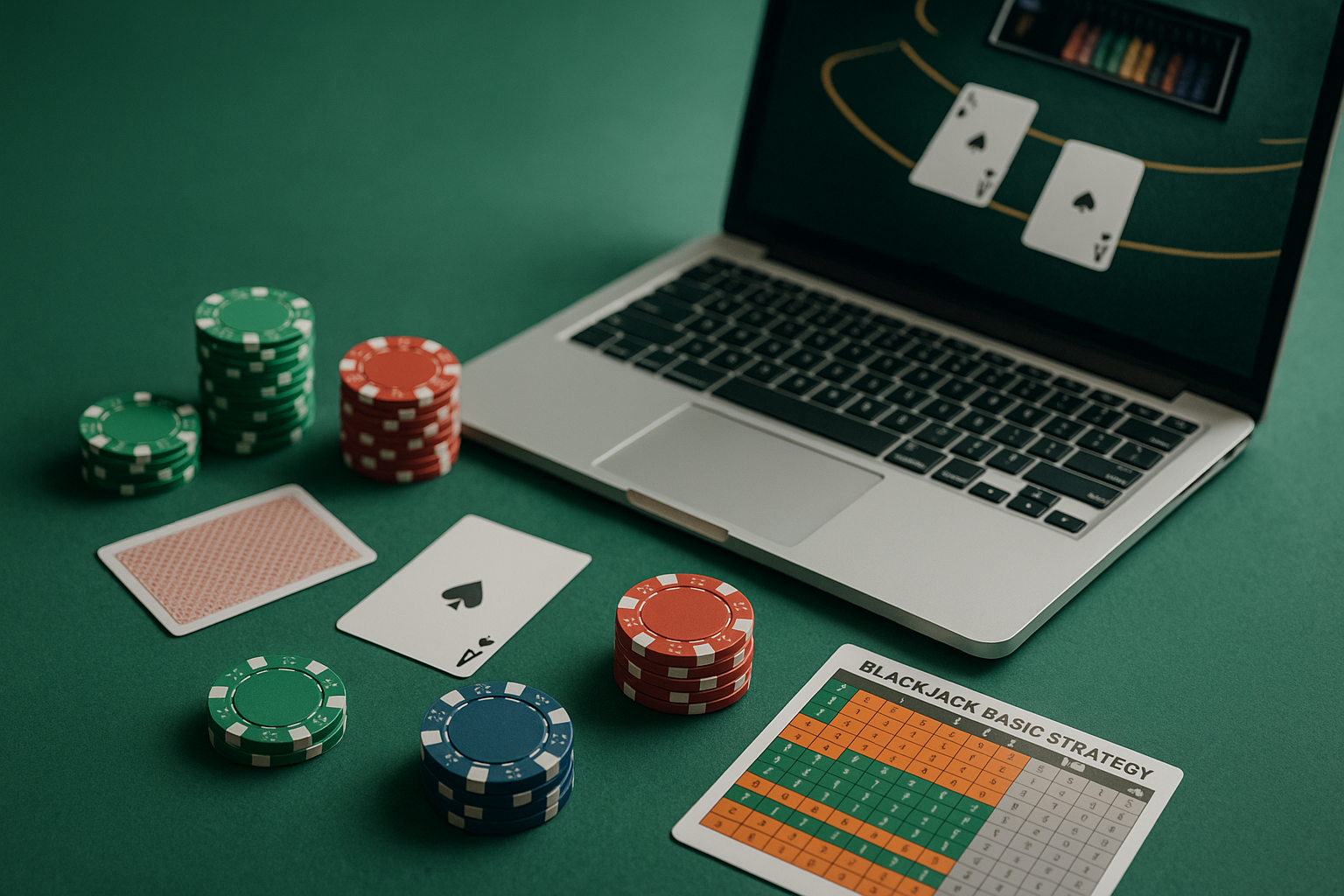
Think of it as a decision matrix: your hand on the left, dealer up‑card across the top, and a single instruction in each cell.
Follow it and you’re playing the EV‑maximizing move every time under the table’s rules.
How to read a basic strategy chart — step by step
Start with these quick checks before you follow the chart’s box.
- Identify your hand: hard, soft, or pair.
- Find the dealer up‑card: 2 through Ace across the top.
- Follow the cell: H for hit, S for stand, D for double (or Dh/Da when restricted), P for split, R for surrender.
For example, a hard 12 versus a dealer 4 shows “stand” because the dealer is likely to bust with a 4.
A soft 18 (A‑7) versus a dealer 9 will often show “hit” or “double if allowed.”
These nuances are exactly why you need the right chart for the table rules you’re playing.
Match the chart to the table rules (why that matters)
Small rule differences change the EV ranking of actions.
Number of decks, blackjack payout, and whether the dealer hits or stands on soft 17 all shift the math.
If you want to test different rule sets or see how much each rule swings the edge, use a blackjack house‑edge calculator.
It’ll show you composition‑dependent results and the difference between total‑based charts and perfect play.
Why the dealer stands on soft 17 matters for a 6-deck basic strategy
When the table rule is “dealer stands on soft 17” (S17), the dealer gives up a small amount of reach.
That changes a few recommended doubles and stands in multi‑deck strategy charts.
For the common six‑deck S17 game, using the correct 6-deck basic strategy is the way to reach the roughly 0.41% house edge level I mentioned earlier.
Use the wrong chart and you can give that advantage back—or worse.
Core “must-know” rules — memorize these first
Before you memorize a full chart, lock these table stakes into your head.
They’re short, high‑frequency plays that save the most EV when done right.
- Always split aces and eights. Splitting aces keeps you in the game with strong potential hands; splitting eights turns a losing 16 into two chances. These are non‑negotiable plays in every multi‑deck chart I trust. Source
- Never split tens or fives. Tens make a hard 20; fives make a hard 10—both are better played as single hands. This rule appears across single‑deck and multi‑deck guidance. Single‑deck note · multi‑deck note
- Stand on hard 17 or higher. It’s basic, but still worth saying. With 17+ you’re ahead enough that hitting risks too much busting. Source
- Stand on hard 12–16 versus dealer 2–6. Dealer bust probability is highest with 2–6, so you force the dealer to beat you. Source
- Hit hard 12–16 versus dealer 7–Ace. When the dealer’s up‑card is strong, you need to improve your total. Source
- Double hard 10 vs dealer 2–9; double 11 often. When you have a strong double opportunity (10 or 11), the math favors increasing your wager for one card in many spots. Precise exceptions depend on the dealer’s ace and the table rules. More on doubles
Splitting, surrender and insurance — the non‑intuitive parts
These three often confuse players because they feel optional or situational.
They’re not optional from an EV perspective.
Surrender is powerful but rule‑dependent.
In many multi‑deck charts you surrender hard 16 (but not 8‑8) against a dealer 9, 10, or Ace, and surrender hard 15 against a dealer 10 if surrender is allowed. Check the four‑deck example.
Insurance and “even money” are almost always wrong under basic strategy.
They’re a separate side bet with negative expectation unless you’re counting cards. Decline them at the table. Source
How to use the chart at the table — a short routine
Before you sit, read the table placard.
Confirm decks, payout (3:2 vs 6:5), and whether the dealer stands on soft 17.
- If it’s a six‑deck game and the dealer stands on soft 17, pull the 6-deck basic strategy chart or a close multi‑deck chart.
- Place your bet and play following the chart for every hand until decisions feel automatic.
If a table pays 6:5 for blackjack, walk away; that rule alone kills much of the benefit of perfect play.
Use the placard to spot that quickly.
Practice drills to make decisions automatic
Muscle memory beats hesitation at a noisy, crowded table.
Try these short drills—ten minutes a day for a week will move most decisions from conscious to automatic.
- Hard‑hand flash drill: Flash cards for hard totals 8–17 versus dealer 2–Ace. Call the play out loud and check against the chart.
- Pair split drill: Run through all pairs and the dealer’s up‑cards. Know the must‑split/must‑not list by heart.
- Soft‑hand drill: Practice A‑2 through A‑9 decisions; soft hands often flip between hit, stand, or double.
- One‑minute table simulation: Use a random card app or a shuffled deck; play 50 hands using only the chart and no money.
Over time, add a stopwatch.
The goal is to answer in under three seconds—fast enough that table pressure doesn’t make you panic.
Composition-dependent play and when a chart isn’t perfect
Most printed charts are “total‑dependent”: they look only at your total, not the exact composition of the cards.
Perfect play can be composition‑dependent and slightly adjust decisions based on which cards make up your total.
If you want to see the difference between total‑based charts and perfect composition play, the calculator will show you how much EV you lose or gain under various rules and compositions.
House edge examples and rule tradeoffs
Rule changes shift the edge more than you might think.
- Using correct basic strategy in a six‑deck S17 game brings the house edge to about 0.41%.
- A single‑deck game with certain concessions can have a house edge as low as about 0.18% under optimal circumstances.
- Switching blackjack payout from 3:2 to 6:5 dramatically worsens the player’s expectation; always check the payout on the placard.
Use a house‑edge tool if you’re comparison shopping.
The calculator runs thousands of rule combinations so you don’t have to guess.
Common mistakes players make with a basic strategy chart
Knowing what not to do is as useful as knowing the right play.
- Using the wrong chart for the table rules (wrong deck count or H17 vs S17).
- Making instinctive plays—like standing on a stiff hand because it “feels” right—rather than following the chart.
- Taking insurance or even money routinely.
- Overlooking surrender when it’s available and optimal.
Where to get charts and a note about PDFs
You’ll find printable charts and online strategy diagrams on reputable pages that explain the rule differences—many of which include downloadable images you can print as a basic strategy chart pdf for offline practice.
If you want a multi‑deck reference, the four‑deck strategy page and the single‑deck notes are good places to start and confirm specifics for the table you’re at.
One last practical table checklist
- Confirm decks and payout on the placard.
- Check dealer rule: H17 or S17.
- Confirm whether late surrender and doubling after split are allowed.
- Use the chart that matches those rules before you sit.
Do these checks and you’ll avoid common traps that hand back EV to the house.
Quick reference: must-split / must-not-split and surrender cheat-sheet
- Must split: A‑A, 8‑8.
- Never split: 10‑10, 5‑5.
- Surrender generally: Hard 16 vs 9–A and hard 15 vs 10 in many multi‑deck charts when surrender is allowed; check the exact rule set.
These are compressed rules; when in doubt, refer to the chart that matches the table’s rule set.
Practice, bankroll, and responsible play
Basic strategy reduces the house edge, it doesn’t eliminate variance.
Set a session bankroll, choose a unit size you can live with, and stop when you hit your loss limit or your win target.
If gambling is becoming hard to control, get confidential support—reach out to the National Council on Problem Gambling for resources and helplines in the United States.
Conclusion
Learning a blackjack basic strategy chart matched to a six‑deck game where the dealer stands on soft 17 is the most reliable way to cut the house edge to roughly 0.41%.
Memorize the high‑frequency rules first, practice short drills until decisions are automatic, and always match the chart to the table’s specific rules.
Do that and you’ll play smarter, hurt your bankroll less, and make the game more about skill than guesswork.
Frequently Asked Questions
What is a blackjack basic strategy chart and why should I use one?
A blackjack basic strategy chart lists the EV‑maximizing move for every player total versus every dealer up‑card under a given set of table rules. Use it to cut the house edge and make decisions that preserve your bankroll long term.
Where can I find a good basic strategy chart PDF?
Reputable strategy pages include printable charts you can save as a basic strategy chart pdf. Look for charts that match your table’s deck count and H17 vs S17 rule; multi‑deck pages often have downloadable diagrams for practice.
How much does the house edge drop using a 6-deck basic strategy when the dealer stands on soft 17?
Under common six‑deck S17 rules, correct basic strategy reduces the house edge to about 0.41%. That’s a meaningful improvement compared to playing without strategy.
Should I ever take insurance or even money?
No, not under standard basic strategy. Insurance and even money are negative‑expectation side bets unless you’re counting cards and have verified a rich ten‑card composition.
What are the fastest ways to memorize the chart?
Start with the high‑frequency rules: always split A‑A and 8‑8, never split 10s/5s, stand on hard 17+, double 10/11 in common spots, and stand on 12–16 vs dealer 2–6. Use flash drills, one‑minute simulations, and printable charts during practice.
How do rule variations like 3:2 vs 6:5 or H17 vs S17 affect the chart?
They can change optimal plays and the overall house edge. A 6:5 payout is substantially worse for the player, and H17 typically increases the house edge compared with S17. Use a house‑edge calculator to measure the exact impact for a specific rule set.
Can basic strategy make me a guaranteed winner?
No. Basic strategy maximizes expected value but does not eliminate variance or guarantee profit. It reduces the house edge and makes your losses smaller and wins more meaningful in the long run.
Is composition-dependent play worth learning?
Composition-dependent play gives a small EV edge over total‑based charts, but it’s more complex. If you want the final few tenths of a percent of EV and you practice, it’s worth exploring with advanced resources and calculators.
If the dealer stands on soft 17, do I still double on soft 18?
It depends on the dealer’s up‑card. In many six‑deck S17 charts, soft 18 (A‑7) is a stand against 2, 7, and 8, but double or hit against 3–6 and hit against 9‑A in some spots. Check the exact chart matched to the table rules.
Where can I get help if gambling is becoming a problem?
Contact the National Council on Problem Gambling or your local helpline for confidential support and treatment options.
More Pubs Casino guides
- Pubs Casino review 2026
- Pubs Casino bonus: 2,000 USDT + 100 free spins explained
- USDT casino guide: deposits, withdrawals and networks
- Pubs Casino games: slots, live casino, crash and sportsbook
- Is Pubs Casino legit? Licence, ownership and safety
18+. Gamble responsibly. Online gambling is not legal everywhere; check your local laws.