Live Roulette Variants French La Partage 98.65% RTP

Live Roulette Variants Compared: Which Live-Dealer Game Gives You the Best RTP? Estimated reading time: 6 minutes Key takeaways Wheel layout (European, American, French) is the main driver of RTP and house edge. Multiplier tables increase short-term variance but do not eliminate the underlying house advantage. Always check the on-table game info for RTP scope, La Partage status, payout caps, and min/max bets before playing. Live roulette variants: RTP and house edge compared Start with the simple fact: the wheel layout—how many pockets it has—drives the math. A single extra pocket changes the percentages in a way that matters over time. European (single-zero) roulette uses a 37-pocket wheel. That layout gives standard payouts a theoretical RTP of 97.30%, which equals a house edge of 2.70% on most bets. You can read that breakdown on a post about single-zero European wheel. American roulette tacks on a 00 pocket, making 38 pockets total. That one extra slot drops RTP to about 94.74% and raises the house edge to around 5.26%. The math is simple and punitive: double-zero costs you roughly twice the edge versus European. See the stats at American roulette FAQ. French roulette is the player-friendly option—when the La Partage rule applies. On even-money bets (red/black, odd/even, high/low), a zero result returns half your stake instead of taking it all. That cuts the effective house edge on those wagers to about 1.35%, giving an equivalent RTP of roughly 98.65% for those specific bets. Check an explanation at French roulette with La Partage. How multiplier tables affect live roulette variants These days, you’ll find a new breed of live tables plastered with lightning bolts and “x50–x500” banners. Lightning Roulette and Mega Roulette are the two big names in that camp. Evolution’s Lightning Roulette randomly selects between one and five numbers each round and attaches multipliers that, according to operator-side material, can range from 50x up to 500x. That makes the payoff on a lucky straight-up huge compared to the base payout. Pragmatic Play’s Mega/Roulette-style products do the same kind of thing—random multiplier hits on chosen numbers—with reported multipliers up to 500x. The exact rules and caps vary by operator, so always check the table info. A primer on multiplier-style games is available at Mega Roulette overview. Important clarity: multiplier features change short-term volatility, not the long-term house advantage of the underlying wheel. Published RTPs sometimes refer to the base game or a weighted combination of outcomes; always read the game info panel to confirm whether the published RTP includes the feature rounds. For a quick read on that distinction, see the comparison at live multiplier RTP notes. Classic live vs auto vs RNG: why the wheel matters more than the dealer “Live” just means a real dealer and a physical wheel streamed to you. An automatic wheel that spins electronically and an RNG-engineered spin use the same wheel layout math when the same number of pockets and payouts apply. The presence of a dealer doesn’t change the probabilities. The live element affects feel, speed, and the social experience, not the odds. That point is covered neatly in a lay explanation at how live differs from RNG roulette. Auto-roulette speeds up the rounds because a mechanical launcher replaces a dealer. If your objective is the number of spins per hour, auto tables increase that figure—which raises your exposure per hour—even though the math per spin remains tied to the wheel type. Read about the mechanics at auto-roulette mechanics. Numbers you should memorize (and why they matter) European roulette: 97.30% RTP / 2.70% house edge. American roulette: 94.74% RTP / 5.26% house edge. French roulette (La Partage on even-money bets): ~98.65% RTP on those bets / ~1.35% edge. These figures are not marketing fluff. They’re the long-run, theoretical expectation for those wheel types and rules. Over a single session you’ll see big deviation—courtesy of variance—but over many spins the math drags the average back toward these numbers. Practical strategy: when to choose which live roulette variant If you care about long-term loss rate, French roulette with La Partage on offer beats European, which in turn beats American. Still, context matters: If you want the lowest house edge on standard even-money bets, hunt for French with La Partage enabled. If you play many small-stakes spins for entertainment, single-zero European is usually the best mix of availability and decent RTP. If you crave a big one-off score and enjoy volatility, a multiplier table like Lightning or Mega can deliver huge paidoffs—but expect wild swings and remember that those multipliers don’t erase the underlying house edge. And a word about betting systems: no progression—Martingale, Fibonacci, or anything else—can beat the house edge in the long run. Systems shift variance around, but they don’t change the underlying probabilities tied to the wheel layout. How to interpret published RTPs on multiplier tables Casinos and providers publish RTP numbers with different scopes. Some list the RTP for the base roulette game (the wheel-only math) while others publish a combined RTP covering the whole product, including multipliers and side features. Two practical checks before you risk money: Open the game information panel and read whether the RTP applies to the base game or the full-featured game. Check any payout caps on multiplier wins—games sometimes cap super-high payouts even if a theoretical multiplier triggers. Operator panels and round rules are the official record. Don’t rely on an announcer’s line or a flashy lobby banner for the fine print. BetsRank and other game-comparison sites can help you find the published numbers, but the single-source truth is the on-screen game info for the table you’re on. Checklist: what to verify at the table Before you place the first bet, confirm each item below. It takes a minute and can save you surprises. Wheel type: Is it European, American, or French? RTP display: Does the on-table info show RTP, and does it cover the multiplier feature? La Partage rule: Is La Partage active on even-money bets (French tables only)? Min/max bets: Are the stakes
Online European Roulette 97.3% RTP with La Partage

Online European Roulette: Find Single‑Zero Tables (97.3% RTP) and Sites With La Partage to Halve the House Edge Estimated reading time: 6 minutes Key takeaways Online European roulette is the single‑zero format with a standard RTP of ~97.30% and a 2.70% house edge. Check table titles, wheel pockets (0–36), and the game rules to confirm single‑zero and any La Partage/En Prison rules. La Partage and En Prison halve the house edge on even‑money bets to about 1.35%. Decide between RNG for speed or live dealer for atmosphere, and always read bonus wagering terms closely. How to confirm it’s single-zero online European roulette There are three quick checks that separate a genuine single‑zero table from anything else. Look for “European” or “Single‑Zero” in the table title — operators usually label it plainly. Confirm the wheel has 37 pockets: 0 through 36. That’s the mechanical definition of single‑zero. Scan the payout table and win percentages in the game info to match the expected RTP and payouts. Most guides list online European roulette as the standard single‑zero format with the 97.30% RTP and 2.70% edge. See a plain summary at Legal Sports Report’s roulette overview. European roulette RTP, payouts, and what they mean “RTP 97.30%” means the game returns 97.30% of stakes in theory across the long run. For roulette that’s mostly bookkeeping: the casino’s payout schedule creates the house edge. Standard single‑zero payouts are the usual suspects: Straight up: 35:1 Split: 17:1 Street: 11:1 Corner: 8:1 Six‑line: 5:1 Dozens/Columns: 2:1 Red/Black, Odd/Even, High/Low: 1:1 Those payouts don’t fully compensate for the single zero; the math works out to the 2.70% house edge and the 97.30% RTP. For a payout table and more detail, this breakdown is a concise reference. Even‑money bets win on 18 of 37 pockets — about 48.6% of spins. For raw percentages and calculations, see the figures at Roulette.Casino. La Partage roulette and En Prison: how to cut the house edge in half If you play even‑money bets, La Partage and En Prison change the math — they reduce the casino’s take on those bets. La Partage: If the ball hits zero, you immediately get half your even‑money stake back. That cuts the effective house edge on those bets to about 1.35%. En Prison: Your even‑money stake is “jailed” and sits for the next spin; if the follow‑up spin wins you get your original stake back, if it loses it’s forfeit. Over time that also reduces the edge to roughly 1.35%. Casinos that offer La Partage or En Prison on online European roulette effectively halve the house edge on even bets compared with the standard 2.70% game. If a table advertises La Partage or En Prison, it’s worth a small premium in your choice of where to play. You can read more about those rules and their effect at EuropeBestCasinos’ roulette guide. Note: La Partage and En Prison often live under “French” or “French/European” table labels rather than every plain European table. Always check the game rules panel before you stake money. RNG vs Live: choosing your online European roulette format Online European roulette comes in two main flavors: RNG (software‑driven) and live‑dealer (real wheel streamed from a studio). They play the same basic rules, but the experience and some practical considerations differ. RNG tables give instant spins, flexible stakes, and multiple variants (auto‑play, fast spin, etc.). The RTP is set by the provider and listed in the info screen. Live dealer tables are slower, social, and use real wheels and croupiers. Providers like Evolution stream high‑quality video and offer immersive features. Which to pick? If you want speed and value‑focused staking, RNG is sensible. If you enjoy atmosphere — the callouts, the wheel hum, the human dealer — live is worth the tradeoff. Both formats are available from the major providers online. Providers and where to find the right table Not every operator hosts the same studios or RNG titles. Major suppliers to watch for are NetEnt, Evolution, Playtech, and Pragmatic Play. When comparing sites, look for: Provider names on the table lobby (the developer is usually shown). Clear rule panels that list pockets, RTP, and whether La Partage or En Prison apply. Stake limits that fit your bankroll: some live tables have much higher minimums than their RNG cousins. Aggregated lists and provider overviews help check who supplies which table. For a simple roll call of providers and titles see the provider roundup at EuropeBestCasinos’ table games. A broader game list is available at SlottyHouse’s roulette pages. Bonuses, wagering rules, and a pre‑spin checklist A great RTP doesn’t automatically give you more value if the casino’s bonus terms hamstring roulette play. Casinos often treat roulette as a low‑value game for bonus rollover purposes. That means the operator will either: Count roulette at a reduced percentage against wagering requirements (for example, only 10% of a roulette wager might contribute). Exclude roulette entirely from certain promotions. Impose maximum bet caps while a bonus is active. A concrete example: one operator’s promotion reportedly had a 15x wagering requirement while counting only $0.10 of every $1 roulette wager toward the total. That specific case is detailed in a DraftKings wagering example, a good warning about reading the fine print. Common reported wagering ranges for roulette bonuses sit between 35x and 70x the bonus amount. If vaulting a slightly higher RTP into a bonus, do the math: a 97.30% RTP table won’t overcome punitive wagering rules. Before you deposit, scan these terms: Eligible‑game percentage (what portion of your bet counts) Maximum bet while the bonus is active Excluded bets or bet types Expiry window and withdrawal limits Minimum deposit to claim the offer If any of that looks ugly, fold the bonus and play for real money with clean rules instead. For guidance on how roulette fits into bonus terms more generally, see theplaybookUSA’s comparison. Practical checklist before you spin Short, sharp, and useful — print this checklist into your brain before depositing or clicking Spin: Confirm “single‑zero” or “European” in
Blackjack Strategy Card H17 vs S17 and 3-2 Payouts
Blackjack Strategy Card: Pick the Right Chart for H17 vs S17 and 3:2 Tables to Cut the House Edge to ~0.5% Estimated reading time: 6 minutes Key takeaways Always match your basic strategy card to the table rules (H17 vs S17, deck count, and payout). Prioritize 3:2 payout tables; 6:5 payouts significantly increase the house edge. Small rule changes (H17, no surrender, limited doubling) shift the house edge by measurable tenths of a percent. Use the card to learn common lines, but confirm rules before the first hand and adjust the chart as needed. Introduction If you walk into a casino thinking “I’ll wing it,” you’re leaving cold, measurable value on the table. A blackjack strategy card is a small, inexpensive tool that tells you the mathematically optimal decision — hit, stand, double, split or surrender — for every player hand versus the dealer’s upcard. Think of it like a road map that trims the casino’s edge to the smallest possible margin. For a favorable, standard ruleset a correct chart can push the house edge down to around about 0.5%. Which blackjack strategy card for H17 vs S17? One of the most common rule splits you’ll see is whether the dealer hits soft 17 (H17) or stands on soft 17 (S17). That S17/H17 distinction is one of the simple, real-world rule changes that affects the recommended plays on soft hands and, ultimately, the house edge. In plain terms: H17 (dealer hits soft 17) usually increases the house edge by about about 0.2% versus the same game where the dealer stands on soft 17. It might not sound like much, but it’s a meaningful shift when your whole goal is to minimize loss over time. So what do you do? Use a blackjack strategy card explicitly labeled for H17 or S17. Charts for H17 change recommendations on soft totals — the ace-plus-number hands — where the dealer’s ability to hit again changes the odds on doubling and standing. If a casino’s posted rules say “Dealer hits soft 17,” grab the H17 chart and follow the soft-hand rows rather than a generic one-size-fits-all card. Match your blackjack strategy card to 3:2 vs 6:5 tables Blackjack payout rules are non-negotiable and they bite harder than most players realize. A table that pays 3:2 for a natural blackjack is vastly friendlier to the player than a 6:5 payout table. Always check the payout before you sit. If you play at 3:2 tables and use the correct chart, you’re playing the game the way it was mathematically modeled. Basic strategy assumptions and expected edge numbers (like the ~0.5% figure) are based on traditional blackjack payouts. Switch to 6:5 and the math behind many plays changes — the house takes a bigger cut and the correct chart for a 3:2 game won’t be as close to optimal. When you spot a 6:5 sign, weigh the trade-off: shorter betting limits or convenience might be tempting, but the payout change materially affects your expected loss per hour. If you’re serious about minimizing the house edge, prioritize 3:2 games. How rule changes shift the house edge — quantify the damage Let’s quantify the bits you can control with your chart choice and the bits you can’t. Correct basic strategy on a favorable, standard ruleset: ~0.5% house edge. Dealer hitting soft 17 instead of standing: ≈ 0.2 percentage points increase in the house edge. Rule changes like no-surrender, limited doubling, or 6:5 payout: each shifts the edge by measurable tenths of a percent — cumulatively they can turn a near-break-even strategy into a sizeable disadvantage. Those “tenths” language matters. If misplaying a hand or using the wrong chart costs you only 0.1–0.3% more per bet, that’s still hundreds of dollars over long sessions. The right chart minimizes variance and reduces the inevitable drag of the house edge. How to use a blackjack strategy card at the table Using a basic strategy card is straightforward, and you don’t need to be a math prodigy. Follow this checklist every time you sit down: Identify whether your hand is hard, soft, or a pair. Locate that section on the chart — hard hands, soft hands, or pairs. Find the dealer’s upcard across the top and read the recommended action. Double-check the chart matches table rules: deck count, S17/H17, blackjack payout, double/surrender options. Execute the play and repeat. That five-step loop — identify, find, read, check, play — is the practical routine. It keeps you from guessing and from being tempted into “clever” deviations that widen the house edge instead of narrowing it. Choosing charts for deck count, doubling and surrender Not all basic strategy cards are created equal. The ideal card recognizes these table-specific rule details: Number of decks (single, double, multi-deck) Dealer hits or stands on soft 17 (H17 vs S17) Blackjack payout (3:2 vs 6:5) Double-down restrictions (which totals you may double) Surrender availability (early or late surrender) Resplitting and doubling-after-split rules Why care about deck count? Because the mathematical probabilities for some hand matchups shift slightly between single-deck and shoe games. The correct card for a six-deck shoe may differ by a few recommended plays from a single-deck card. The differences are often in edge fractions, but when your goal is to cut the house advantage to roughly half a percent, these fractions matter. If you want quick reliable guidance on which chart fits which ruleset, look for charts explicitly advertised as matching the casino conditions. A chart that’s matched to rules will state whether it’s for single-deck, multi-deck, H17 or S17, and whether surrender is included. Common mistakes with basic strategy cards — and how they cost you Here’s the bartender-style truth: the biggest losses usually come from predictable mistakes, not from bad variance. Using the wrong card. If you’re on an H17 table but using an S17 chart, you’re effectively giving the house a head start. Ignoring payout changes. Playing 6:5 with a 3:2 chart is like using the wrong fuel in a car — it still
Baccarat house edge Banker 1.06% vs Player 1.24% today

Baccarat house edge: Banker 1.06% vs Player 1.24% — how to read a table’s RTP and avoid the 14.36% tie trap Estimated reading time: 8 min read Key takeaways Banker is the best main bet (≈1.06%) but check the commission and table rules first. Player is slightly worse (≈1.24%); Tie (8:1) is a high‑edge trap (~14.36%). Always read the paytable for commission, deck count, tie payout and side‑bet RTPs. Baccarat house edge: the core numbers and what they mean Standard punto banco baccarat keeps the math straightforward. Face cards and 10s count as zero, aces are one, the rest are face value. Only the final digit of the hand’s total matters — 8 and 9 are the best hands. The drawing rules are fixed and automatic, so you aren’t making hit‑or‑stand choices like in blackjack (baccarat rules and mechanics). That structure produces three main bets with very different expectations: Banker — Pays even money minus a commission (typically 5%). House edge ≈ 1.06%, which is about a 98.94% RTP (Banker bet house edge). Player — Pays even money with no commission. House edge ≈ 1.24%, or about a 98.76% RTP (Player and Banker comparisons). Tie — Often pays 8‑to‑1 online and in many casinos. House edge soars to ≈ 14.36%, roughly an 85.64% RTP — the most expensive wager on the table (tie bet odds explained). Short version: if you want the best theoretical return on the main wagers, Banker wins. But the commission and other rules can nudge those numbers. Know the table’s exact paytable before you bet. How table rules move the baccarat house edge There isn’t a single “baccarat house edge” for every table. Small rule changes shift the math in meaningful ways. Commission rate: Most live tables take 5% on Banker wins. Cut that commission, and Banker’s advantage improves. Some variants advertise “no-commission” Banker, but watch the fine print — many offset with altered payoffs that change the effective edge. Number of decks: The game can run from 6 to 8 decks online and in casinos. Deck count changes the odds slightly; the house edge moves in small increments, so it’s worth checking the table spec (deck and commission effects). Tie payout: That 8‑to‑1 tie payout is the usual online figure, and it creates a huge house edge. Some venues pay 9‑to‑1, 10‑to‑1, or offer “super tie” promotions — those alter the tie bet’s house edge substantially. Side bets and special features: Pair bets, fortune piles, or dragon bonuses almost always carry much worse edges than the main bets. Treat them like slots — fun, but expensive (side-bet house edges). When a casino advertises a single RTP number — say “99% baccarat RTP” — read the small print. That figure often applies to one wager (usually Banker) rather than the table as a whole (advertised RTP caveats). How to read a baccarat paytable like a pro Don’t be fooled by glossy lobby pages. Here’s how to parse a paytable so you can compare tables properly. Look for the Banker commission line. If it’s 5%, expect ~1.06% house edge on Banker; if it’s different, run the numbers or avoid assumptions. Find the tie payout. If it’s 8:1, that’s the ~14.36% trap. Higher payouts can be friendlier, lower are worse. Check the number of decks. The table spec should list this; 6 or 8 decks are common online. Check whether the advertised RTP applies to Banker, Player, Tie, or an overall blended figure. Spot side bets and their payouts. Anything paying 11‑to‑1 for a pair with a double‑digit house edge is a sucker bet unless you’re playing for novelty. Example: an online “NetEnt Baccarat Professional” listing is typically around 98.94% RTP for the Banker bet — that’s not an overall table figure, it’s specifically the Banker wager’s return (NetEnt Baccarat RTP example). Choose the table: format, provider and volatility Format matters. Live‑dealer baccarat feels different from RNG baccarat. Squeeze tables slow the deal and highlight the drama of revealing cards. Speed variations compress rounds. Game provider and volatility can be surprisingly relevant. Some titles show a published volatility score and a single‑wager RTP like Origami baccarat, which lists a 99.00% RTP and “medium” volatility on one platform — but that number might represent only one bet’s return (Origami baccarat listing). When you compare tables, match these things: Live vs RNG vs squeeze Provider and exact game title Published volatility or variance rating Min/max bet limits Why it matters: a low‑variance Banker bet over a long session behaves very differently from chasing side bets on the same table. If you care about bankroll longevity, those differences are practical, not theoretical. Side bets and the tie — the money leaks you can avoid Side bets and tie bets are where casinos build their profits. The main bets are low‑edge — the extras are not. Example: common Player Pair/Banker Pair side bets often pay 11‑to‑1, but analyses put their house edge near 10.36%. That is roughly ten times worse than a Player or Banker main bet (pair and side‑bet analysis). And the tie — it sounds glamorous: a big payoff for a rare result. But the math is brutal. With an 8‑to‑1 payout the house edge computes to about 14.36%. That’s closer to a slot machine’s return than a table game’s. Rule of thumb: if your goal is minimizing expected loss, stick to Banker (with transparent commission) or Player. Treat tie and side bets as entertainment rather than strategy. Practical examples and bankroll perspective Let’s ground this with numbers. Suppose you bet $10 per hand for 1,000 hands (that’s $10,000 wagered overall). Betting Banker with a 1.06% edge gives an expected loss ≈ $106 over that run. Betting Player with a 1.24% edge gives an expected loss ≈ $124. Betting Tie at 14.36% gives an expected loss ≈ $1,436 — on average, a far worse grind. That doesn’t mean you’ll experience those exact losses in 1,000 hands — variance still matters — but the expected value over many replications is
Odds of Winning the Lottery Powerball 1 in 292,201,338

Odds of Winning the Lottery: Powerball is 1‑in‑292,201,338 and Here’s What That Really Means Estimated reading time: 6 min read Key takeaways Powerball jackpot odds are 1 in 292,201,338 per single play; Mega Millions is about 1 in 290,472,336. Buying more tickets increases your chance linearly but remains extremely small unless you buy huge numbers of tickets. The advertised jackpot is usually an annuity; the cash option is materially smaller and jackpots can be split among winners. What the odds of winning the lottery actually are Let’s lay out the headline figures so there’s no confusion. Powerball jackpot odds: 1 in 292,201,338. Mega Millions jackpot odds: 1 in 290,472,336. Powerball — match five white balls (no Powerball): 1 in 11,688,053. Mega Millions — chance of winning any prize: about 1 in 23.07. Those first two lines are the ones that matter if you’re thinking “jackpot.” The others show why smaller prizes are actually where most wins happen. That 1 in 23 for any Mega Millions prize includes $2, $10, and mid-tier hits — not the billion-dollar checks. How buying more tickets changes the odds (and why it barely helps) Buying extra tickets does increase your probability, but the improvement is linear and tiny compared to the size of the pool. Example: if you buy 10 unique Powerball tickets, your chance of that draw producing the jackpot on one of your tickets is roughly 10 in 292,201,338 — or about 1 in 29.2 million. Better than one ticket, yes. Still astronomically unlikely. Think in plain terms: each ticket is one draw out of ~292 million possible combinations. Ten tickets are ten tries. Ten divided by 292 million is still a very small number. That’s why syndicates that buy thousands of tickets are tempting in theory but massive in cost and logistical hassle in practice. Independence of draws — why “due” numbers are a myth Lotteries are memoryless. A losing streak yesterday does not increase your odds today. Each Powerball or Mega Millions drawing is independent; the machine has no scorecard tracking “overdue” sets. Quick-pick numbers and player-selected numbers have identical mathematical chances as long as the combination is a valid entry. The only difference is human behavior: popular birthdays or sequences make it likelier you’ll share a prize if that combo hits. So picking less-common numbers won’t improve your chance to hit the jackpot, but it can reduce the chance you share it with others if you do win. Jackpot advertised vs. cash option — and the reality of split wins When you see a jaw-dropping advertised jackpot on the board, that figure is usually the annuity total — not the lump-sum cash in your hand. The advertised number assumes an annuity paid over decades. The immediate cash payout is materially smaller. Recent jackpot listings show this difference in action. See the Powerball reporting and the jackpot listings for examples of advertised totals versus likely cash options. Another practical detail: if more than one ticket hits the exact winning combination, the jackpot is split equally. That means a “shared” jackpot can significantly reduce what each winner actually gets — and with popular number patterns or large rollovers, splitting is a real possibility. Understanding smaller prizes: the real odds that people often miss People fixate on the jackpot, but most winners walk away with modest checks. Mega Millions’ overall prize odds — about 1 in 23.07 — include everything from matching just the Mega ball for a free play up to multi-million-dollar secondary prizes. Powerball’s second-tier prize for matching all five white balls (but missing the Powerball) is about 1 in 11,688,053. That’s still long odds, but drastically better than the jackpot line. If you play mainly for the entertainment of small wins (free ticket, $4, $10, $100), those overall odds are what you should focus on, not the astronomical jackpot probability. Practical takeaways: what to do (and not do) with these odds Here’s the part most people skip: how to translate the numbers into actual behavior at the counter. Decide a fixed entertainment budget. Treat a lottery ticket like a movie ticket: you pay to enjoy the possibility, not to guarantee returns. Buying extra tickets is increasing your entertainment stake, not turning the math in your favor. Ten tickets for Powerball moves you to roughly 1 in 29.2 million — still not a plan to retire on. Quick picks are fine. Self-picks are fine. The draw doesn’t care. What matters is not chasing losses or increasing spending because the jackpot rolled over. Remember the annuity-versus-cash difference before you imagine walking away with the big advertised number. The difference can be tens or hundreds of millions on the largest jackpots. Responsible-gambling standards recommend clear information about odds and limits. If you need guidance on limits or game rules, check resources like government responsible gambling standards. How journalists and statisticians communicate these chances Reporters and lotteries usually give both the precise odds for a single play and context for smaller prizes. That’s good practice because a single-play jackpot probability (1 in ~292 million) sounds abstract until you see equivalent comparisons. For example, the chance of winning any Mega Millions prize at ~1 in 23 is more tangible: you’ll hit something roughly once every two dozen plays on average. But the distribution of prizes is heavily skewed toward very small amounts. Numbers matter: the exact odds above come from official game data and reporting, not hearsay. When you read about a 1-in-292-million chance, you can trust that figure as the single-play probability for Powerball. Scaling the math: what “covering the field” would require People sometimes ask: what if I bought every combination? Mathematically, buying every unique combination would guarantee a win for that draw. Practically, this is essentially impossible: it requires purchasing hundreds of millions of unique tickets, plus dealing with the chance of splitting the jackpot and the huge cash outlay. That’s why syndicate stunts in headlines usually involve enormous sums and complex logistics. They make for interesting stories, but they’re not
Crazy Time RTP 1 Bet at 96.08% Is Best Long-Run Play

Crazy Time RTP: Why the “1” Bet (96.08%) Is the Best Long‑Run Play — When to Chase the 20,000x Bonus Estimated reading time: 7 minutes Key takeaways The “1” bet has the highest published RTP at 96.08%, making it the best expected-value play for long sessions. Bonus wagers (including Crazy Time) have lower RTP (around 94.41%) but offer the chance at massive multipliers such as the advertised 20,000x. Use a bankroll split: keep most funds on the “1” for longevity and a small separate bonus fund (5–15%) for controlled chasing of big multipliers. Crazy Time RTP: the raw numbers Evolution’s official information lists the overall theoretical RTP as 94.41%–96.08%, depending on which wager you back. You can read the official breakdown on Evolution’s how to play page. Put plainly: Highest listed RTP: the “1” bet at 96.08% (best expected return). Lowest listed RTP: the Crazy Time bonus wager at 94.41% (largest variance). Third‑party breakdowns give more granular RTPs for specific bonus rounds and number bets — for example, Pachinko ~94.33%, Coin Flip ~95.70%, Cash Hunt ~95.27%, and number wagers 2/5/10 clustered around the mid‑95% range. See a third-party breakdown for those figures. RTP is a long-run theoretical average, not a guarantee for a session. But it does tell you the expected cost of play. If you bet $100 repeatedly on the “1” bet in the long run, the math says you’ll keep about $96.08 of that $100 on average — an expected loss of about $3.92 per $100. Bet the Crazy Time bonus instead and that expected loss increases to about $5.59 per $100. Why the “1” bet (96.08%) wins on paper There are two simple reasons the “1” is the mathematically best play: frequency and payout symmetry. Number bets pay that number times your wager when the wheel lands on it. The “1” appears more often in the wheel’s math and pays only 1x, so its payout frequency keeps the theoretical return higher. That’s backed by Evolution’s published RTPs on the same game information page. The math isn’t glamorous — it’s just expected value. Higher RTP equals lower expected loss per spin. Here are practical loss figures so you can feel them in your wallet: “1” bet at 96.08% → expected loss ~$3.92 per $100. Crazy Time bonus at 94.41% → expected loss ~$5.59 per $100. If your goal is to stretch a bankroll and minimize theoretical loss, the “1” bet is the place to be. If your goal is spectacle and the off-chance of a life‑changing multiplier? Bonuses are an understandable choice — just know what you’re trading away in expectation. Crazy Time bonus frequency and the 20,000x temptation Evolution says players face roughly a 1-in-6 chance of a bonus round on each spin. That figure comes straight from Evolution’s literature and is a useful rule of thumb when planning how often you’ll see the features you want (1-in-6 chance). Crazy Time runs four bonus rounds — Coin Flip, Cash Hunt, Pachinko, and the eponymous Crazy Time — and a Top Slot that can attach random multipliers to a number or bonus before the spin. That Top Slot can swing a session: it’s where you sometimes see very large combined multipliers. Evolution lists the Crazy Time bonus maximum as 20,000x your stake in its official materials. That’s the advertised top‑end multiple on the game’s how‑to‑play page. Note that some third‑party pages list a 25,000x cap for particular operator configurations, so check the operator’s game wrapper if the absolute maximum matters to you (25,000x maximum). That explains the psychology: the bonus wager’s lower RTP is the cost of a tiny shot at a huge multiple. That tiny shot is exactly what draws players — but it’s also what makes those wagers poor value for sustained bankroll growth. Crazy Time bets: what each wager really does to your math Let’s put the bets side by side so you can see the trade-offs without the noise. Number bets (1, 2, 5, 10) — These are the “base” wagers. Evolution’s numbers place them in the high‑95% RTP neighborhood, with the “1” at the top at 96.08% and 2/5/10 slightly lower. A concise third-party breakdown lists those mid‑95s values. Coin Flip — Two outcomes, a multiplier applied; mid‑95% RTP territory but slightly lower than the best number wagers. Cash Hunt — Choose among targets; offers a wide multiplier spread but lower RTP than the top number bet. Pachinko — A puck drops, with possible “Double” hits that can cascade; slightly lower RTP again. Crazy Time bonus — Lowest RTP at ~94.41% but the possibility of the largest single‑spin win, up to the advertised 20,000x maximum or higher on some listings. Numbers matter: lower RTP equals higher expected loss. That’s the immutable arithmetic behind the showy multipliers. Practical staking plan: how to allocate between “1” and the bonuses There’s no one true strategy, but if you want to maximize longevity while still getting the thrill, here’s a clear, number‑driven approach. Two rules I like at the table: Keep most of your bankroll on the “1” bet to preserve expected value. Treat bonus wagers as a separate “entertainment” fund sized to the amount you can comfortably lose. Concrete example: say you have a $500 session bankroll. Base allocation: put 80% ($400) to use as your long‑play pool and bet mostly on “1” — for instance $1 per spin on “1” gives you 400 theoretical spins of base play (ignoring wins and losses). Bonus allocation: earmark 10% ($50) as your “bonus fund.” With a bonus bet size of $1 or $2, that translates to 25–50 attempts at bonus rounds. Statistically you’ll hit a bonus about once every six spins when you bet on a bonus segment, but since you’re not staking the bonus every spin, that fund buys you intentional, controlled exposure. Reserve 10% ($50) for flexibility, stop-loss, or to exit gracefully. This plan does two things: it keeps your long-run expected return nearer the 96.08% of the “1” bet while letting you chase big
Online Casino Bonus Ohne Einzahlung 50 Freispiele Interwetten

Online Casino Bonus ohne Einzahlung: 50 Freispiele bei Interwetten (3× Umsatz, 14 Tage) — so prüfen Sie Bedingungen und Auszahlungsmöglichkeiten Estimated reading time: 6 minutes Key takeaways Interwetten bietet 50 Freispiele mit 3× Umsatz und 14 Tagen Gültigkeit — Gewinne werden als Bonusguthaben geführt. Wichtig sind Umsatzfaktor, Maximalgewinn, Frist und Verifizierungsanforderungen bei Auszahlungen. Lesen Sie die Bonus‑AGB, dokumentieren Sie Belege und nutzen Sie Limits und Hilfsangebote bei Bedarf. Was ist ein online casino bonus ohne einzahlung genau? Kurz: Sie erhalten Bonusspiele oder Bonusguthaben, ohne selbst Geld einzuzahlen. Die häufigste Form in Deutschland sind freispiele ohne einzahlung — also eine bestimmte Anzahl Drehungen an vorgegebenen Slots. Wichtig ist, dass „ohne Einzahlung“ meist nur für die Bonisausgabe gilt. Auszahlung der daraus resultierenden Gewinne hängt an Bedingungen wie Umsatzvorgaben, Verifizierung und Maximalgewinn. Interwetten Spotlight: 50 Freispiele, 3× Umsatz, 14 Tage Das Angebot: 50 Freispiele nach Registrierung, drei Mal umsetzter Bonus und eine Frist von 14 Tagen. Gewinne aus den Freispielen werden als Bonusguthaben geführt. Bevor Sie auszahlen, muss dieser Bonusbetrag dreimal umgesetzt werden — typischerweise auf erlaubten Slots. Die Quelle listet ausdrücklich „50 Freispiele – 3× Umsatz – 14 Tage“ für Interwetten. Interwetten Bonusübersicht. Wie Sie den Bonus einlösen: Registrieren Sie ein neues Konto beim Anbieter. Gegebenenfalls Verifizierungs-Dokumente hochladen (siehe Checkliste weiter unten). Freispiele werden automatisch gutgeschrieben oder nach Abschluss einer kurzen Aufgabe aktiviert. Gewinne erscheinen als Bonusguthaben und unterliegen dem 3×-Umsatz innerhalb von 14 Tagen. Hinweis zur Compliance: 18+, T&Cs apply, gamble responsibly. Schnelle Prüf-Checkliste: Lohnt sich der Bonus? Bevor Sie losklicken: prüfen Sie diese Punkte systematisch. Kleine Details entscheiden, ob ein Angebot wirklich wertvoll ist. Umsatzbedingungen: 3× bedeutet: Bonusbetrag (oder nach Casino-Definition) muss dreimal gesetzt werden. Maximalgewinn: Viele No-Deposit-Freispiele begrenzen, wie viel Sie maximal auszahlen dürfen. Fristen: Bei Interwetten sind es 14 Tage. Andere Boni verfallen oft schneller (24–72 Stunden). Typische Gültigkeit wird so beschrieben. Spielauswahl: Freispiele gelten meist nur für bestimmte Slots; andere Spiele zählen nicht oder nur anteilig. Verifizierung: Manche Anbieter zahlen erst nach Identitätsprüfung aus — das kann Zeit kosten. Eine Übersicht nennt, dass Freispiele teilweise erst nach Verifizierung gewährt werden. Verifizierungshinweis Lizenz & Recht: Prüfen Sie, ob der Anbieter eine Erlaubnis der Gemeinsamen Glücksspielbehörde der Länder (GGL) hat. Einsatzlimits: Manche Boni setzen eine maximale Einsatzhöhe während der Erfüllung der Umsatzbedingungen. Umsatzbedingungen entwirren: Rechenbeispiele für Interwetten Ein nüchternes Beispiel hilft: Angenommen, Ihre Freispiele ergeben 10 € Bonusguthaben. Mit einem 3×-Umsatz heißt das: 10 € × 3 = 30 € Mindesteinsatz, bevor Sie auszahlen können. Wie schnell das geht, hängt vom Einsatzniveau und erlaubten Spielen ab. Wenn nur Slots zählen, sind Slots Ihr bester Verbündeter; Tischspiele können ausgeschlossen oder nur anteilig zählen. Auszahlung: Wo die meisten Spieler stolpern Zwei Stolperfallen sehen wir immer wieder: Verifizierung: Ohne Identitätsnachweis gibt es oft keine Auszahlung — auch wenn Sie die Umsatzbedingungen erfüllt haben. Maximalgewinn & Einsatzlimit: Wenn der Anbieter einen Auszahlungslimit von beispielsweise 100 € aus Freispielgewinnen setzt, dann nützt ein 10.000‑€ Treffer nichts. Die Regel: lesen Sie die Auszahlungs-Klausel. Suchen Sie Sätze wie „Maximalgewinn aus Freispielen“ oder „Einsatzlimit während Umsatz“ — merken Sie sich die Zahlen. Marktüberblick Deutschland: Wer bietet aktuell No‑Deposit‑Boni? Kurz zusammengefasst nennen aktuelle Übersichten neben Interwetten auch Löwen Play, StarGames, SlotMagie und Jokerstar. Die Art der Boni variiert: Manche sind 50 Freispiele bei Registrierung, andere sind Geburtstagsboni oder Freispiele nach Verifizierung. Zum Beispiel führt eine Übersicht Löwen Play mit einem Geburtstagsbonus, der einen 35× Umsatz verlangt und ebenfalls 14 Tage gültig ist — ein anderes Profil als die Interwetten-Offerte. Löwen Play Beispiel Eine andere Liste fasst deutsche Spielotheken-Angebote zusammen und hebt hervor, dass Freispiele manchmal erst nach Identitätsprüfung gutgeschrieben werden. Übersicht deutscher Anbieter Checklist: So prüfen Sie ein Angebot in 90 Sekunden Öffnen Sie die Bonus‑AGB und suchen Sie nach „Umsatz“, „Maximalgewinn“, „Gültig bis“ und „Verifizierbar“. Notieren Sie Umsatzfaktor, Frist in Tagen und maximal mögliche Auszahlung. Prüfen Sie die Spielauswahl (welche Slots sind erlaubt?). Überprüfen Sie Lizenzhinweis (GGL) im Fußbereich der Seite. Wenn Unklarheiten bleiben: Screenshot machen und Support fragen — Antworten per Chat sind später ein Beleg. Wie Pubs‑Casino die Information aufbereitet Auf Pubs‑Casino betrachten wir solche Angebote als Spotlight: wir nennen Anbieter und die genauen Zahlen (z. B. 50 Freispiele, 3×, 14 Tage). Das Ziel ist nicht, blind zu locken, sondern Ihnen alle Zahlen auf den Tisch zu legen — damit Sie entscheiden können, ob sich die Aktion für Ihre Spielweise lohnt. Vorsicht bei „Gratis“-Versprechen: typische Klauseln In den AGB stehen oft Formulierungen, die Sie kennen sollten. „Bonuseinsätze sind limitiert“ — Sie dürfen nicht mehr als x € pro Spin einsetzen, sonst wird der Bonus ungültig. „Nur bestimmte Spiele zählen“ — Klassiker sind Book‑of‑Ra‑Kopien oder Megaways‑Slots. „Maximalgewinn aus Freispielen“ — häufig zwischen 50 und 200 €, Werte variieren stark. Deshalb: prüfen Sie die Zahlen, nicht nur die Headline „50 Freispiele“. Responsible play: Hilfen und Kontaktmöglichkeiten Auch bei kleinen Boni ist es sinnvoll, Grenzen zu setzen. Die staatliche Glücksspielaufsicht empfiehlt das Programm „Check dein Spiel“ mit Selbsttest und Online‑Hilfen. Check dein Spiel Es gibt eine kostenfreie Telefonberatung unter 0800 137 27 00 (Mo–Do 10–22 Uhr, Fr–So 10–18 Uhr). Limits, Reality Checks und Selbstausschluss sind Tools, die seriöse Anbieter zur Verfügung stellen sollten — nutzen Sie sie. Praxis-Tipps: Wie Sie das Maximum aus 50 Freispielen holen Ein paar nüchterne, praxistaugliche Tricks: Spielen Sie nur die erlaubten Slots und prüfen Sie die Volatilität. Setzen Sie konservativ: hohe Einsätze verkürzen die Spielzeit trotz schnellerer Umsatzerfüllung. Dokumentieren Sie Spielstände: Screenshots vom Anfangsbonus und vom Erfüllen des Umsatzes helfen bei Streit. Häufige Fallen und wie man sie vermeidet Die meisten Ärgernisse entstehen durch: Missverständnisse bei der Bonusdefinition, fehlende Verifikation und Zeitüberschreitung der Frist. Vermeidung ist einfach: lesen, screenshotten, verifizieren, und rechtzeitig spielen. Wenn der Support zickt Falls der Live‑Chat widersprüchliche Angaben macht, fordern Sie eine schriftliche Antwort per E‑Mail und speichern Sie sie. Das schafft Klarheit und ist nützlich bei offiziellen Beschwerden. Wechselspiel mit Lizenz und Legalität In Deutschland ist die GGL‑Lizenz das wichtigste Kriterium für seriöse Anbieter. Eine Lizenz der Gemeinsamen Glücksspielbehörde der Länder bedeutet, dass der Anbieter strenge Regeln befolgen muss. Wenn ein Anbieter kein GGL‑Lizenzlogo zeigt, sollten Sie
Blackjack basic strategy chart lowers six-deck S17 to 0.41%
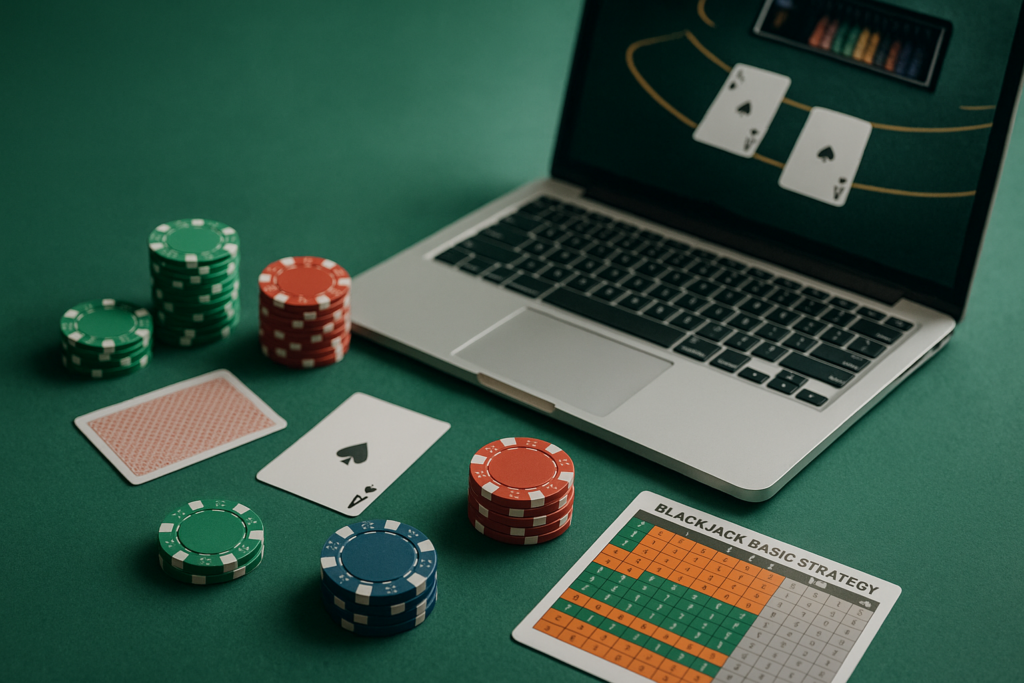
How to Use a Blackjack Basic Strategy Chart to Cut the House Edge to ~0.41% (Six‑Deck S17 Guide) Estimated reading time: 6 minutes Key takeaways Use the correct six‑deck S17 basic strategy chart to reduce the house edge to roughly 0.41%. Memorize high‑frequency plays (split A‑A and 8‑8, never split 10s/5s, stand on 17+) before the full chart. Always match the chart to table rules (decks, 3:2 vs 6:5, H17 vs S17) to avoid giving up EV. What a blackjack basic strategy chart actually tells you A chart converts expected‑value math into five clear decisions: hit, stand, double, split, or surrender. It does that for every player hand against every dealer up‑card. Think of it as a decision matrix: your hand on the left, dealer up‑card across the top, and a single instruction in each cell. Follow it and you’re playing the EV‑maximizing move every time under the table’s rules. How to read a basic strategy chart — step by step Start with these quick checks before you follow the chart’s box. Identify your hand: hard, soft, or pair. Find the dealer up‑card: 2 through Ace across the top. Follow the cell: H for hit, S for stand, D for double (or Dh/Da when restricted), P for split, R for surrender. For example, a hard 12 versus a dealer 4 shows “stand” because the dealer is likely to bust with a 4. A soft 18 (A‑7) versus a dealer 9 will often show “hit” or “double if allowed.” These nuances are exactly why you need the right chart for the table rules you’re playing. Match the chart to the table rules (why that matters) Small rule differences change the EV ranking of actions. Number of decks, blackjack payout, and whether the dealer hits or stands on soft 17 all shift the math. If you want to test different rule sets or see how much each rule swings the edge, use a blackjack house‑edge calculator. It’ll show you composition‑dependent results and the difference between total‑based charts and perfect play. Why the dealer stands on soft 17 matters for a 6-deck basic strategy When the table rule is “dealer stands on soft 17” (S17), the dealer gives up a small amount of reach. That changes a few recommended doubles and stands in multi‑deck strategy charts. For the common six‑deck S17 game, using the correct 6-deck basic strategy is the way to reach the roughly 0.41% house edge level I mentioned earlier. Use the wrong chart and you can give that advantage back—or worse. Core “must-know” rules — memorize these first Before you memorize a full chart, lock these table stakes into your head. They’re short, high‑frequency plays that save the most EV when done right. Always split aces and eights. Splitting aces keeps you in the game with strong potential hands; splitting eights turns a losing 16 into two chances. These are non‑negotiable plays in every multi‑deck chart I trust. Source Never split tens or fives. Tens make a hard 20; fives make a hard 10—both are better played as single hands. This rule appears across single‑deck and multi‑deck guidance. Single‑deck note · multi‑deck note Stand on hard 17 or higher. It’s basic, but still worth saying. With 17+ you’re ahead enough that hitting risks too much busting. Source Stand on hard 12–16 versus dealer 2–6. Dealer bust probability is highest with 2–6, so you force the dealer to beat you. Source Hit hard 12–16 versus dealer 7–Ace. When the dealer’s up‑card is strong, you need to improve your total. Source Double hard 10 vs dealer 2–9; double 11 often. When you have a strong double opportunity (10 or 11), the math favors increasing your wager for one card in many spots. Precise exceptions depend on the dealer’s ace and the table rules. More on doubles Splitting, surrender and insurance — the non‑intuitive parts These three often confuse players because they feel optional or situational. They’re not optional from an EV perspective. Surrender is powerful but rule‑dependent. In many multi‑deck charts you surrender hard 16 (but not 8‑8) against a dealer 9, 10, or Ace, and surrender hard 15 against a dealer 10 if surrender is allowed. Check the four‑deck example. Insurance and “even money” are almost always wrong under basic strategy. They’re a separate side bet with negative expectation unless you’re counting cards. Decline them at the table. Source How to use the chart at the table — a short routine Before you sit, read the table placard. Confirm decks, payout (3:2 vs 6:5), and whether the dealer stands on soft 17. If it’s a six‑deck game and the dealer stands on soft 17, pull the 6-deck basic strategy chart or a close multi‑deck chart. Place your bet and play following the chart for every hand until decisions feel automatic. If a table pays 6:5 for blackjack, walk away; that rule alone kills much of the benefit of perfect play. Use the placard to spot that quickly. Practice drills to make decisions automatic Muscle memory beats hesitation at a noisy, crowded table. Try these short drills—ten minutes a day for a week will move most decisions from conscious to automatic. Hard‑hand flash drill: Flash cards for hard totals 8–17 versus dealer 2–Ace. Call the play out loud and check against the chart. Pair split drill: Run through all pairs and the dealer’s up‑cards. Know the must‑split/must‑not list by heart. Soft‑hand drill: Practice A‑2 through A‑9 decisions; soft hands often flip between hit, stand, or double. One‑minute table simulation: Use a random card app or a shuffled deck; play 50 hands using only the chart and no money. Over time, add a stopwatch. The goal is to answer in under three seconds—fast enough that table pressure doesn’t make you panic. Composition-dependent play and when a chart isn’t perfect Most printed charts are “total‑dependent”: they look only at your total, not the exact composition of the cards. Perfect play can be composition‑dependent and slightly adjust decisions based on which cards make up
Win money mini casino? 96% RTP and £40 cost explained

Can You Win Money Playing Mini Casino Games? What 96% RTP, Volatility and Bonus Wagering Actually Mean Estimated reading time: 6 minutes Key takeaways Yes—you can win money in individual mini casino sessions, but RTP (e.g., 96%) implies a long-run house edge (4%) that favours the operator. RTP and volatility are different: RTP is a long-term average; volatility governs payout frequency and swing size. Bonuses require wagering and often increase expected losses while clearing; always check contribution rates and max-bet caps. Use bankroll rules, session limits and operator safeguards to keep play entertaining and reduce risk of harmful losses. Can You Win Money Mini Casino Games? The plain truth Mini casino games—instant wins, crash, mini-slots, scratch cards, Plinko-style rounds, dice multipliers and compact roulette or blackjack variants—deliver bite-sized rounds and quick results. That makes big wins possible within minutes. It also makes big losses possible within minutes. RTP (return to player) is the average proportion of money wagered that a game returns over an enormous number of plays. So a 96% RTP game has a theoretical house edge of 4%: expected value is £96 back for every £100 wagered in the long run. That doesn’t stop someone walking away with a five-figure hit in one session, but it does mean the odds favour the operator over time. For the mechanics behind these claims, see a clear overview of how casino games work. How RTP and the house edge affect your chances to win money mini casino Keep a mental model: RTP is a long-term average, not a guarantee for your single session. The house edge = 100% − RTP, so 96% RTP = 4% edge. Bet £1 one spin on a 96% RTP game and your expected loss on that spin is 4 pence. Wager £100 across many spins and the long-run theoretical loss is about £4. Wager £1,000 to clear bonus or just play and the long-run expectation is a £40 loss at 4% edge. That math comes from the same framework used across regulated sites. If you want to confirm a game’s published RTP or configuration, check the operator’s game information panel for that specific version. Different operators sometimes host slightly different variants of the same title. mini casino RTP vs mini casino volatility: why two 96% games play differently RTP doesn’t tell you payout timing or swing size. That’s volatility (also called variance). Low-volatility games: frequent small wins, fewer nail-biting droughts. Good for stretching a small session. High-volatility games: long losing runs, occasional large hits. Good if your bankroll can take the drought and you’re chasing a big score. Two games can both advertise 96% RTP and yet feel completely different. If you’re aiming to protect your session balance, pick lower volatility. If you’re chasing a one-off payday, accept that higher volatility means higher risk of ruin before the payout arrives. The game’s rules and provider notes usually list volatility or provide a qualitative descriptor—again, the game panel is the authoritative source. Bonus wagering cost: how promotions change the maths Promotions aren’t free money. They change the scale of your wagers and therefore the expected loss while you clear the offer. Key terms that determine the real value of a bonus: Wagering requirement (how many times you must bet the bonus/deposit) Eligible games and contribution rates Max bet while wagering Expiry and withdrawal caps Example: a £50 bonus with a 20x wagering requirement forces £1,000 of play. If the eligible games carry a 4% house edge, the rough theoretical cost to clear that wagering is ~£40. You might come out ahead, you might come out behind; the expectation is that you pay that house edge in the long run. Also watch for limitations: some casinos restrict which games count at 100% toward wagering, or cap how much you can win while clearing. These are not cosmetic details; they determine whether the bonus is worth the time and risk it requires. Practical pre-play checklist: what to check before pressing spin Make these checks routine. They’ll save money and headaches. Confirm the operator is licensed where you play and that game certification is visible—operators usually show this in the footer or game panel. The UK Gambling Commission’s rules are a good baseline; see UKGC guidance. Open the game’s info panel: note the advertised RTP, declared volatility, maximum win and jackpot conditions. Read bonus terms carefully: eligible games, contribution rates, wagering requirement, max cashout and time limits. Decide your session bankroll and loss limit before you play—don’t chase losses. Use account tools: deposit limits, loss limits, time limits and reality checks. Most regulated operators offer them and they work. Think of the money as an entertainment budget. That reframing nudges you away from treating gambling as a way to pay bills. Concrete bankroll and time rules you can use tonight Here are tight, practical rules that mirror sensible responsible gambling advice and that you can adapt to your own finances. Monthly entertainment budget method: allocate a single amount you can afford to lose—e.g., £200. Don’t exceed it. Divide that into sessions (for example, ten £20 sessions or four £50 sessions). Session loss limit: 25–50% of the session stake. If your session bankroll is £20, set a stop at £5–£10 loss. This reduces the urge to chase bigger bets to “get it back.” Wager-per-spin rule: never stake more than 1–2% of your session bankroll on a single spin or round on volatile titles. For a £50 session, keep bets at £0.50–£1 maximum on high-volatility options. Time cap: 30–60 minutes per session with a five-minute break and a reality check before continuing. Short bursts keep losses predictable. Loss-chase protocol: if you exceed two session loss limits in a week, stop for at least 72 hours and reassess your budget. Chasing losses is statistically likely to make things worse. These are practical rules, not guarantees. They reduce exposure to variance and make short-term wins more meaningful without letting losses cascade into problems. Can play strategy close the gap to profit? For most
Replay Poker Free Chips 2,500 Starter and 10,000 Referral

Replay Poker Free Chips: How to Claim the 2,500 Starter, 10,000-Chip Referral Bonus and Other Legit Ways to Top Up Estimated reading time: 6 minutes Key takeaways New accounts receive a 2,500-chip starter automatically upon registration. The referral program can award 10,000 chips to both inviter and new player once qualifying steps are met. Freerolls, daily logins and site tasks provide steady, play-money-only ways to top up without spending. How Replay Poker Free Chips Work Replay Poker is a browser-based social poker site that uses virtual chips rather than real-money wagers. The platform makes this explicit on its Replay Poker help page, which also explains how chips are earned and spent. Those chips are purely play-money. The site’s terms and conditions state chips have no real-world value and can’t be exchanged for cash, prizes, or transferred off-site. That removes cash risk and shifts how you should view promotions and purchases. Claiming the 2,500-chip starter Every new registered account receives a 2,500-chip starting balance automatically when you sign up. The starter is handed out through the site’s registration flow, as explained on the help page. How to claim it in plain steps: Create an account on Replay Poker with a username, email and password. Confirm your account per the welcome email (if required) and log in. Check your lobby chip balance — the 2,500 chips should be there straight away. Treat the starter like a trial bankroll. Use it to learn table selection and experiment with strategy. Because chips don’t convert to money, this is a risk-free place to practice tournaments and short-stack play. Replay Poker Free Chips: 10,000-chip referral bonus One of the most generous ways to top up is the referral program. According to the official help page, both the person who invites a friend and the new player can receive a 10,000-chip bonus when the referral registers and meets qualifying conditions. Practical claim steps: Log into Replay Poker and find your referral link in your account settings or invite area. Send that link to a friend who doesn’t already have a Replay account. When the friend registers via your link and fulfills any stated criteria, both accounts get 10,000 chips. Note the limits: the program is for play-money chips only and is governed by the site terms. Confirm the exact qualifying steps on the Replay Poker help page before running a large invite campaign. Also: 18+, T&Cs apply, gamble responsibly. Daily logins, tasks, freerolls and promotions Beyond the starter and referrals, Replay Poker awards chips via routine engagement. Daily logins and simple site tasks can grant chips periodically; specifics appear in your account UI and help pages. Freeroll tournaments run on a schedule and are a reliable source of free chips if you perform well. Check the tournaments page. Special promotions, holiday events or leaderboard rewards occasionally top up balances; these are time-limited and announced on the site. Caveat: some third-party writeups claim freerolls hand out real-money prizes. That contradicts Replay Poker’s official position. Follow the site’s tournament pages and help center for accurate details. Buying chips and the money angle — what to watch for Replay Poker lets players purchase additional chip packages with real payment methods. The help page lists payment options such as debit/credit cards, PayPal, and SuperRewards. Before you buy, understand the rules in the terms and conditions: Purchased chips are non-transferable and provided under a revocable licence. They have no cash-out value and may not be refundable if an account is terminated or the service changes. Buying chips is entertainment spending; treat it like a ticket to a show or a night out. If you buy, set a strict cap and decide how you’ll use the chips — bankroll for tournaments or practice cash games. Because Replay Poker isn’t licensed as a gambling operator, the usual regulated protections don’t apply in the same way. See the site summary and terms. Where to find replay poker free chips during play In the lobby, watch for these reliable sources of free chips: Pop-up daily bonuses and tasks listed on your account page. Timed freerolls in the tournament lobby — often low buy-in or free entry. Social promotions and site events announced in the announcements area. Use the tournament filters to find freerolls. If none appear, the schedule on the tournaments page shows upcoming events. Freerolls attract large fields, so expect stiff competition even though entry is free. Stretching your virtual bankroll: practical tips Play-money chips don’t buy coffee, but treating them like a real bankroll helps you learn discipline. Here are field-tested ways to stretch your play chips. Start small: Stay at micro-stakes tables until you build comfort. Lower stakes give more post-flop practice per chip. Pick soft tables: Sit where players limp or show leaks. Exploit recreational tendencies for profit. Use sit-and-go satellites: Enter low-cost SNGs and avoid big-field MTTs until your stack grows. Bankroll rules: Keep at least 20 buy-ins for your chosen game type; treat chips like real money for discipline. Grind freerolls: Make freerolls routine. Consistent results compound into a comfortable bankroll. Avoid impulse purchases: If tempted to buy after a bad run, wait 24 hours. These controls make practice meaningful and keep play fun. What the game mechanics actually mean for players Unlike slots or roulette, poker on Replay is not governed by an RTP or house edge. Outcomes depend on player decisions, table makeup, and variance. The site’s terms emphasize the platform is play-only, so strategy and study matter more than house statistics. You aren’t battling a fixed edge — you’re battling other humans, so improve reads, position play, and bankroll management. Responsible play and warnings Replay Poker removes real-money wagering, which lowers financial harm risk. But the platform permits chip purchases, which still involve real outlay. Decide your spending limit before buying chips and never chase losses. Treat purchased chips as non-refundable entertainment spend; the site’s terms make this clear. If play affects sleep, work or relationships, take a break and consider formal support in your country.