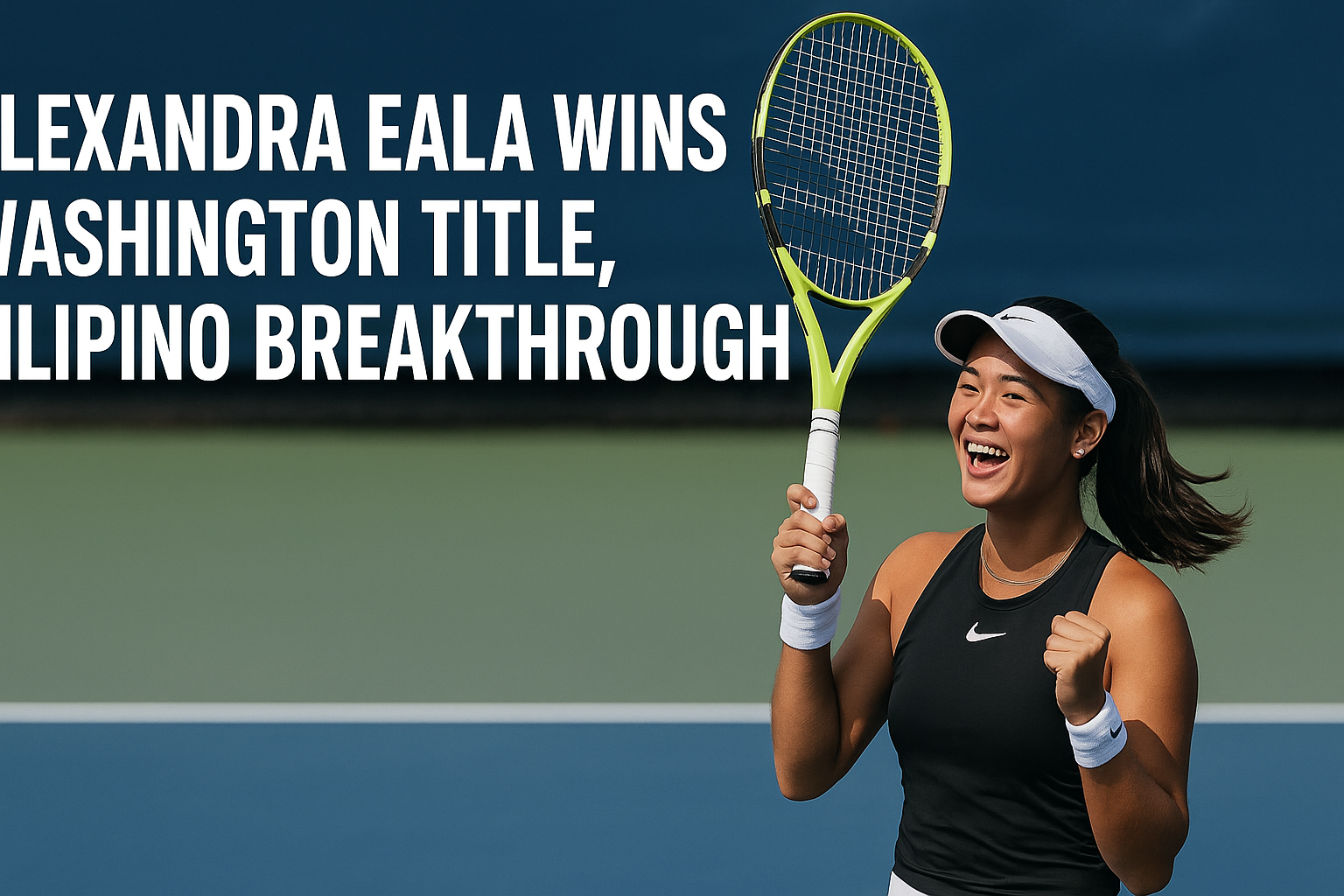
Alexandra Eala Lives Up to the Hype — Washington Win Signals a New Era for Filipino Tennis
Alexandra Eala arrived in Washington with a lot of buzz and left with a trophy, headlines and a little bit of history. The 19-year-old Filipina completed a thrilling week — beating top names, surviving pressure moments and claiming her first WTA Tour singles title — becoming the first player from the Philippines to win at that level. If you’ve followed her since junior success or watched her at Wimbledon earlier this summer, the Washington run felt like the confirmation everyone was waiting for: Eala isn’t just a promising prospect, she’s a real contender.
The Washington run, match by match
There’s a reason sportswriters love a string of victories over marquee names. In Washington, Eala took down a sequence of established stars that would intimidate many players: Elina Svitolina, Leylah Fernandez, Naomi Osaka and Jessica Pegula. Those wins are what turned hopeful headlines into an undeniable statement.
- Elina Svitolina: A veteran and former world No. 3, Svitolina is a tough baseline grinder. Eala navigating past her showed composure against a player who consistently tests movement and point construction.
- Leylah Fernandez: The Canadian’s scrappy, counterpunching style demands patience and precision; Eala’s success against Leylah highlighted her improving tactical range.
- Naomi Osaka (semifinal): Beating a multi‑Grand Slam champion in a late‑stage match captured attention around the tennis world — not least because Osaka’s power and returning ability can derail many opponents. Reuters summed it up when reporting Eala’s upset of Osaka en route to the final.
- Jessica Pegula (final): Pegula is a top‑tier player — world No. 3 at the time — and the final tested everything about Eala: tactical change, physical endurance, and mental resilience.
For a compact recap and the tournament context, the WTA’s report and the BBC’s coverage provide a good play‑by‑play of the week. Both outlets noted not just the opponents but the way Eala handled them — often rallying from behind or closing matches decisively.
The final: from a set down to a dominant finish
The final against Jessica Pegula was a microcosm of why this title matters. Pegula took the first set 6‑4, and the match looked — briefly — as if experience might prevail. Instead, Eala adjusted, grabbed the second set 6‑4 and then obliterated Pegula 6‑0 in the decider to complete the comeback, finishing 4‑6, 6‑4, 6‑0.
That 6‑0 third set is the kind of scoreline that tells you the momentum swing wasn’t small — it was seismic. Winning the second set after dropping the first often comes down to keeping belief and tightening the tactical screws; then Eala effectively steamrolled in the final set. The WTA’s match report captures the arc of that comeback and the significance of beating a current top‑three player in such emphatic fashion: Eala completes Pegula comeback.
Why this is historic for the Philippines
Numbers and firsts matter in sport because they create context. Eala’s Washington trophy isn’t just personal — it’s national. As reported by multiple outlets, she is the first player from the Philippines to win a WTA Tour singles title. That’s a landmark achievement for Filipino tennis and will likely be referenced every time a young player from the country stages a breakthrough.
Her rise wasn’t built in isolation. Earlier this season she made history at Wimbledon as well: Eala became the first singles player from the Philippines to reach the fourth round of a Grand Slam in the Open Era. The BBC’s feature on her Wimbledon run and the broader coverage of her Washington title both emphasize that these aren’t random flashes — they’re milestones in a sustained upward arc (BBC report).
What actually makes Eala’s tennis special — beyond headlines
Watching clips or reading scores gives you one view; reading match patterns gives you another. What stands out about Eala’s Washington week is the combination of varied weapons and mental adaptability.
- Variety in attack: Eala can step inside the baseline to take the ball early, redirect pace and flatten out groundstrokes against aggressors like Naomi Osaka. Against counterpunchers such as Leylah Fernandez, she showed patience and the ability to construct points.
- Return and serve adjustments: Top‑level wins often require timely returns and serve hold under pressure. The progression from losing the first set to dominating the third in the final suggests Eala made effective mid‑match adjustments, improved first‑serve percentages or returned more aggressively — the kinds of small shifts that add up.
- Mental toughness: Beating a player of Pegula’s calibre after dropping the opening set is a credibility builder. Closing out a second set tight and then going 6‑0 in the decider shows both belief and the capacity to exploit momentum.
Those takeaways are consistent with the match reports from Reuters and the WTA, which highlighted not only the opponents she beat but the manner of the victories: both high quality and convincing in the end (Reuters coverage).
How this fits into a breakout season
One title doesn’t make a legacy, but it sure helps the narrative. The Washington title came on the heels of Eala’s Wimbledon breakthrough and a string of strong performances — a sequence that media outlets have framed as a genuine breakout season rather than a single lucky week. The BBC and Reuters both reported this as part of a sustained escalation in her results and level of play.
What that means practically: more attention from tournament directors, a better seeding outlook at big events, and a shift in how opponents prepare for her. Players who once treated Eala as a prospect will now mark her as a dangerous opponent early in draws. A WTA title also often leads to more media exposure and off‑court opportunities, opportunities that can translate into better coaching, travel stability and resources — all of which feed back into on‑court performance.
What to expect next — realistic trajectories
Let’s be careful here: tennis is a sport of ups and downs, and young champions still face a steep learning curve. But the honest, optimistic projection is that Eala will:
- Enter upcoming events with increased confidence and be treated as a threat on hard courts and possibly other surfaces.
- See her ranking and seeding prospects improve (tournament results determine rankings over rolling weeks), which can reduce the number of early matches against top seeds — though those matchups will keep coming as she climbs.
- Attract more strategic preparation from opponents — expect teams to scout her patterns more intensively and target specific weaknesses.
These are not certainties — they’re likely pathways if she maintains form. Both the WTA’s coverage and mainstream outlets have framed the Washington win as confirmation of a wider surge rather than an isolated upset (BBC, Reuters).
Broader impact: inspiration, visibility and national pride
Beyond the tennis bubble, Eala’s win matters in cultural and developmental ways. A first national WTA champion becomes a visible role model — kids see that someone from their country can reach the top tier of women’s tennis. That can stimulate grassroots participation, attract sponsor investment in training facilities, and encourage federations to double‑down on youth development.
It’s too early to measure the long‑term developmental effects, but historic achievements often have ripple effects. Media coverage in the Philippines and global outlets has already amplified her profile, and that attention usually leads to more resources for both the player and the sport back home.
From a bettor’s and market perspective (a careful note)
As someone who spends a lot of time around odds and markets, I’d caution against overreacting to a single tournament when evaluating future betting lines. That said, wins of this magnitude do shift how bookmakers view a player:
- Expect shorter outright odds in near‑term tournaments — bookmakers price in recent form. Big wins against top players will attract wagers, and odds reflect that.
- Market attention increases: more bets, more liquidity, and often more short‑term movement in lines. That can mean more volatility, which experienced bettors can exploit but novices should treat cautiously.
Importantly, markets respond to narrative as well as data. A breakout week like Washington often creates narratives that sustain higher expectations; whether those expectations are justified depends on follow‑up performances. For anyone placing money, the best bet is to use this title as one data point among many, not the whole story.
Where you can read more (selected reports)
If you want the original reporting referenced here, the best places to start are the WTA’s match report (WTA – Eala completes Pegula comeback), the BBC’s overview of her season and Washington performance (BBC – Alexandra Eala lives up to the hype), and Reuters’ match and tournament dispatches (Reuters – WTA roundup). For regional perspectives, The Straits Times covered how the Washington victory played in the Philippines and the wider region (The Straits Times – Eala dismantles Pegula), and ESPN provided additional reporting on the title and what it means for Eala’s trajectory (ESPN – Eala claims first title).
For coaches and fans: what to watch next
If you’re a coach, player, or an observant fan, watch four things in her upcoming matches:
- First-serve percentage under pressure: How she starts points after a big win will indicate if confidence is translating into execution.
- Return aggression: Against bigger servers, does she step in or sit back? Her Washington wins suggest she can toggle modes effectively.
- Tactical variety: Does she keep the opponent off rhythm with slice, angles and net approaches, or default to baseline rallies?
- Mental consistency: Can she replicate the calm that helped her overturn Pegula and beat Osaka? Reproducing that mindset is often the differentiator between a one‑week wonder and a sustained top‑level career.
Frequently Asked Questions
Who is Alexandra Eala?
Alexandra Eala is a young Filipina tennis player who has emerged as a rising star on the WTA Tour. She gained attention with strong junior results and has translated that into notable senior breakthroughs this season, including a historic run at Wimbledon and her first WTA singles title in Washington.
What did she win in Washington?
Eala won her first WTA Tour singles title in Washington, beating Jessica Pegula in the final 4‑6, 6‑4, 6‑0. The victory made her the first Filipino player to capture a WTA singles title.
Who were the top players she beat during the tournament?
Her Washington victories included wins over Elina Svitolina, Leylah Fernandez, Naomi Osaka in the semifinal, and Jessica Pegula in the final. Those names represent a mix of Grand Slam champions and top‑ranked tour regulars.
Why is the Washington title significant beyond just one tournament?
It’s significant because it’s a first for the Philippines — the first WTA Tour singles title for a Filipino player — and it capped a season that already featured a historic Grand Slam run at Wimbledon. The quality of opponents she beat also suggests this was not a fluke.
How did she manage the comeback in the final?
After losing the first set, Eala tightened up her game, won a close second set 6‑4 and then dominated the third 6‑0. That trajectory indicates effective mid‑match adjustments, growing confidence and the ability to capitalize on momentum swings.
Will this win change her ranking or seeding at big events?
A WTA title typically improves ranking points and seeding possibilities, which can affect draw difficulty at future events. Exact ranking changes depend on the WTA’s rolling points system and which points she’s defending, so for precise movement refer to the official WTA rankings updates after the tournament.
Is this the start of a major career, or could it be a one‑off?
Nothing is guaranteed in tennis, but the combination of a Wimbledon breakthrough and a WTA title in the same season points to a meaningful upward trajectory rather than an isolated result. Continued development, scheduling, injury management and tactical growth will determine whether this becomes the first of many titles.
How does this affect tennis in the Philippines?
Historic achievements raise visibility and inspire participation. Eala’s success could encourage investment in grassroots programs, draw more media attention to the sport locally, and motivate young athletes in the Philippines to pursue higher levels of competition.
Conclusion
Alexandra Eala’s Washington triumph is both a personal milestone and a national landmark. It’s the kind of achievement that redefines expectation: for Eala, for Filipino tennis, and for fans watching a new generation of players shake up the WTA order. She beat quality opponents — Svitolina, Fernandez, Osaka and Pegula — in ways that showed tactical maturity and mental grit. Whether this week becomes a launching pad for a long career at the top will depend on what follows, but for now the headlines are deserved.
Want to read the full reports that captured her path to the title? The WTA’s match report provides the tournament context (WTA – Eala completes Pegula comeback), the BBC lays out the wider season significance (BBC – Lives up to the hype), and Reuters offers a concise match-by-match dispatch (Reuters – WTA roundup).