Six-Deck Blackjack Strategy Card (Dealer Stands on Soft 17) — Play to ~0.41% House Edge, Don’t Take Insurance
Estimated reading time: 6 minutes
Key takeaways
- This card is tailored to six decks with dealer standing on soft 17 (S17) and assumes 3:2 blackjack and DAS allowed.
- Correct basic strategy under these rules yields about a 0.41% house edge; insurance is a bad bet (~7.395% house edge).
- The card lists core actions for hard hands, soft hands, and pairs — match the chart to the table rules before playing.
- Practice short drills and consult a rule-matched chart if the table uses different rules (H17, 6:5, no DAS, different deck count).
How this blackjack strategy card is built (S17, six decks)
Basic strategy is not universal. It shifts with deck count and rule tweaks.
This card is built for: six decks, dealer stands on soft 17 (S17), blackjack pays 3:2, double after split allowed, late surrender not used, dealer peeks for blackjack.
- This rule mix is common in online shoe games and many casino “strip-style” tables.
- Under these six-deck S17 rules, correct basic strategy gives about a 0.41% house edge; see the basic-strategy estimate for technical origin.
- If your table differs (different deck count, dealer hits S17, 6:5 blackjack, no DAS, etc.), use a rule-matched chart. The Wizard of Odds blackjack calculator helps test exact rules.
Printable blackjack strategy card — core decisions
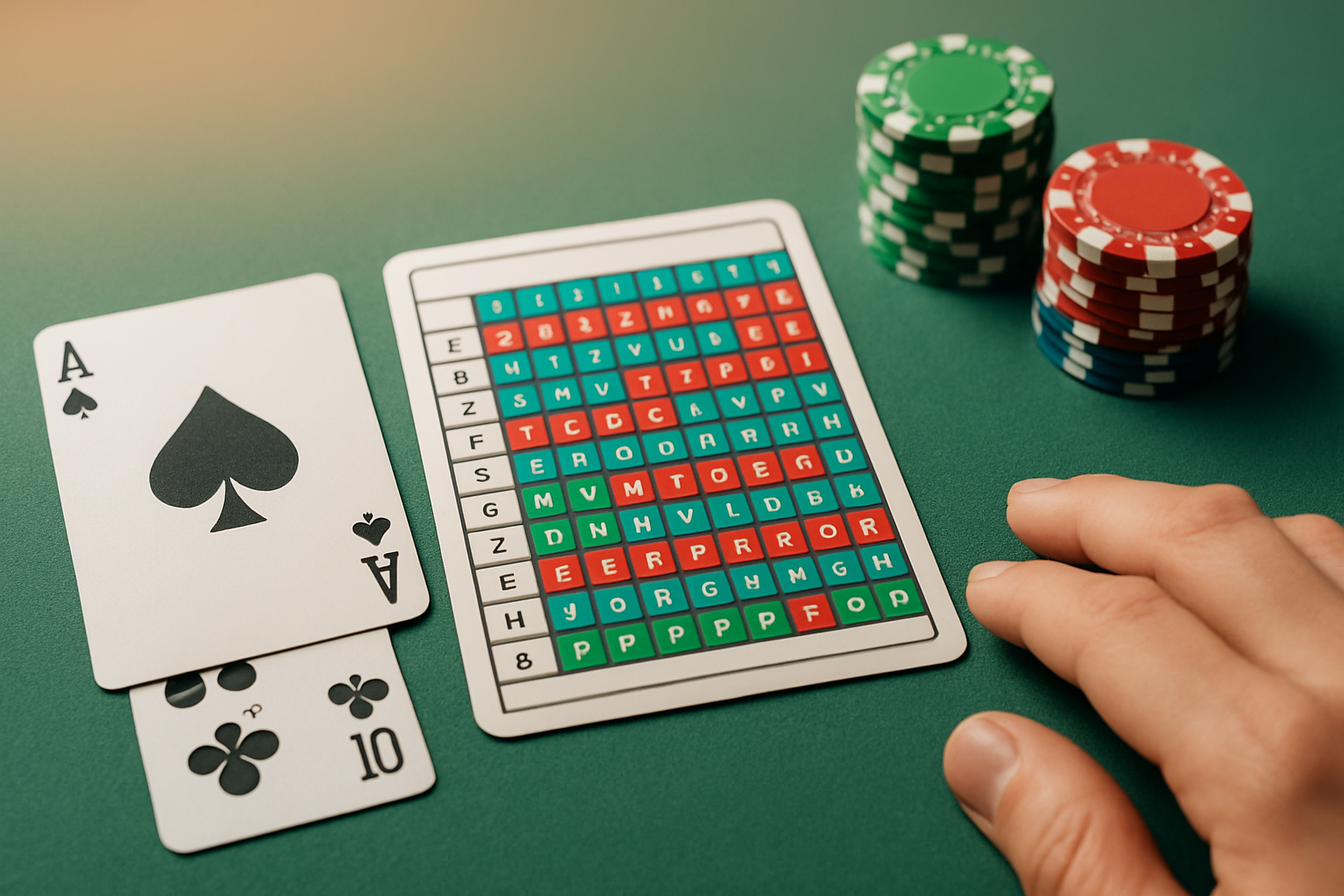
Below is a compact, print-friendly strategy summary for the above rules.
Think of it as a one-page cheat-sheet covering hard hands, soft hands (containing an ace), and pairs.
Hard totals (no ace)
- Hard 8 or less — Hit.
- Hard 9 — Double vs dealer 3–6, otherwise Hit.
- Hard 10 — Double vs dealer 2–9, otherwise Hit.
- Hard 11 — Double vs dealer 2–10, otherwise Hit.
- Hard 12 — Stand vs dealer 4–6, otherwise Hit.
- Hard 13–16 — Stand vs dealer 2–6, otherwise Hit.
- Hard 17+ — Stand.
Soft totals (ace counted as 11)
- Soft 13–14 (A,2–A,3) — Double vs dealer 5–6, otherwise Hit.
- Soft 15–16 (A,4–A,5) — Double vs dealer 4–6, otherwise Hit.
- Soft 17 (A,6) — Double vs dealer 3–6, otherwise Hit.
- Soft 18 (A,7) — Double vs dealer 3–6; Stand vs 2,7,8; Hit vs 9–A.
- Soft 19+ (A,8–A,9) — Stand.
Pairs (splitting)
- Pair Aces — Always Split.
- Pair 8s — Always Split.
- Pair 2s and 3s — Split vs dealer 2–7, otherwise Hit.
- Pair 4s — Don’t split (Hit, except some charts split vs 5–6; this card keeps standard play: don’t split).
- Pair 5s — Never Split; treat as a hard 10 (Double vs 2–9, otherwise Hit).
- Pair 6s — Split vs dealer 2–6, otherwise Hit.
- Pair 7s — Split vs dealer 2–7, otherwise Hit.
- Pair 9s — Split vs dealer 2–6 and 8–9; Stand vs 7,10,A.
- Pair 10s — Never Split; Stand.
This condensed card captures the moves that matter most in live play.
For a full, table-style chart with every matchup printed neatly, use detailed resources such as the Wizard of Odds basic strategy page.
Why these specific rules (and where the ~0.41% number comes from)
The house edge is rule-driven. Under many six-deck S17 rule sets the long-run edge against a perfect basic-strategy player is roughly 0.41%.
That number comes from calculators and simulations for a typical “liberal” six-deck shoe where the dealer stands on soft 17.
- “Liberal” rules like DAS and 3:2 blackjack tighten the house edge; stricter rules (no DAS, H17, 6:5 blackjack) increase it.
- Public tools let you test specifics. Use the blackjack calculator to plug in deck count, payouts, and options.
Playing a simplified strategy instead of a complete one costs measurable expected value.
Under Vegas-strip-style rules the cost of a simplified strategy is about 0.53%, while the more detailed strategy reduces the cost of imperfect play to around 0.14%.
More math is available on the Wizard of Odds basics page.
Insurance and “even money” — why you should decline
Insurance is almost always a losing side-bet unless you are counting.
For six-deck games the average insurance house edge is roughly 7.395%.
Take “even money” when your blackjack is against a dealer Ace? Under basic strategy you should decline — playing your blackjack normally has better long-run expected value.
See the insurance explanation for the calculation behind the headline.
Match the card to the table: don’t be that player
Confirm the table’s rules before using this card.
- Number of decks (single, double, six, eight).
- Dealer action on soft 17 (S17 vs H17).
- Blackjack payout (3:2 vs 6:5 — the latter is a big negative).
- Whether double after split (DAS) is allowed and if re-splitting aces is allowed.
- Late surrender availability.
When in doubt, plug the combination into the Wizard of Odds blackjack rules overview or the calculator to produce the correct chart.
Practicing the card and avoiding mistakes
Two minutes a day with practice drills beats an hour at the table making avoidable errors.
Here’s a drill plan that helps:
- Play free online drills or a simulator for 20 minutes focusing on one section — hard, then soft, then pairs.
- Carry this one-page card and consult it for 50 hands, then phase it out until plays are automatic.
- When you make a mistake, note if it was a rule mismatch (e.g., H17 vs S17) or a memorization slip.
Short practice sessions reduce the “simplified strategy” leak. Over thousands of hands a few tenths of a percent matters.
Common situations players ask about (quick answers)
- Dealer shows Ace — never take insurance under basic strategy. Decline even-money offers.
- Face-down hole card — if the dealer peeks and pops 21, you lose less time because the dealer settles early; always check whether the table peeks.
- Surrender — if the table offers late surrender, it can improve your position on certain hands; check the rules and the detailed chart.
- Counting — basic strategy is the baseline. If you’re not counting, don’t deviate from basic strategy hoping for “hot” runs.
For technical math on rule impacts and to compare variants, the strategy calculator is a useful resource.
Printable and mobile-friendly tips
To print, print this page or copy the “core decisions” lists into a notepad file and print double-sided.
For phones, screenshots work fine. Be discreet: showing a card at some casinos can be frowned upon.
If a table pays 6:5 for blackjacks, walk away. That rule boosts the house edge massively compared with 3:2.
Responsible play
Basic strategy reduces your expected loss rate but doesn’t guarantee profits.
Set a session budget, use table limits that fit your bankroll, and remember the cards don’t care about your mood.
If gambling is becoming a problem, the NHS lists practical help options; see the NHS gambling support.
How much value does this particular card give you?
Short answer: meaningful but not magical.
- Baseline under typical six-deck S17 rules: ~0.41% house edge with correct basic strategy.
- Using a simplified strategy instead of a full one costs about 0.53%; using the detailed strategy reduces that cost to about 0.14%.
- Insurance adds about 7.395% house edge and should be declined unless you’re counting.
With the right card you reduce the rate at which you lose and avoid costly errors. Over thousands of hands, a few tenths of a percent is not trivial.
S17 blackjack strategy vs alternatives (H17, single-deck, etc.)
Dealer standing on soft 17 (S17) is friendlier to players than H17.
If the table is H17, adjust strategy slightly — a few doubles and stands flip and the house edge climbs.
The blackjack calculator shows edge differences instantly when you change S17 to H17 or change deck count.
When to deviate from this card
- If the table pays 6:5 blackjacks, basic strategy still applies but the house edge is substantially worse — consider leaving.
- If surrender is available and you have a chart that includes late surrender for your rules, use it on specific surrender matchups.
- If you’re counting, basic strategy is the baseline; index plays change decisions based on the count — that’s advanced and outside this card’s scope.
For an exact rule-by-rule chart tailored to your table, run your rules through the Wizard of Odds blackjack rules overview and use its strategy outputs.
Quick-reference checklist before you sit down
- Confirm deck count and S17/H17.
- Confirm blackjack pays 3:2, not 6:5.
- Check if DAS and resplitting aces are allowed.
- Decide and set a loss limit for the session.
- Keep this card handy and practice the tricky spots (soft 17–18, pair splitting).
Do those five things and you’ll play cleaner, with fewer second-guessing moments and fewer costly miscues.
What to take away
This blackjack strategy card is a practical, rule-specific tool for six-deck S17 games.
It cuts memorization to a single sheet and, when used correctly, helps you play toward a house edge of about 0.41%.
The simplified shortcut costs roughly 0.53% versus ~0.14% with the full chart on typical Vegas-strip rules. And remember: insurance is negative EV — decline it.
Match the card to the table’s rules, practice the tricky hands, and keep play within your bankroll.
For rule-specific math and downloadable charts, see the strategy calculator and the basic strategy guide.
Play smart, stay curious, and don’t let the table rush you into sloppy plays.
Frequently Asked Questions
How do I use this blackjack strategy card vs a live dealer?
Check the table rules, then consult the printed card before each hand.
The card gives the mathematically best action for the stated rules (six decks, S17).
Be quick and discreet: most casinos allow looking at a strategy card but don’t slow play.
Is this blackjack strategy card valid if the dealer hits soft 17?
No. If the dealer hits soft 17 (H17), several plays change.
Use a chart specifically for H17 rules or run the table configuration through the calculator to generate the right strategy.
What if the game uses 8 decks instead of six?
The basic shapes of play stay similar, but exact doubling and splitting edges shift slightly with more decks.
For precise play get a chart built for the specific deck count. See the Blackjack rules overview for deck-count impacts.
Should I ever take insurance?
Not under basic strategy. In six-deck games insurance carries about a 7.395% house edge.
Only consider insurance if you are counting and know the true odds have shifted in your favor.
How much does a simplified strategy cost me?
Under typical Vegas-strip rules the simplified strategy costs about 0.53% in expected value versus perfect play.
The full, detailed strategy reduces that cost to ~0.14%. See Wizard of Odds for details.
Where can I get a downloadable, rule-matched chart?
Plug your table’s rules into the blackjack calculator or use the strategy outputs on the strategy calculator to generate a printable chart tailored to your rules.