France vs Spain Semifinal Betting Tight Odds and Plays
France vs Spain Semifinal Prediction: Why the Books Say Tight — and Why That Makes for Great Drama Two of the world’s most attractive footballing nations meet in a semifinal that feels both inevitable and razor-close. Markets and models cozy up to France as the team most likely to reach the final, but the betting prices, predictive models and pundits are all whispering the same thing: expect a tight, low-scoring affair where small margins and one moment of brilliance decide who goes through. Below I walk you through the numbers, the probable scorelines, tactical reasons behind the odds and practical betting angles you can actually use — plus a bank of FAQs that answer the specific market questions bettors care about. No hype; just the view the models and markets are offering, and what it means for a fan or bettor watching at home. Market snapshot: who’s favored and by how much? Across major books and prediction markets, France are the favorites to advance, but they’re not priced as a runaway. On FanDuel and BetMGM the “to qualify” numbers put France in the mid-140s while Spain sits around +115 to +118, which translates to roughly a 55–60% implied probability for France to reach the final and about 40–45% for Spain. Those prices come with a clear message: France have the edge, but an upset is far from unlikely. See the market lines reported by Sports Illustrated and the bookmaker snapshot in the New York Times preview. Digging into 90‑minute moneyline pricing, the books make the draw a serious outcome. Typical opening threes-ways look like: France ~+130 to +145 Spain ~+220 to +233 Draw ~+210 to +230 In implied probabilities from model-based previews, France win in 90 minutes is roughly in the low‑40% range, Spain in the low‑30s, and the draw is roughly a 27–30% chance — enough to make overtime and penalties a visible split in the outcome distribution. For a compact read on model outputs, check the machine-learning breakdown from Syracuse.com. Goals market: low-scoring lean, but both teams can find the net Totals markets sit in a pretty narrow band. Books are split on the Over/Under 2.5 goal line — some lean Under (-122 on FanDuel opening lines), while hybrids and model-driven lines are essentially coin flips around 2.5 goals. One ML preview puts Under 2.5 narrowly ahead at about 51% vs. 50% for Over — in practice that’s a push: this is a match you’d expect to see 1–2 goals from each side or a 1-1 draw. At the same time, Both Teams To Score (BTTS) markets favor “Yes” — the model-based preview is near ~59% for both teams scoring. That squares with how these teams operate: Spain typically dominates possession and creates chances, while France rely on high-efficiency finishing from elite forwards. A low total with both sides scoring — e.g., 1-1 or 2-1 — is squarely in the market’s headspace. Sources on these market splits are compiled in the Syracuse preview and bookmaker lines reported by CBS Sports. Exact-score probabilities: the model’s top picks If you like granular probabilities, the ML model reported by Syracuse gives us a neat window into expected score clusters. The single most likely exact score is: Spain 1–1 France — about a 12.9% probability. Other leading scorelines are clustered very close: France 1–0 Spain — ~11.4% Spain 0–1 France — ~9.9% Translation: a draw after 90 minutes is slightly more likely than any single win scoreline, and one-goal margins are nearly as probable as the 1-1 draw. Big scorelines are comparatively rare in the model’s distribution. If you’re shopping exact-score or HT/FT markets, that 1-1 pocket looks like the largest single probability bucket — but it’s still only about one chance in eight. For the full model breakdown see the Syracuse piece linked earlier. Why the market favors France: the tactical and performance story Markets don’t set prices for mystical reasons — they price likely outcomes based on data and narratives investors find convincing. The market case for France is built on three pillars: Elite finishing and firepower. Kylian Mbappé is central to France’s edge: tournament numbers cited by handicappers show him with 8 goals and a cadence that’s roughly a goal every 65 minutes, plus a record of scoring against Spain in recent high-profile matches. That kind of striker efficiency matters a lot in tight games. Sources discussing Mbappé’s form can be found in the CBS Sports previews and SportsLine analysis. Depth and experience. France’s roster depth and recent World Cup form give them an edge in late moments and extra time; many pundits point to championship experience as a difference-maker. Style matchup. Pundits and models agree on the stylistic matchup: Spain will control possession and territory; France will look to be clinical on counters and set-pieces. In a knockout match with similar talent levels, counter efficiency and the ability to convert few chances is decisive. That narrative — possession vs. punch — is why books give a modest but real edge to France rather than treating the game as coin-flip even money. Fox Sports and multiple commentary pieces have framed it as a battle between Spain’s control and France’s direct finishing; for a mainstream media take see the Fox Sports preview. What the pundits and media are saying There’s variety in expert picks. Some U.S. media panels are conspicuously bullish on France and even forecast multi-goal wins — USA Today’s panel, for example, produced several 2-0 and 3-1 calls for France. Others, including handicappers who lean on statistical models, favor higher-goal outcomes and highlight Spain’s roughly two-goals-per-game scoring rate as a reason to take Over 2.5. Bottom line: professional odds-makers and data-driven previews lean France. Traditional punditry is more split and sometimes more aggressive on France’s attacking output. Fan forums and social channels show the most divergent views — everything from “France by two” to “Spain will dominate possession and nick it 2-1.” If you want a balanced view, the marketplace sits between the measured ML projections and
World Cup 2026 France Morocco Odds and Betting Guide
World Cup 2026 Quarterfinal: France vs Morocco — Prediction, Odds and Betting Guide We’re down to the business end of the tournament: France vs Morocco in a quarterfinal that reads like déjà vu for many fans. Bookies, models and pundits are largely in agreement — France are favourites — but this matchup is plenty nuanced. If you like betting with a brain (and a healthy respect for variance), this is a juicy game to dissect. Market snapshot: what the odds say Let’s start with the cold numbers. The 90‑minute moneyline markets have France as a clear favourite — typically around -175 to -180 (roughly a 63–64% implied chance to win in regulation). The draw sits about +285 and Morocco around +525 to +550 in pre‑match books. Those ranges are reflected across mainstream markets and tipster pages. See the odds and commentary from CBS Sports for a practical market read. For “to advance” (accounting for extra time and penalties) the market makes France even more solid: about -370 to -410 — roughly a 79–81% implied probability — with Morocco priced around +285 to +310. Models echo the same story: Opta’s simulations put France winning in regulation or extra time in about 60.9% of runs and Morocco at 16.9%, with draws (leading to extra time/penalties) covering the rest. If you want one line to bookmark: the consensus expectation is that France are the clear favourites but not invulnerable. The market isn’t treating Morocco as a coin‑flip longshot — there’s genuine value in the underdog narrative, particularly in markets beyond the straight 90‑minute moneyline. For a quick look at expert odds commentary, ESPN’s preview collects a number of lines and predictions you can cross‑check. CBS Sports: France vs Morocco odds & prediction | ESPN: Quarterfinal preview & predictions What the experts predict (and why that matters) There’s a strong qualitative consensus across newspapers, pundit desks and modelers: France progress. The majority of expert scorelines cluster in low‑to‑moderate scoring wins — think 1–0, 2–0, 2–1 or 3–1 in favour of Les Bleus. ESPN’s panel, for instance, leans heavily toward France with predictions like 2–0 and 3–1, while USA Today’s experts all pick France as well (scorelines ranging from 2–0 to 3–1). That consensus matters for two reasons. First, market pricing tends to converge around those expert calls — meaning the obvious moneyline is efficient. Second, when everyone lines up on the same short favourite, value often shifts to less obvious markets (correct scores, props, or “Morocco to qualify” specials). There are dissenting voices — a minority sees Morocco forcing penalties or producing a low‑scoring upset — and those contrarian views are exactly the spots a value‑seeking bettor studies. For a compact roundup of expert predictions, check Extra Time Talk’s quarterfinal predictions and SportsMole’s tactically nuanced preview. Extra Time Talk: quarterfinal predictions | SportsMole: France v Morocco preview Tactical matchup & context — why this is more than just a rematch On paper, this is a rematch of the 2022 World Cup semifinal (France beat Morocco 2–0). But conditions, squad form and tournament momentum shift between cycles. Here are the practical, game‑defining threads. France’s form and firepower: France have been prolific in 2026 — five wins from five heading into this tie, netting 14 goals and conceding only 2, per match summaries. Their depth (attackers like Mbappé, Dembélé, Olise and others) gives them multiple ways to hurt Morocco. That attack profile is a key reason most models favour France strongly. Midfield disruption: A real wrinkle: Aurélien Tchouaméni is ruled out with a groin injury. France already navigated the Round of 16 without him, but his absence shuffles midfield responsibilities and could slightly blunt defensive screen capacity. Markets have nudged, but not enough to overturn France’s edge. The Syracuse betting writeup covers how markets responded to that update. Morocco’s identity: Morocco have built a reputation as a well‑organised, tactically flexible underdog — capable of slowing games and executing structured defending. Their path to this stage reinforced that status with big results against higher‑profile opposition. But several analysts note Morocco may not be as impenetrable as in 2022; they’re still dangerous, but the narrative is “veteran giant‑killer” rather than an immovable fortress. Psychology & stakes: Quarterfinals change incentives. France will likely prioritise control and smart risk management; Morocco can afford to sit in and counter. That dynamic tends to compress goals early and open up second‑half opportunities — a theme that matters for in‑play bettors. If you want the tactical short: France supply the threats, Morocco supply discipline. The question for bettors is whether France’s superior finishing and depth overcome Morocco’s ability to compact play and frustrate. Syracuse betting update on Tchouaméni Goals and game style: over, under, or both teams to score? Oddly, this is where the market splits most. Two credible camps emerge: Overs camp: Those leaning Over 2.5 goals point to France’s tournament scoring rate (about 2.8 goals per game according to CBS Sports reporting), the attacking personnel available, and recent expert scorelines like 3–1 in favour of France. If France play freely, 2.5+ becomes a realistic baseline. Unders camp: Others expect a methodical knockout cage match where Morocco slows the tempo and France trade caution for control — classic low‑scoring knockout play. Outlets like Squawka and SportsMole explicitly favour tight games (1–0 or 2–0 scorelines appear regularly in their previews). Markets reflect that split: Over 2.5 and Under 2.5 are often near coin‑flip pricing. That parity makes totals markets interesting for selective stakes — especially if late team news (starting XI or a tactical tweak) tilts the probability one way. If France rotate and favour a more conservative midfield without Tchouaméni, Under 2.5 or a 1–0 France could look appealing at decent prices. CBS Sports on France’s scoring form | Squawka match preview Practical betting angles — where a sharp bettor might look If you’re reading this with a betting account open, here are evidence‑based angles that make sense given the research consensus — plus the pros and cons of each. Baseline
Switzerland vs Colombia World Cup 2026 Betting Preview
Switzerland vs Colombia — World Cup 2026 Round of 16 Prediction & Betting Guide Welcome to the sweet spot between armchair punditry and bookmaker odds. Switzerland vs Colombia in the 2026 World Cup Round of 16 is shaping up as one of those classic knockout chess matches: one side steady and efficient, the other dangerous and electric on the break. Most models and sportsbooks give Colombia the edge, but it’s the details — where the goals come from, how the teams handle pressure, and which markets are mispriced — that create betting value. Below I’ll walk you through the data-backed prediction, tactical context, market angles worth considering, and practical betting approaches (including bankroll-friendly plans). I’ll lean on projections from Opta and The Analyst, betting previews from Rotowire and VSiN, and consensus odds reported by USA Today and others to keep this grounded in real-world prices. Who’s Favored — and What the Numbers Say Short answer: Colombia are the favorite, but it’s a close one. The Opta-driven simulation published by The Analyst produces Colombia wins in regulation at roughly 42–43%, Switzerland wins at about 29%, and draws around 28%. That mirrors moneyline pricing across major books, where Colombia typically sits in the +120 to +130 range (implied win probability ≈43–45%), Switzerland around +240 to +280 (≈25–29%), and the draw about +210 to +225 (≈30–31%). Key takeaway: bookmakers and models agree on a Colombia edge, but not an overwhelming one. That means bettors should expect a close game where small tactical moments and set-piece chances can swing the result. Most Likely Scorelines and the Over/Under Debate Predicted scorelines cluster tightly. The consensus from data-driven previews is a narrow Colombia victory — most commonly 2–1 or 1–0. For example, handicap and match previews from Rotowire and the USA Today Sportsbook Wire both lean to Colombia and commonly list 2–1 or 1–0 as the likeliest outcomes. But the totals market is where opinions diverge. On one hand, markets and some handicappers favor Under 2.5 given knockout caution and defensive organization — VSiN noted the market pricing for Under 2.5 at a heavy favorite in some books. On the other hand, several respected analysts point to Switzerland’s recent goal glut (eight goals in their last three tournament games) and Colombia’s strong expected-goals profile to justify Over 2.5 and Both Teams To Score (BTTS). How to reconcile it: treat the base case as an under-ish game with room for goals. A practical forecast would be: Primary match prediction: Colombia 2, Switzerland 1 (Colombia win in regulation) Conservative alternative: Colombia 1, Switzerland 0 (tight, low-scoring knockout) If you believe Colombia’s xG numbers are the truer reflection of form, Over 2.5 and BTTS carry value versus the implied market tilt toward the under. Both Teams to Score (BTTS) vs. Clean Sheet — Which Side Has Edge? BTTS is one of the most debated lines here. Rotowire makes a persuasive case for goals at both ends: Switzerland have been unusually prolific in this tournament, while Colombia’s attack — led by the likes of Luis Díaz and supported by creative outlets — produces chances and threatens in transition. USA Today’s Sportsbook Wire specifically points to Switzerland’s eight goals in three matches and Colombia’s xG dominance against Ghana as reasons to expect both teams to find the net. Counterpoint: a portion of the market still prices higher probability on a blank for one side, reflecting the natural caution of knockout ties and Switzerland’s structurally tidy defense. VSiN pointed out that the Under 2.5 market is a heavy favorite in several books, which implicitly supports at least one clean sheet. Practical reading: BTTS may be slightly undervalued relative to the underlying data. If you like Colombia to win in regulation but worry the moneyline is inefficient, a BTTS + Colombia win (two-leg or same-game parlay) can be a sensible compromise — it boosts the odds while still backing the favorite’s attacking profile. Tactics, Form and the Intangibles that Matter Numbers are great, but soccer is played on a pitch where coaching choices, player form, and crowd energy matter. Here are the qualitative edges that swing this match: Switzerland’s profile: entering the match they were unbeaten in 10 competitive internationals (W7 D3), and their tournament run showed surprising attacking output. They tend to manage games efficiently rather than dominate; they’ll likely look to control tempo, defend compactly, and hit on the counter or set pieces. Colombia’s profile: higher upside through individual attackers and transition speed. Their match against Ghana is a useful example: Colombia outperformed expected goals by a meaningful margin and looked likelier to score more — that kind of attacking threat creates pressure in close knockout ties. Historical and situational edges: a long-ago World Cup meeting (Colombia 2–0 Switzerland, USA 1994) is trivia rather than predictive power, but local context matters: a sizeable Colombian diaspora and the North American location (Vancouver) give Colombia something close to a home-field feel, which handicappers often value in tight knockout games. Bottom line: Switzerland can drag the game into extra time with structure and discipline; Colombia have the higher ceiling and a better probability to win in regulation thanks to attacking personnel and momentum. Smart Betting Strategies — How to Play This Match As a gambling-savvy friend, here’s how I’d approach the markets depending on your appetite for risk and desire for value. (Note: I’m not suggesting unlimited stakes — manage bankroll and treat any sports bet as entertainment with downside.) Conservative/Primary Play Small stake on Colombia moneyline at +120 to +130 — this lines up with model consensus and gives you a straightforward upside if Colombia convert chances. If you prefer safer but lower payout: Colombia to advance (including extra time/penalties) often pays shorter than the moneyline but reduces variance if you fear an extra-time scenario. Value/Analytics Play BTTS – Yes as a single or in an enhanced combo with Colombia to win. Several analytics previews (including Rotowire) argue BTTS is undervalued given both teams’ scoring trends. Over 2.5 if you find +130/+140
France vs Paraguay Betting Odds and Value for Bettors
France vs Paraguay: Will France Win? A Betting-Savvy Breakdown Short answer: the market says yes. France enters the knockout tie as the clear favorite across bookmakers and prediction models, with estimated win probabilities ranging roughly from the high 60s up to the mid-80s percentiles depending on the model. But as any experienced bettor knows, “favorite” doesn’t mean “guaranteed.” Let’s walk through what those numbers mean, why the gap exists between models and sportsbooks, the realistic scorelines to expect, and how to approach wagering on this one without getting burned by tournament variance. What the markets and models are actually saying Look at the headlines and you’ll see a consistent message: France is heavily favored. Different sources put the chance of a French win at anywhere from roughly 68% to as high as 85%: Sports Mole’s model pegs France’s win probability around 68.05%, Paraguay at about 11%, and a draw at 20.9% — a meaningful favorite but not an overwhelming blowout (Sports Mole preview). Dimer (reported in AZ Central) gives France about a 79% chance, Paraguay roughly 6.1%, and draws near 15% — a steeper view of French dominance (AZ Central reporting). Bookmaker pricing reported by Covers lists France about -550 on the moneyline, which implies a very strong market-implied probability (bookmakers’ pricing can differ from statistical models because books build in vig and react to betting flow) (Covers odds page). Some previews and tipsters lean even higher, placing France at around an 85% prospect of victory in their assessments (SportsGambler preview). Why the spread between 68% and 85%? Models disagree because they weight inputs differently — Elo ratings, recent form, head-to-heads, roster availability, and home/neutral venue factors all matter and are treated with different emphasis. Bookmakers, meanwhile, set prices to manage liability and reflect what customers are willing to bet, so their odds can depart from pure statistical outputs. Why France is the clear favorite (and why that matters) When multiple independent models and the betting market converge on the same conclusion, it’s not just noise — it’s a signal. France’s high probability estimates reflect a few unavoidable realities: Depth and tournament pedigree: big tournaments reward squads with quality across the pitch and the ability to replace starters without a dramatic drop-off. Match control and goal threat: favorites tend to generate more scoring chances and control decisive phases of knockout games. Market confidence: heavy money on France compresses payouts and pushes lines to make betting the favorite less attractive — the -550 line is a good example of that market confidence in action (Covers reporting). Why this matters to you as a bettor: favorites still lose. But knowing France is expected to win lets you tailor your wagers more intelligently — think backing the favorite in conservative single bets, or seeking alternatives where the market might be over-pricing certainty (more on that below). Why Paraguay shouldn’t be written off Underdogs live for moments. Knockout football creates compact, emotionally charged games where small edges — a set-piece, a slice of luck, tactical discipline — flip outcomes. A few points to keep in mind: Tournament variance is real: one inspired performance or one refereeing decision can alter a match that models expected to be “comfortable.” That’s why sensible projections often still expect narrow France wins like 1–0 or 2–0 rather than routs (SportsGambler predictions, Sports Mole). Underdogs can frustrate: Paraguay may adopt a compact, low-block defensive shape and look for counters — a style that increases the probability of low-scoring results and sometimes penalties/late drama. Value in the upset: models give Paraguay win probabilities in the low double digits or single digits in some reports. That low implied chance can produce attractive odds for a small, speculative stake. Bottom line: prefer the favorite for steady bankroll growth, but a disciplined, small-ticket play on Paraguay (or alternative markets) can be a reasonable high-variance play if your bankroll allows it. How to interpret the lines and find value Numbers matter — but so does perspective. Here are practical ways to interpret the disparate probabilities and translate them into smart bets. 1) Compare model probabilities to market-implied odds An example: a bookmaker moneyline of -550 implies a probability in the mid-80% range once you account for the vig. If a respected model (e.g., Sports Mole) assigns France only about 68% probability, that gap suggests the market is pricing more confidence than that model’s expectation — not necessarily an exploitable inefficiency, but a divergence to note (Sports Mole, Covers). 2) Look for bets where the market and model converge — and where they don’t Convergence gives confidence: if several models and the market all point to a narrow France win, that’s a safer read. Divergence creates opportunity if you trust a particular model’s inputs. Assess why a model is higher or lower — lineup injury news, recent matchups, or underlying metrics — before placing a contrarian wager. 3) Consider alternative markets over the moneyline Heavy favorites depress moneyline value. That’s when alternative markets can be more attractive: Handicap/Asian handicap markets — you might pay to back France at -1 rather than straight moneyline if you want some scoring margin protection. Under/Over goals — tight projections (1–0, 2–0) make the under market worth examining. Both teams to score (BTTS) — if you expect Paraguay to sit deep, BTTS=No may be a logical play. Small stakes on Paraguay or double-chance covers — if you want a longshot with limited downside. These are strategic alternatives, not silver bullets. Always weigh payout vs probability and keep bets proportional to your bankroll. Scoreline forecasts and realistic outcomes Professional previews commonly settle on low-margin French wins in this matchup — think 1–0, 2–0, or perhaps a narrow 2–1 if Paraguay earns a goal on a set-piece or counter. That matters for prop bettors and for live-betting strategies: If you believe a 1–0 or 2–0 is likely, under 2.5 goals or betting France + under 2.5 goals can offer better value than the costly moneyline. If you expect Paraguay to sit back
Spain vs Austria World Cup betting odds and market outlook
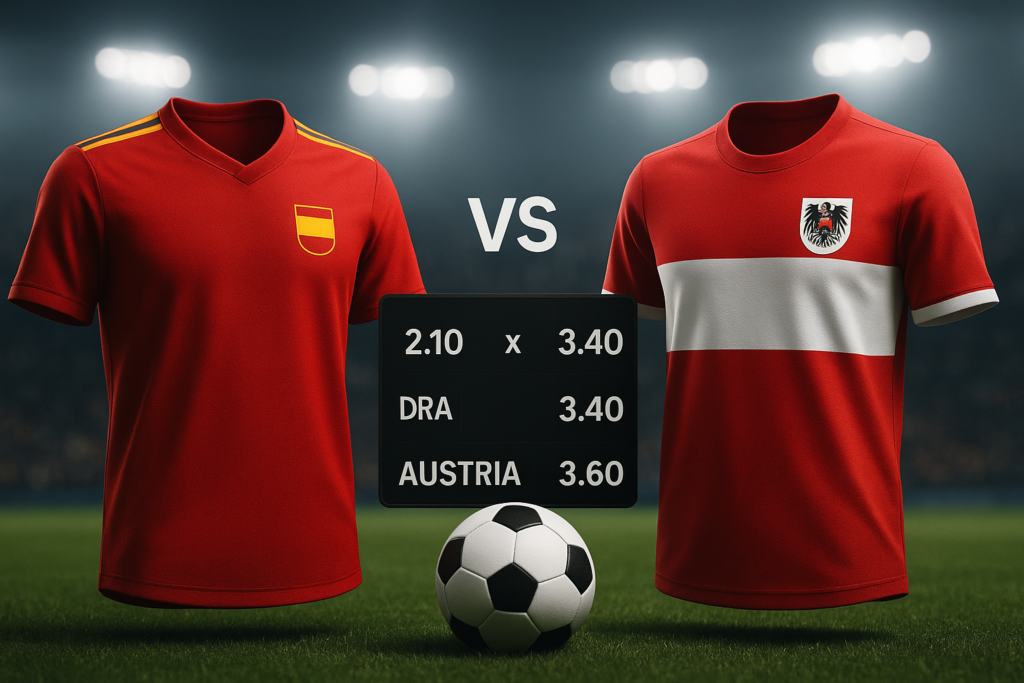
Spain vs Austria — Who Will Win the World Cup Knockout Match? Short answer: everything points to Spain. The market, models and the media are largely aligned that Spain will win in 90 minutes — most previews and handicappers lean toward a tidy, low-scoring Spain victory, often 2–0. But as any tournament fan knows, knockouts invite shocks. Below I’ll walk you through the numbers, the footballing reasons behind Spain’s favoritism, the realistic paths for an Austrian upset, where the betting value might be, and how to manage the risk if you plan to back a side. What the markets and models are saying (and why it matters) Bookmakers make their living reflecting where money and probability overlap — and right now their prices are shouting Spain. The 90‑minute moneyline is around 1.30 (−300) for Spain, with Austria quoted near 15.0 (+900–+1011) and the draw roughly 4.25–4.56. Those prices equate to a rough implied probability of 70–75% for Spain to win in regulation, 6–8% for Austria, and 18–20% for a draw (the exact conversions depend on the book’s margin). For a succinct market overview, see the Covers odds and picks page here: Spain vs Austria prediction, picks & odds (Covers). Model-based previews reach the same conclusion — the Action Network’s projection work tags Spain as the clear favorite and frames the match as one Spain should advance from: Action Network model and betting edges. Why this matters to a bettor or a fan: the short price for Spain compresses potential profit for a straightforward win bet, so many bettors pivot to alternative markets (scorelines, totals, Asian handicaps) where a sharper edge — or at least better value relative to perceived probability — can occasionally be found. Why Spain are heavy favorites: form, defense and experience The bookmakers aren’t being sentimental — Spain’s case is grounded in form and numbers. Spain cruised through the group stage without conceding a goal and arrive on the back of an exceptional run: unbeaten in 32 matches with clean sheets in eight of their last nine competitive fixtures. Those figures underpin the expectation of a controlled, professional performance rather than a high‑variance shootout. Experts highlight these same features. The Racing Post’s preview notes Spain’s defensive solidity and recent consistency, and the outlet’s betting tips favor a Spain win with a low goal count — “Spain to win & under 3.5 goals” is their top idea: Racing Post betting tips. Sports Illustrated’s match preview also projects a tidy Spain performance, specifically calling a 2–0 Spain win as the likeliest exact score: Sports Illustrated match preview. Other contextual facts that reinforce Spain’s edge: Spain’s defensive record in recent competitive games suggests structure and control rather than haphazard results. Head-to-head and recent meeting history favors Spain — they’ve won six of their last eight matches against Austria. Spain are a pre-tournament favorite with underlying metrics consistent with short prices, so model projections expect them to advance. How Austria can make this a game — and why the upset isn’t impossible Austria are big underdogs on paper, but every underdog has a path. The most realistic avenues for Austria to cause trouble are straightforward: Set-pieces and physicality: If Austria can make the match scrappy and score or draw early from a dead-ball situation, they force Spain out of their scripted control game and into higher variance territory. Counter-attacking efficiency: Spain’s possession model invites teams to sit in and hit them on the break. If Austria are clinical on transition, the game tightens and single moments can decide the match. Mental edge in a low-pressure environment: Austria are playing their first World Cup knockout fixture since 1954. That lack of recent knockout experience can be a double-edged sword: nerves for Austria, but also less historical baggage and pressure — if they play without fear they can be dangerous. That said, the market probabilities (Austria ~6–8%) reflect that while upsets happen, they’re not the most likely outcome here. If you’re backing Austria, you’re buying a long‑odds scenario — and you should size stakes accordingly. Scoreline, totals and practical betting angles Across previews, handicappers and models, the most common projected scoreline is Spain 2–0 Austria. Pundits and tipsters repeatedly land on this number, and several video analysts and preview sites also flag under totals as the smart play. Key market levels to know: Main total: 2.5 goals — with many handicappers preferring under 2.5 expecting a controlled Spain win rather than a goal-fest (see the Covers preview and several analyst videos: Covers and the Doc’s Sports review: Doc’s Sports video). Asian handicap: Some previews push Spain −1.5 as a best‑bet idea (expect Spain to win by 2+ goals), which pays better if you’re confident in a 2–0 or 3–0 outcome. Conversely, an Austria +1.5 is a defensive/hedged play if you think Spain will win narrowly and want insurance against a two‑goal rout. Exact score bets: 2–0 or 1–0 for Spain are commonly projected; if you want higher payout at reasonable probability, 2–0 is the consensus “most likely” pick among experts. Practical betting guidance: If you want a low‑variance, small-stakes play: straight Spain win covers most scenarios (70–75% implied). Expect low returns on large stakes. If you want more juice and accept more volatility: consider Spain −1.5 (requires a 2+ goal margin) or a Spain exact score (2–0) — but size those stakes smaller because variance rises. If you want defensive value: Austria +1.5 or a draw in 90 minutes are ways to capitalize on the improbable but plausible tight match outcome. Totals: under 2.5 is the market’s favorite tactical pivot — smaller odds than an upset but often decent value relative to bookmakers’ expectations for a controlled Spain performance. Where recreational bettors commonly go wrong Over‑staking on a short-priced favorite: the math punishes big bets on heavy favorites. Chasing exotic bets without factoring in implied probabilities: a longshot upset looks tempting but has very low true probability. Ignoring match context like cards, injuries or late lineup changes: goalkeepers and defensive pairings matter
England vs DR Congo World Cup Betting Outlook 2026
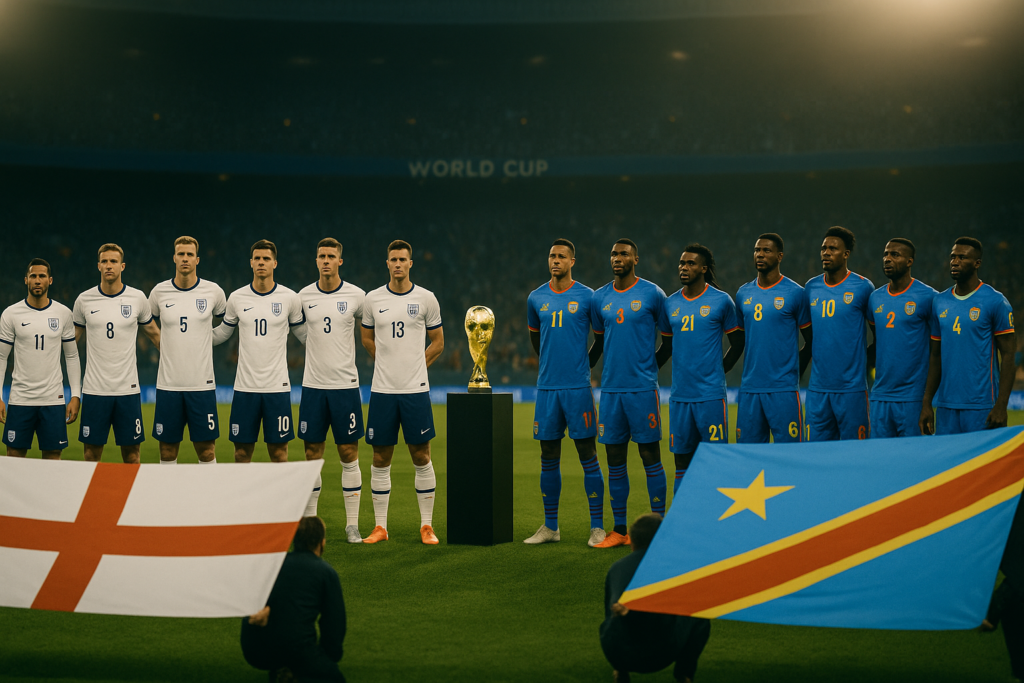
FIFA World Cup 2026 — England vs DR Congo: Who Will Win? Short answer: England are the clear favorites. The numbers and the markets line up behind them, and most previews expect a controlled, low-scoring English win — think 2-0 and under 2.5 goals. But football always carries an upset risk, and DR Congo bring enough pace and unpredictability to make this an interesting Round-of-32 tie. Let’s unpack the data, the likely match shape, the betting angles, and smart ways to think about risk before you stake real money. What the numbers actually say When you compare model probabilities and betting markets you get a picture that’s consistent but not identical. Opta’s model, as reported, gives England a 73.9% chance of winning in regulation time, with DR Congo at 11.3%. Opta also assigns a 14.8% chance that the game goes to extra time or penalties — that’s useful because it shows the model thinks a draw in 90 minutes is not negligible. If you prefer market prices, moneylines reported ahead of the game were roughly England between -335 and -380, which translates into implied probabilities in the high 70s (around 77–79%). That’s slightly more bullish than Opta’s 73.9% figure, which is a small but meaningful gap to consider if you’re hunting value. See a typical roundup of those market odds in the CBS analysis and the betting previews. Sources used widely across previews include the Opta-based prediction piece on Al Jazeera, market summaries from CBS Sports and Yahoo Sports, plus match-shape assessments on sites such as WhoScored. How the game is likely to play out Across previews the most common theme is: England in control, but not rampant. Expect a tight, defensive game where England try to manage tempo, keep possession in midfield, and look for periods of pressure to break DR Congo down. Typical scoreline predictions center on 1-0 or 2-0 results and the “under 2.5 goals” angle features prominently in analyst picks. Why that matters: a low-scoring shape changes the betting markets you should focus on. If the model consensus is a narrow England win, value can often be found in markets like: Under 2.5 goals — aligns with the “tight, defensive” outlook; Correct score 2-0 — the most common specific prediction in previews; First-half markets — England may control the opening, so first-half winning or clean-sheet props are useful smaller-stake plays; Lower-liability England moneyline via Asian handicaps or -1 markets — better odds for a single-goal victory scenario. The YouTube previews and tactical breakdowns available ahead of the match also highlight defensive organisation and set-piece importance for both sides — another reason the game could stay low on goals if DR Congo sit in and try to strike on transitions. For readers who like the numbers: those extra-time odds (14.8%) mean a draw at full time is not a rounding error. If you like longer-tail options, a small-play on penalties or extra time markets can be an inexpensive hedge, but be aware they’re long shots from a probability perspective. Why England are favorites (and why that’s sensible) There are three practical reasons the bookies and models favor England: Depth and squad quality: England come into knockout matches with a deep roster that can absorb tired legs and tactical switches. That depth often proves decisive in tournament knockouts. Experience under pressure: England have players used to big-game environments, which matters in managing stoppages, penalties, and set pieces. Market liquidity and consensus: The public and sharp money tend to push England markets down — the -335 to -380 lines reflect both model outputs and public confidence. All of that practicality earns England strong pregame support. But being favorite doesn’t guarantee a comfortable win — styles make fights, and DR Congo can make this messy if England misread the tempo. Why DR Congo are no walkover — the realistic upset routes DR Congo reach knockout stages because they can be fast, athletic and unpredictable. Underdogs usually have a handful of upset routes, and these apply here: Set-piece or counter-attack goals: A single well-taken free-kick or a counter can flip the script in a low-scoring game. Tempo disruption: If DR Congo deny England rhythm early, it increases the chance of a low-quality game that favors the underdog. Clinical finishing or an early goal: A shock opener forces England to chase and increases variance — that’s where underdogs thrive. That’s not to overstate the risk. Opta’s model gives DR Congo just 11.3% to win in regulation. But an 11% upset probability isn’t zero — it’s the kind of outcome that pays well if you size stakes carefully. Smart betting angles and practical staking guidance If you’re thinking of wagering, this is where a calm head earns more than reckless confidence. Here are practical angles that mirror the match expectations and where you can potentially find value. Value vs. market — where the numbers disagree Compare Opta’s 73.9% vs. market-implied ~77–79% for England and you see a slight market edge against betting England outright at full-book prices. That doesn’t mean don’t bet England — it means: Look for alternative markets where the market isn’t as efficient (under 2.5 goals, correct-score 2-0, first-half markets). Consider betting England but at better priced options like -1 handicap (if available) or above-market prices from less efficient sportsbooks. Conservative ticket (low variance) Small stake on England to win in regulation or England -1 in Asian handicap — lower odds but less variance. Place a separate small stake on under 2.5 goals — aligns with the consensus match shape. Aggressive ticket (higher payout, higher risk) Small outright on DR Congo to win — large payout if the upset hits. Correct-score 2-0 for England — higher odds than the straight moneyline and matches mainstream predictions. Staking rules I’d recommend Never stake more than 1–2% of your bankroll on a single market unless you accept the full downside. Use small, fixed-unit stakes for longer-shot markets (DR Congo win / extra time / correct-score) and larger relative units for markets you
France vs Sweden World Cup 2026 Betting Angles and Tips
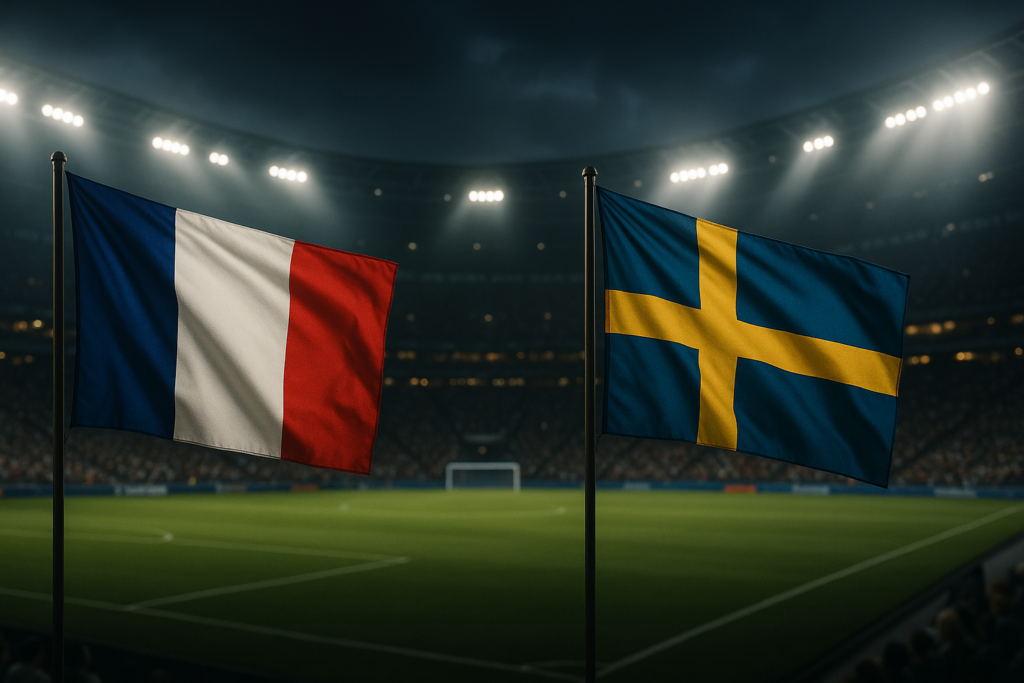
France vs Sweden — World Cup 2026 Predictions, Betting Angles, and How to Think Like a Smart Bettor This is one of those knockout games where the betting market and the narrative pretty much agree: France are heavy favorites, Sweden are the plucky underdogs, and most scoreline models land somewhere in the 3–0 to 3–1 band for Les Bleus. But heavy favorite ≠ lock, and tournaments have a funny way of reminding bettors about variance. Below I break down the market signals, the tactical reasons behind the consensus, the clearest betting angles, and the real risks you need to accept if you’re staking money on this one. Market signals: what the prices are telling you If you like numbers, the market has done your thinking for you. The 90‑minute moneyline for France sits in the neighborhood of -370 to -400 — a price that tells you the typical sportsbook expects France to win comfortably. For the “to advance” market bookmakers are even more emphatic: France are roughly -1000 to reach the Round of 16 while Sweden checks in near +550. Those are extreme contrasts in implied probability, and they show how much weight the market gives France’s quality and tournament form. Model-based projections reinforce that picture. One projection in the public domain puts France’s win probability at roughly 77.3%, Sweden at 8.4%, and a draw after 90 minutes at 14.3%. Those numbers aren’t gospel, but they help explain why sharp analysts and betting shows are steering bettors away from the moneyline and into spreads and totals where reasonable value can still be found. Read a compact odds and preview roundup at azcentral’s World Cup preview for one of the model summaries. Consensus scorelines and the most popular betting angles Across mainstream preview desks and betting channels, the consensus cluster is tight: Most common correct-score bracket: France 3–0 or 3–1. Margin play: France -1.5 is a repeatedly recommended spread — in plain English, that’s France to win by at least two goals. Totals: Strong lean to Over 2.5 goals; a push into Over 3.5 is suggested by some as “plus-money” value if you think France will continue their recent high-scoring tempo. Same-game parlay ideas: France to win + France to score first + Over 2 goals is a commonly-cited combo by betting commentators aiming for a reasonable payout on a heavy favorite. If you want the short, actionable translation: the market believes France will score early, control possession, and turn this into a multi-goal win. If you prefer reading the narrative treatment, check the Sports Illustrated match preview for an explicitly projected 3–0 French win: Sports Illustrated — France vs Sweden preview. For a betting-focused view that leans to France -1.5 and Over 2.5, Yahoo’s betting column has the details: Yahoo Sports — betting preview. Why France are the obvious favorites — form, talent and tactics Let’s be blunt: France’s group-stage numbers and player pool make them look like one of the tournament’s real heavyweights. They took a perfect nine points from Group I, beating Senegal 3–1, Iraq 3–0 and Norway 4–1, compiling 10 goals for and only 2 against. Beyond the raw results, France have won four of their last five matches heading into this knockout — the only loss came in a pre-tournament friendly — and they arrive with a frontline and midfield capable of controlling tempo and creating volume chances. That offensive depth is the core of the market’s thinking. Kylian Mbappé is the obvious match-winner, but the real tactical advantage is France’s ability to own the middle of the park with a double pivot and then stretch opponents quickly with wide pace. A commonly cited starting XI in previews uses a 4–2–3–1 structure: Maignan; Koundé, Upamecano, Saliba, Digne; Tchouaméni, Rabiot; Dembélé, Olise, Doué; Mbappé. Sports Illustrated lays out that exact XI and why the midfield pair is crucial to dictating possession and shot volume: SI predicted lineup and analysis. Beyond formation and personnel, the numbers matter: France have scored at least three goals in five of their past six matches. When a team consistently turns attacking phases into high-quality chances, their expected goals and shot volume tend to overwhelm opponents who lack both depth and composure in transition. Why Sweden are underdogs — legitimate weaknesses and the upside they still have Sweden’s path to this round was more muddled. They advanced as one of the best third-placed teams, which is fine — knockout football includes teams that take different roads — but it also flags that Sweden didn’t dominate their group. The 5–1 loss to the Netherlands during group play is the headline defensive issue: a heavy concession against top-level attacking pressure that many analysts point to as proof their back line can be exposed. Graham Potter’s Sweden typically line up in a 3–4–3, and the tactical expectation is that they will morph into a back five or heavily compacted defensive block when France press. The projected Swedish XI includes Zetterström; Lagerbielke, Lindelöf, Gudmundsson; Bernhardsson, Ayari, Karlström, Stroud; Elanga, Gyökeres, Isak, which hints at wanting to transition quickly through the wide attackers but also leaves them vulnerable to overloads on the flanks and through the center. You can read the Sweden tactical preview at Goal’s match preview. There’s also an injury and selection wrinkle: Sweden are missing center-back Isak Hien, a factor that further weakens a defense expected to cope with France’s verticality. That said, Sweden aren’t without hope: compact shape, set‑piece threat and counter-attack danger can always change a match’s script — especially in one-off knockout football. Upsets happen; the market just treats them as low-probability events here. Putting the predictions into practice: where the value and risks actually live When everyone agrees France are likely to win, value rarely sits on the moneyline. At -370 to -400 you’d need to stake a lot to get meaningful returns. The smarter, consensus-aligned approaches are the ones that tilt toward margin and goals: Spread play (France -1.5): If you accept the 3–0/3–1 band as the modal outcome,
Brazil vs Japan betting primer for World Cup 2026 knockout

Brazil vs Japan — World Cup 2026 Round of 32: A bettor’s friendly primer Welcome to the kind of World Cup knockout tie that keeps bettors, neutrals and notebook-toting fans buzzing: five-time champions Brazil against an organised, hungry Japan side that arrives unbeaten. This is Houston, NRG Stadium, on Monday, June 29, 2026 — kickoff 1:00 p.m. ET / 6:00 p.m. BST / 10:30 p.m. IST — and it’s a classic clash of pedigree versus momentum. Below I’ll walk you through the facts, the tactical angles, what the markets are saying, and practical wagering ideas you can actually use — without pretending to predict miracles. I’ll also point you to the best places to confirm last-minute team news and the broadcasters showing the game live. Let’s get into it. Why this match matters — beyond national pride Round-of-32 knockout football is where form collides with pressure. Brazil carry an enormous weight of expectation as five-time world champions; everyone thinks they should win and many bookmakers list them as the market favourite. Japan, by contrast, are the flavour-of-the-tournament underdogs: they topped Group F unbeaten and have been quietly effective, disciplined and dangerous in transition. Context is everything. Brazil did not have the smoothest start — a draw with Morocco and questions over consistency have made some punters wary — while Japan’s unbeaten streak and the recent October 2025 head-to-head win add fuel to the upset narrative. You can read a succinct match preview at Goal’s World Cup preview and another detailed roundup at the Evening Standard’s preview. Location, kickoff and how to watch Everything about a match day can influence a bettor’s approach — kick time, travel fatigue, climate, and the broadcasters carrying the game. Kickoff: Monday, June 29, 2026 — 1:00 p.m. ET / 6:00 p.m. BST / 10:30 p.m. IST. See the TV and streaming rundown via ESPN’s match preview. Venue: NRG Stadium, Houston, Texas — a flat pitch, big crowd and all the knockout-game atmosphere you’d expect. More on the stadium in general coverage at Goal’s preview linked above. Broadcasters: ITV1 in the UK, Fox Sports in the U.S., Zee5 in India and SBS in Australia — confirm local rights and streaming windows before staking money. Brazil: strengths, weakness and how that affects betting Brazil remain Brazil: depth, technical quality and attacking options across the pitch. As five-time winners they carry experience through multiple World Cups, but that history cuts both ways — it’s part of why markets price them as favourites and why there’s pressure to deliver. Key betting implications: Market calming effect: Brazil being the favourites tends to compress prices on match-winner markets. If you’re backing Brazil, be selective — the lower odds demand a higher confidence level or a hedge. Value in alternate markets: When favourites struggle to dominate (for example, a slow start or stout opponent), value can pop up in markets like both teams to score (BTTS), half-time result, or Asian handicap lines that give Brazil a small goal buffer. Form check: The team’s draw with Morocco and some uneven displays have made a number of bettors cautious. That’s prudent: favorites are favourites for reasons, but they aren’t immune to tactical puzzles. Japan: form, tactics and why bettors shouldn’t ignore them Japan arrive unbeaten in the tournament, having topped Group F, and their October 2025 3-2 win over Brazil is still fresh in players’ and fans’ minds. ESPN noted a 10-game unbeaten run leading into the knockout stage — momentum that matters hugely in sudden-death football. What this means for wagering: Upset potential: Japan’s discipline, compact defending and quick counters make them a classic underdog that can frustrate and punish. Upset bets or extra-time/penalty markets are not just romantic — they carry realistic implied probability when one side can sit deep and strike smartly. Value on draws and double-chance: With Brazil favoured but not flawless, a Japan draw or Japan + draw (double chance) can offer better risk-reward. If Japanese players are fit and disciplined, those lines can look attractive. Look at volatility markets: Japan’s style often produces open phases and long-range shots by design. Consider BTTS or over/under 2.5 goals depending on how open Brazil are early on. Tactical matchup — where the game could be won or lost This is a classic contrast: Brazil often want control — possession, progressive passes and creating overloads — while Japan tend to thrive on structure, fast counters and maximizing spaces. Here are a few tactical betting takeaways: Transitions matter: If Japan can hit Brazil on the break, quick goals are a realistic scenario. Markets like “first team to score”, “time of first goal” and in-play props that reward early goals become interesting. Set-pieces and physicality: Knockout matches often drift toward set-piece battles. If Japan can neutralize Brazil’s creative phases, look for lower-scoring scenarios where any single set-piece decides it. In-game management: Brazil may chase the game if they fall behind, which can open channels for Japan to score on the counter. Live markets (in-play betting) can be profitable if you’re disciplined and ready to pounce when lines shift. Practical scouting tips before placing money Check starting lineups and injury updates within an hour of kickoff — personnel changes massively affect prices. ESPN’s preview and broadcaster pages are good starting points for this. Watch early betting market moves. Heavy money for Brazil early might signal sharp action, but sometimes it’s public opinion. Distinguish between the two by watching price shifts across multiple books. Consider the referee and card tendencies if you plan to bet on corners, cards or disciplinary props. Betting markets to watch — and how to size your plays As a gambling expert, I’ll be candid: there’s no safe bet. What you can do is choose markets with favourable risk-to-reward and size your stake according to probability, not hope. Here are markets that typically make sense in a Brazil vs Japan knockout — with a practical sizing approach. Match result (1X2): Brazil will likely have the shortest price. If you back them,
Canada vs South Africa World Cup 2026 Betting Guide

South Africa vs Canada — World Cup 2026 Round of 32: Odds, Predictions and Betting Guide Welcome to the sweet spot of World Cup knockout football: Canada vs South Africa. If you’re a bettor, a casual fan, or that friend who loves arguing about penalty shootouts, this match is one to circle. Markets and pro tipsters are largely aligned — Canada are the clear favorites — but this isn’t a foregone conclusion. Below I unpack the numbers, the tactics, the sensible bets and the long‑shot angles, with practical staking ideas and the context you need to pick your lane responsibly. Market snapshot: what the prices are telling you Bookmakers and leading analysts lean on Canada to win in 90 minutes. The standard market ranges sit around 4/6 (about -140) for a Canada victory — translating to an implied 60–65% chance of a regulation win — while South Africa’s victory is priced in the long odds area around +440 to 9/2. The draw is commonly quoted near +250 to +270. These numbers come from the same previews and market roundups that have been tracking this tie closely; see the Total Football Analysis preview and the JuveFC World Cup predictions for the market line‑ups and reasoning. If you prefer a “to qualify” angle, Canada’s chance to reach the next round is being traded around -280 to -360 (roughly 70–75% implied), while South Africa as qualifiers are priced as clear underdogs in the +245 to +300 neighborhood. That split — a meaningful edge but not a blowout — is what shapes most smart market plays. Why Canada are the favorites (and why that matters) 1) Firepower up front — Jonathan David and company The most repeated narrative across previews is simple: Canada can score. They netted eight goals in the group stage, and Jonathan David arrives at this tie with three World Cup goals already. Multiple analysts describe David as “lethal” and the focal point who forces opponents to tip their defensive shape to contain him. That kind of individual quality — a proven finisher with European top‑flight experience around him — is a major reason why Canada are trading as favorites; game plans and odds reflect the fact that Canada bring reliable chance creation and finishing to the table (see the market breakdown from SportsLine’s expert picks). 2) Squad depth and experience Beyond one star, Canada’s bench and forward options have more experience in European leagues than South Africa’s attacking corps. That depth matters in a knockout fixture where substitutions, late tactical tweaks and fatigue management can decide mini‑battles across 120 minutes. Multiple written previews stress that the odds reflect a genuine quality gap rather than pure public bias (for a deeper read on that view, check the JuveFC analysis: JuveFC World Cup predictions). 3) Group form and game profile Canada’s group stage displayed consistent attacking intent — not just one‑off results. That pattern creates a higher expected goals profile going into the knockout match. South Africa, on the other hand, are widely described as compact, resilient and dogged defensively, yet lacking in consistent cutting edge in the final third. That contrast — a proactive, forward‑looking Canada vs a conservative, defence‑first South Africa — is the core tactical read driving market consensus (see the match preview at Football365). How South Africa can produce an upset “Underdog” doesn’t mean “hopeless.” South Africa’s best path is classic: stay compact, frustrate Canada, neutralize David where possible, and hope set pieces or transition moments tilt the game. There are three pragmatic routes for a South Africa surprise: Defend deep and deny space — force Canada to break down a low block rather than run at a stretched back line. Exploit set plays — knockout matches often reward physical, organized sides who can capitalize on dead‑ball situations. Push for penalties — several analysts explicitly list the draw/penalty route as a value play, with Football365 even highlighting South Africa to win on penalties as a long, speculative target. That last angle is priced as a proper outsider — a Football365 note floated South Africa to win on penalties at odds like 11/1 — but in knockout football, small margins and one hot goalkeeper can flip markets. If you’re playing contrarian in the knockout market, double‑chance or “win on penalties” are the kind of high‑variance plays that fit the narrative (read the Football365 piece here: South Africa v Canada preview). Goals markets: open game or tactical slog? Totals markets are in that nice grey area where both Over and Under arguments are credible. The main totals are sitting around 2.0–2.5 goals. Some books price Over 2 goals as attractive (near 4/6) because Canada’s attack has been productive. Others — including at least one SportsLine expert — lean Under 2.5 expecting a tighter knockout contest. Those split viewpoints are practical: Canada’s intent and finishing argue for goals, while the knockout context and South Africa’s defensive discipline temper the number. Typical market‑friendly scorelines floating around the expert community are: 2–0 Canada — a controlled win and clean sheet, common in several video previews. 2–1 Canada — competitive, where South Africa gets on the scoresheet. 1–0 or 3–0 Canada — less common but within the expected outcomes listed by analysts. For bettors: if you like the aggressive play, Over 2.0 or Canada to score 2+ are logical. If you prefer a conservative route, Canada to qualify combined with Under 4.0 goals is a way to guard against penalty drama while still siding with the favorite — that’s a combo many tipsters reference in video breakdowns (see a blend of opinion in these tactical videos: tactical preview 1, tactical preview 2, tactical preview 3). Practical betting strategies — sample stakes and rationales Let’s move from theory to practice. I’ll lay out three tidy approaches depending on your appetite: conservative, balanced, and contrarian. These aren’t instructions to bet, they’re examples of how to convert market information into disciplined plays. Conservative (bankroll‑friendly) Main bet: Canada to qualify (around -280 to -360). Rationale: higher implied